

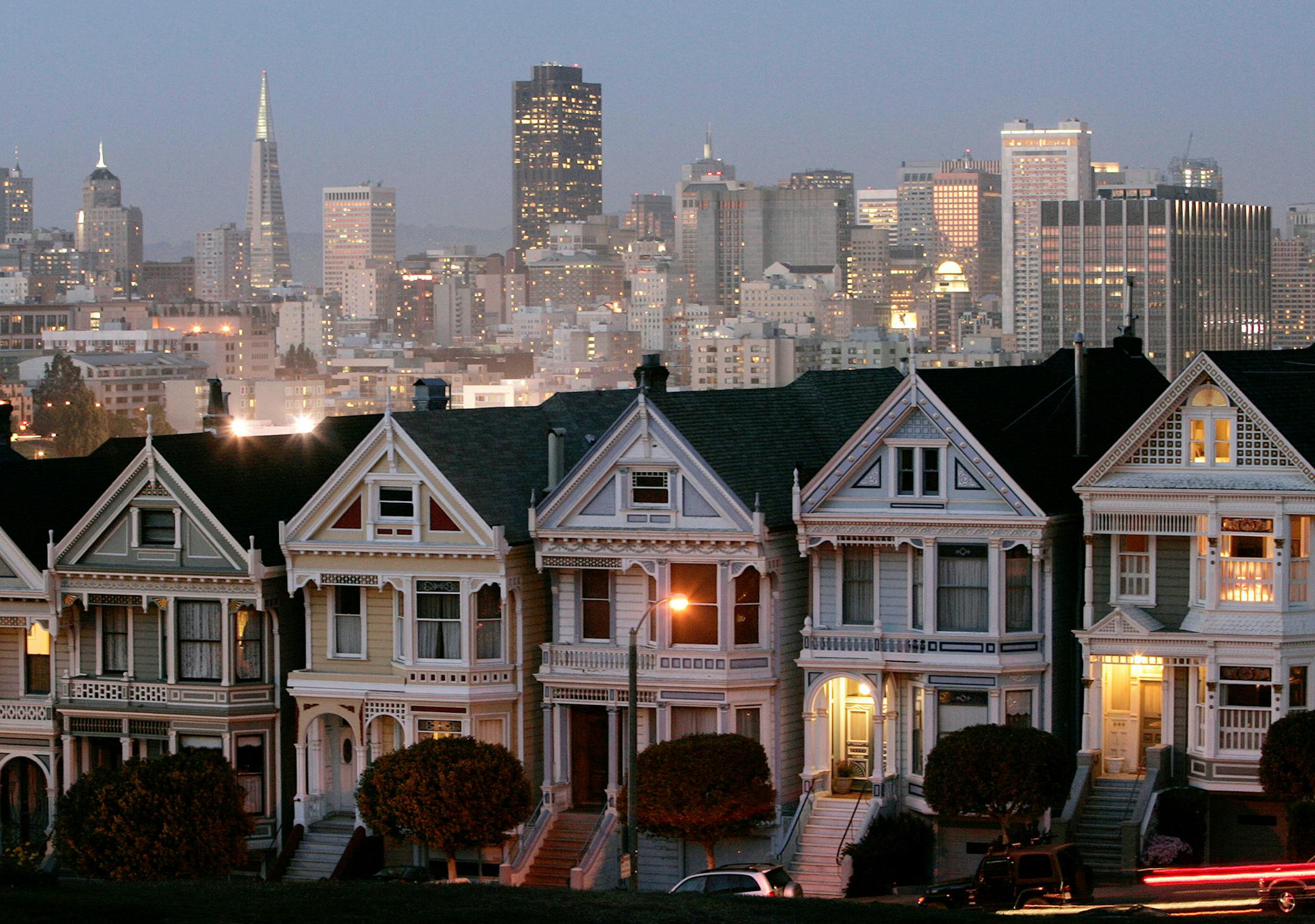
Since the huge crime drop that began in the 1990s, cities have become a more attractive place for young and high-income people to live. At the same time, the shift of the economy toward knowledge-based industries has made cities more important to the economy, since ideas and workers can easily move from company to company within industrial clusters. These factors, combined with steadily increasing U.S. population, have increased demand for urban real estate. But supply hasn't kept up. Zoning laws and other restrictions make it hard for residential developers to build more densely in cities or the immediate suburbs.
When demand increases and supply doesn't keep up, price tends to rise. Thus, it is no surprise that rent has been going up faster than the overall cost of living in the U.S. In cities such as San Francisco, where demand is especially high and development restrictions particularly severe, housing has eclipsed almost every other economic issue.
But the politics of housing is fraught. Easing development restrictions — the preferred solution of a growing number of thinkers calling themselves "market urbanists" — isn't a straightforward populist position. Many of the homeowners who benefit from zoning restrictions are not rich but middle-class and upper-middle-class. Even after the housing price collapse of 2008, many still view owning a home as the essential path to prosperity — the classic American dream.
Development restrictions thus prop up the wealth of many middle- and upper-middle-class households. Steve Randy Waldman, who blogs at Interfluidity, explains that these restrictions themselves form a kind of wealth:
"The customary property rights surrounding homeownership … include much more than the use of a square of earth and whatever is built on it. Existing homeowners bought into particular neighborhoods in large part because of their 'character,' which includes nice-sounding things like walkability or 'charm,' as well as not-so-nice-sounding things like access to exclusionary education … 'Zoning reform' is an expropriation of those customary rights. It amounts to diminishing residents' ability to preserve or control the evolution of their neighborhoods."
Waldman is right about the economic facts. The value of my house depends not just on the house and the land but on who and how many people live nearby. If I'm upper-middle-class and a large apartment complex filled with working-class people goes up at the end of the street, my property value will go down. The neighborhood will be more crowded, the schools will have more working-class kids and crime may increase. Perceptions about the quality of life in my neighborhood will diminish, driving down the price of my house.
But when it comes to the ethics of the matter, I'm not sure Waldman has it right. The wealth homeowners derive from their quiet, low-density neighborhoods doesn't just materialize out of thin air. In a way, that wealth is taken from those who are excluded from the neighborhood. Working-class Americans, shut out from neighborhoods by development restrictions, are forced to live in worse neighborhoods as a result — decreasing their own wealth. If expensive neighborhoods are also close to the city center, it means that poorer residents are forced to commute for longer times — a punishing penalty that costs money, stress and time.
A new study from Michael Lens and Paavo Monkkonen of the University of California, Los Angeles, provides confirmation. They find that government restrictions are causing income segregation in U.S. cities. In particular, the wealthy are being separated from the upper-middle class, who in turn are being isolated from the working class. The more zoning a city has, the more segregated it is.


