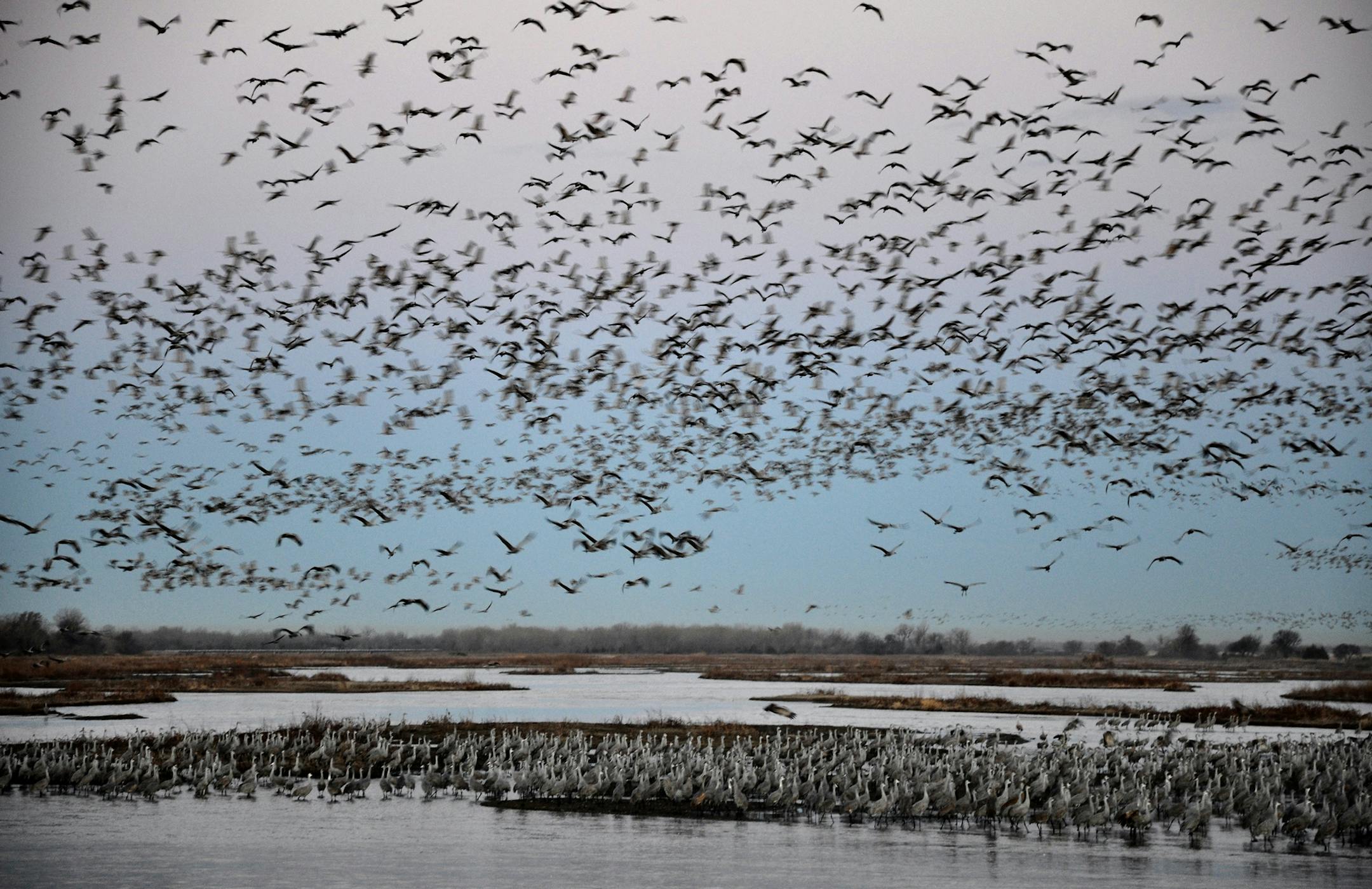
The thousands of sandhill cranes congregating on the sandbars and islands of the Platte River seem completely unconcerned about the gathering storm.
In south-central Nebraska, a few miles south of Grand Island, the prairie sky stretches nearly unbroken in all directions. On this sunny evening in late March, it's easy to see that a change of weather is coming. Clouds fill the sky from southwest to northeast, building from wispy to billowing to anvil-shaped.
I am less than a mile from the Crane Trust's Nature and Visitor Center, and the viewing blind is a small, insubstantial building — just plywood and clear plastic — specially designed for viewing the cranes, but not a good place to ride out a bad storm. The winds build. Windows, walls and doors bang, rattle and shake like Dorothy Gale's house during the opening scenes of "The Wizard of Oz." But the great masses of cranes just outside the blind don't seem to care a whit.
Every night during the migration season of spring, storm or not, the birds return to the braided watery strands of the Platte to bed down for the night. In the hour before darkness, they soar back to the waterway in tight, linear formations like World War II fighter squadrons. Twenty or 30 at a time, they glide down, banking into the wind for their descent onto sandbars. Rapidly, this small section of the river fills with a huge assemblage of cranes, nearly one atop the other, until there's no more room on the sandbar for latecomers.
As the sun sinks farther below the flat horizon, the weather outside the blind turns worse. The interval between the lightning flashes and the thunder claps, previously a rather benign 15 "Mississippis," shrinks to a disquieting four or five. We crane watchers decide that, with the increasing difficulty of seeing well in the gloom and the likelihood of a very wet walk back to our cars if we delay much longer, it's probably time to go.
Each spring, half a million sandhill cranes stop in this area on their way to summer breeding grounds in Canada, Alaska and Siberia. They winter over in a wide expanse of territory that includes New Mexico, Texas, Florida and Mexico. While the cranes disperse over a huge area in summer and winter, the route north is an hourglass-shaped flyway, and nearly all of the cranes stop on the Great Bend of the Platte River in March and April to rest and eat.
Such a concentration of large birds in a relatively tiny area makes this spot among the world's most spectacular animal migration sites, on par with those of the Serengeti wildebeest, Pacific baleen whales and Alaskan caribou. And it's less than a day's drive from the Twin Cities.
Each day during crane season, the elegant long-necked birds feed in cornfields that lie adjacent to the Platte. A drive along the county roads paralleling the river is sure to provide excellent views of large flocks feeding on leftover grain. They do this from sunup to sundown, when they again return to the river to sleep.