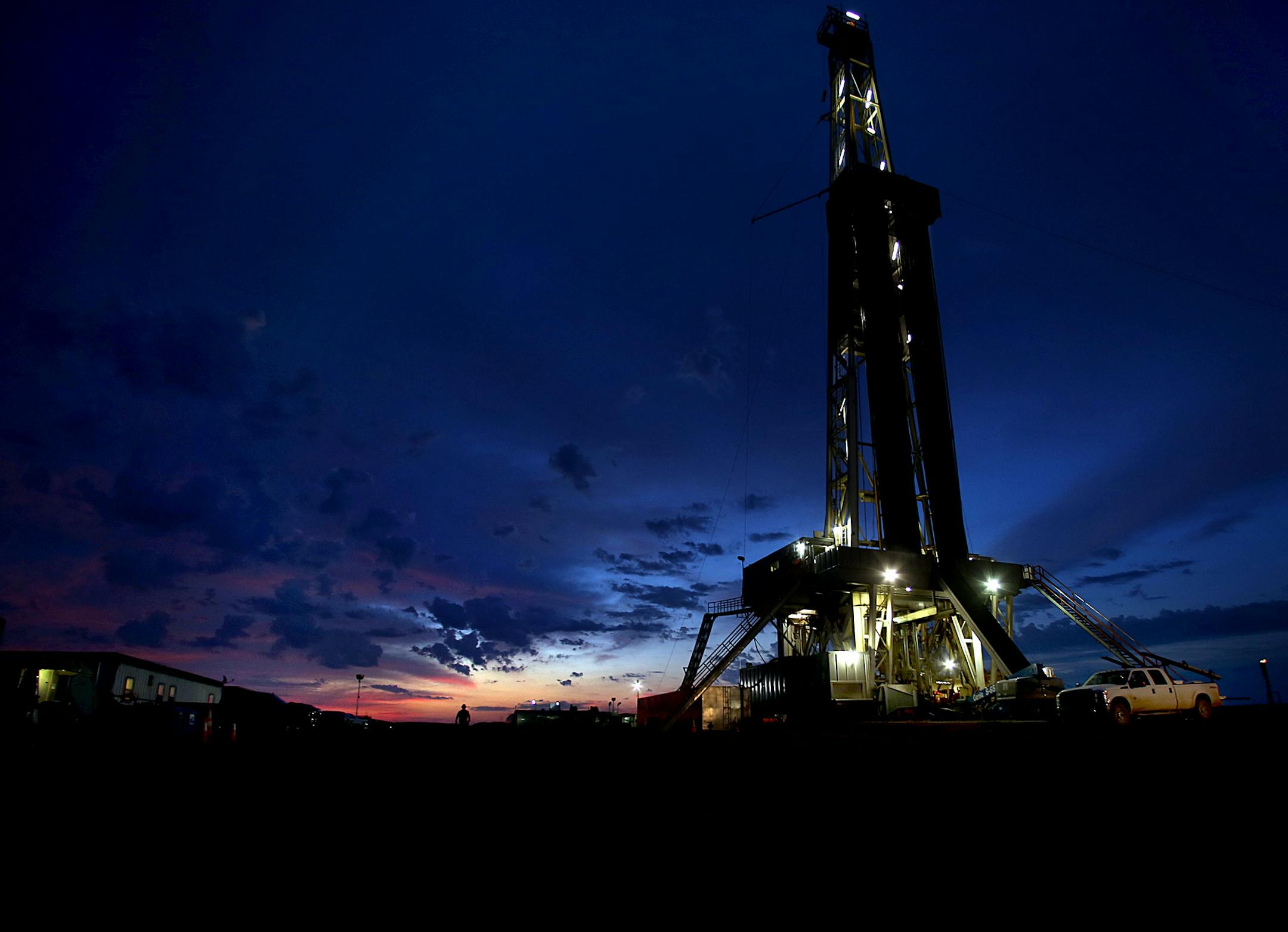
![Floor hand Ray Gerrish worked to make repairs on a drilling rig as the sun rose near the site outside Watford City. ] (JIM GEHRZ/STAR TRIBUNE) / December 17, 2013, Watford City, ND – BACKGROUND INFORMATION- PHOTOS FOR USE IN FINAL PART OF NORTH DAKOTA OIL BOOM PROJECT: Men work around the clock at Raven Rig No. 1 near Watford City, one of nearly 200 towering oil rigs in the Bakken. Once the rigs drill holes, several miles deep and then several miles horizontally, hydraulic fra](https://arc.stimg.co/startribunemedia/RAPHWQRVOK7GSYF5ONXDPXBYGY.jpg?&w=1080)
North Dakota has joined the big leagues of crude oil production, surpassing 1 million barrels per day — an output second only to Texas in the U.S.
State officials said Tuesday that North Dakota yielded 1,001,149 barrels daily in April from a record 10,658 wells. Jubilant oil industry officials hailed the benchmark as another sign that the United States is freeing itself from the grip of foreign oil.
"People can step back and say, 'We don't care that much about what OPEC does anymore,' " said North Dakota Petroleum Council President Ron Ness, reflecting on past decades when the Organization of the Petroleum Exporting Countries controlled world oil supplies.
North Dakota's oil bounty also has transformed the state economy, creating thousands of jobs and fueling a population surge that's the fastest in the U.S. Formerly sleepy towns across the western part of the state are suddenly beset with traffic jams, housing shortages and sprawling man camps as workers from across the nation flood into the oil fields.
"It put so many people back to work coming out of a recession," said Michael Reger, chief executive of Northern Oil & Gas of Wayzata.
Oil production contributes $50 million per day to North Dakota's economy, with more than $11 million per day paid in state oil and gas taxes, according to the North Dakota Petroleum Council. Over the past two years, the state's gross domestic product, a measure of economic muscle, soared 32 percent.
Reaching the 1-million-barrel-a-day threshold represents a 20-fold boost in North Dakota oil production in six years, coming largely from the use of horizontal drilling and hydraulic fracturing, or fracking technology, a controversial process that has raised environmental concerns in North Dakota and other states. The oil and natural gas extracted from shale layers known as the Bakken and Three Forks under North Dakota represent 12 percent of U.S. domestic production.
Texas is the only other state producing more than 1 million barrels daily. Federal leases in the Gulf of Mexico also exceed that level, as does the province of Alberta. Three other states — Alaska, California and Louisiana — once produced 1 million barrels per day but have dropped below that level.
![Williston Mayor E. Ward Koeser displayed a jar containing Bakken crude oil. ] (JIM GEHRZ/STAR TRIBUNE) / May 2, 2013 / 12:00 PM Williston, ND and region: BACKGROUND INFORMATIN-According to the latest U. S. Geological Survey estimate, there are 7.4 billion barrels of recoverable oil in Western North Dakota and Montana, more than twice the estimate from five years ago. There is nearly triple the amount of natural gas than earlier thought as well. As a result, the economic boom in the B](https://arc.stimg.co/startribunemedia/H3FNVXS23FN6OWB4DESJIJXKIE.jpg?&w=1080)
![Derrick hand Scott Berreth (right) rappelled through the drilling rig structure as the crew prepared to restart machinery after some repairs had been made earlier in the morning. ] (JIM GEHRZ/STAR TRIBUNE) / December 17, 2013, Watford City, ND – BACKGROUND INFORMATION- PHOTOS FOR USE IN FINAL PART OF NORTH DAKOTA OIL BOOM PROJECT: Men work around the clock at Raven Rig No. 1 near Watford City, one of nearly 200 towering oil rigs in the Bakken. Once the rigs drill holes, severa](https://arc.stimg.co/startribunemedia/FV3EOLZGI2B63SIJZYJYMSAFYU.jpg?&w=1080)