

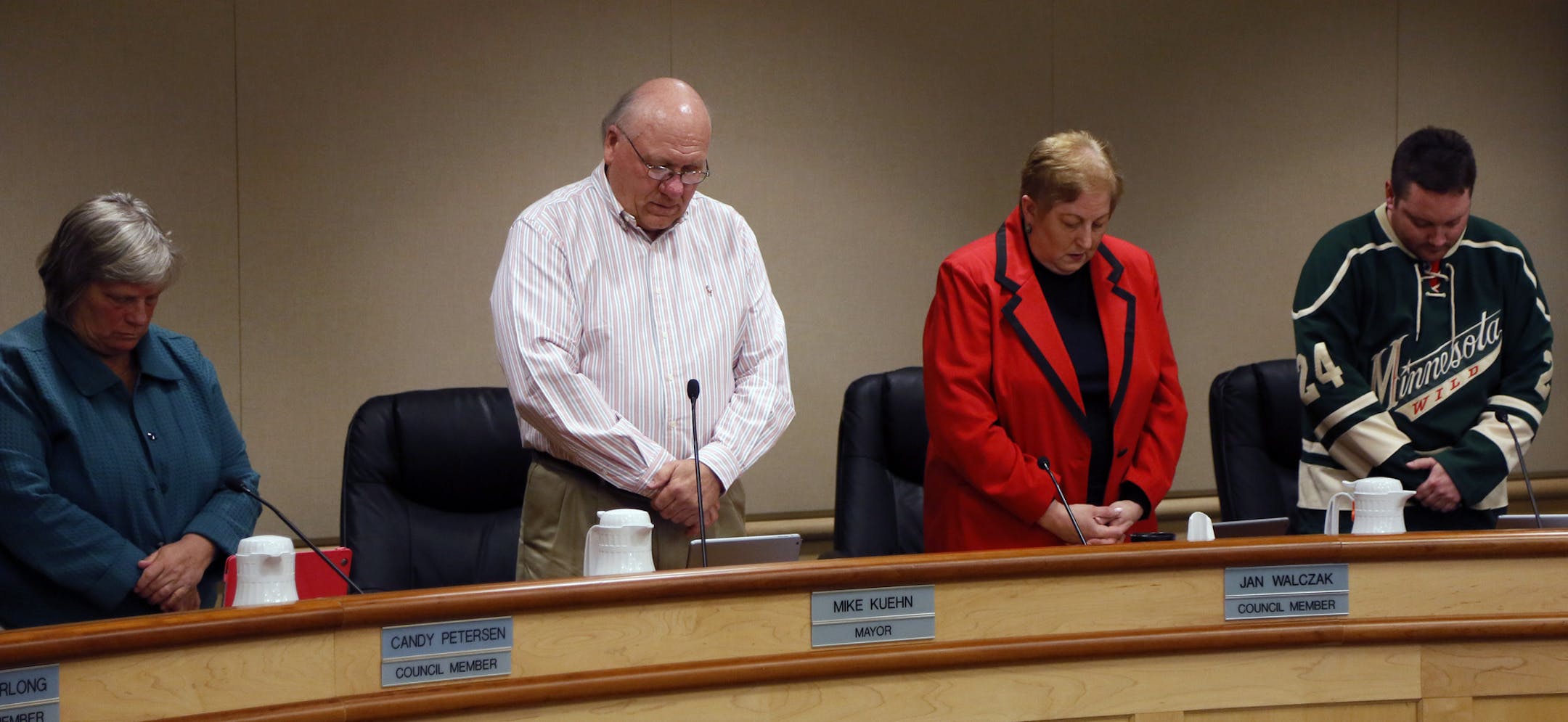
They'd been praying before City Council meetings from 1979 to 2011 in Litchfield, a central Minnesota town of nearly 7,000 people and more than a dozen Christian churches.
Then Mayor Keith Johnson pulled the plug on the practice.
"For me, state and church both have their place, but it becomes a touchy situation in a public place," Johnson said. "I just felt the Christian religion wasn't the only religion — even if about 98 percent of this little hamlet are Christian, with a few agnostics and atheists."
Johnson is now rethinking his position after the U.S. Supreme Court's 5-4 decision this week, ruling that a New York town board wasn't violating the Constitution when it invoked Jesus Christ in prayers before its meetings. Justices said local legislative bodies "need not become a 'religion-free zone' " — even if the prayers specify a single faith tradition.
"It's a whole different story and we've got a little more ammunition with the Supreme Court ruling on it," Johnson said. "I would not have a problem with prayer coming back in our place, and I'll bring it up."
Across Minnesota, from Albert Lea to Fergus Falls, Columbia Heights to North St. Paul, city councils have been praying to open meetings for years — using a rotation of typically Christian pastors who don't shy away from using Jesus' name. That practice will only grow following the justices' latest opinion.
"I was glad to hear that decision — it's definitely on my radar right now," said Jim Butterfield, chairman of the Kandiyohi County Board in Willmar, 30 miles west of Litchfield and 90 miles west of the Twin Cities.
When Butterfield was sworn in as chairman, his pastor gave a benediction, as has been the custom in Kandiyohi County for years. Butterfield said he'll consider expanding that once-a-term prayer to a more regular offering.
![The Supreme Court ruling that prayer is OK before city council meetings has Litchfield considering bringing back pre-meeting prayers. Several communities, like here in North St. Paul, have been praying before city council meetings for years and consider this a thumb's up from the justices. Here, chaplain Crist Langelett leads a prayer before the City Council Meeting in North St. Paul.] BRIAN PETERSON • brian.peterson@startribune.com N. St. Paul, MN 5/04/2014](https://arc.stimg.co/startribunemedia/ZGAWVZUVRAR6YLFDZVKLWVV7HY.jpg?&w=1080)


