

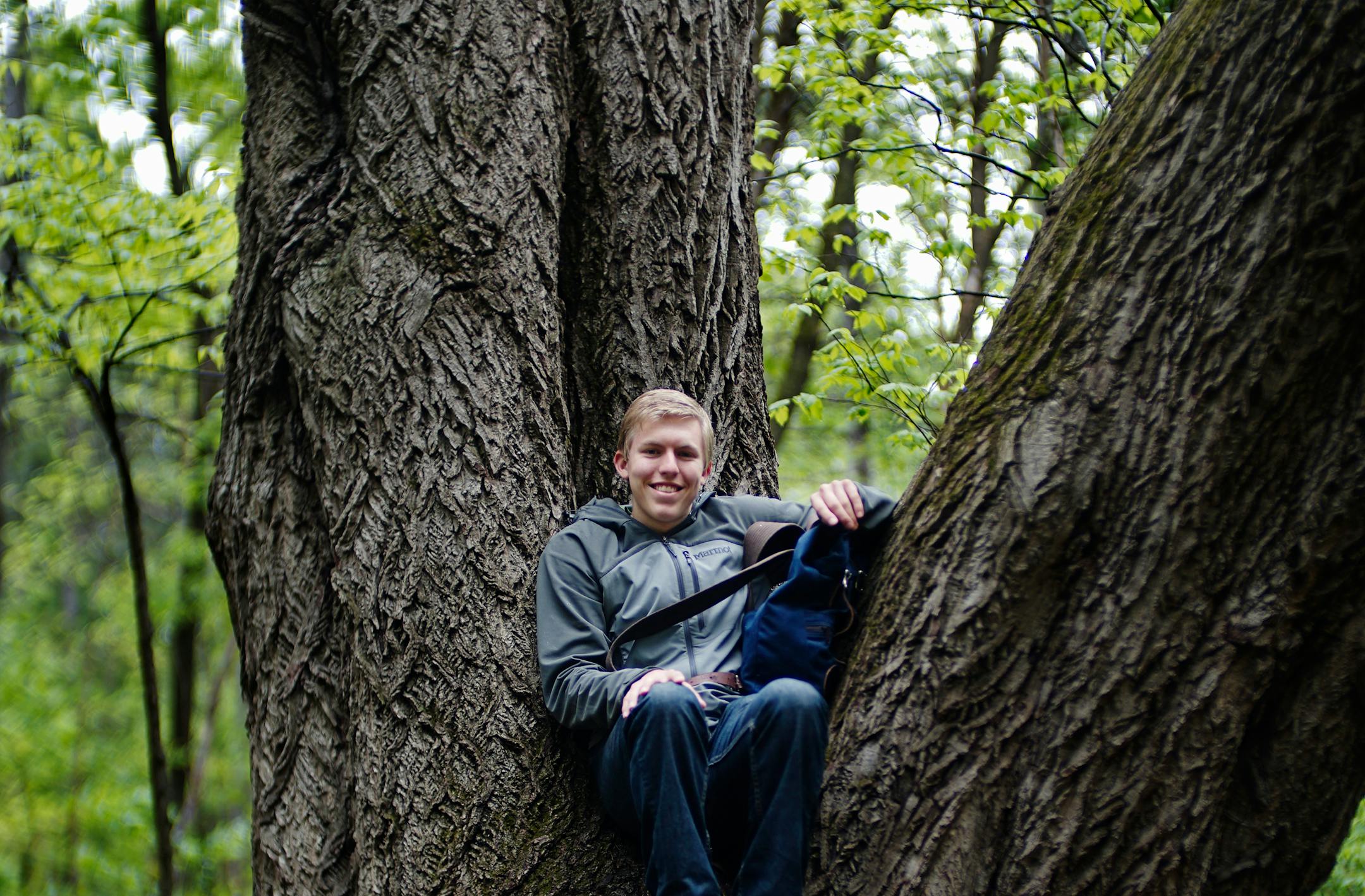
Riley Smith is a big-tree hunter. A documenter of what he calls the silent witnesses of history.
The Plymouth college student will log hundreds of miles this summer on foot, in a canoe and behind the wheel, trying to give voice to the state's largest native tree species. His summer travels could take Smith — armed with two range finders, a 100-foot tape measure, a GPS and assorted other gear — to a green space near a suburban strip mall or the remote reaches of the Boundary Waters Canoe Area Wilderness. His goal: hunt, find and measure a record big tree and have it placed on the state's Big Tree Registry.
"I've always been fascinated by trees. They live in one place, sometimes for centuries. They watch as generation after generation pass by and as communities grow and change around them," said Smith, 18, an urban forestry major at the University of Wisconsin-Stevens Point. "That intrigues me. Being a big-tree hunter allows me to be a part of Minnesota's evolving natural history. That intrigues me, too."
This month, the Minnesota Department of Natural Resources relaunched its Big Tree Registry program. The registry began in 1962. It was mothballed two years ago, owing to a lack of resources. "We just didn't have the staff to administer the program and not enough foresters to verify measurements," said Jennifer Teegarden, DNR forestry outreach specialist. "We now have a staff member to administer the program and an increase in the division of forestry's general funds allowed us to hire more foresters."
The program's overriding goal, Teegarden said, is to enlist as many Riley Smiths as possible to document the state's biggest trees. Her hope is the emphasis will encourage a greater appreciation for trees and their environment. Minnesota has 52 native tree species scattered across the state. A "big tree" nominee is judged on a scoring formula of three measurements: circumference, height and crown spread. An application must be filled out to nominate a tree for the registry; a DNR forester verifies nominees.
"Trees are an important part of Minnesota and its history," Teegarden said. "The large pines and hardwoods brought pioneers to Minnesota. Although most of the large trees in Minnesota were cut down in the late 1800s and 1900s, some big trees survived. So it's a rare opportunity to see one of the state's largest native trees."
Teegarden said the program also helps the public with tree identification and measuring. "The program celebrates our natural resources, and the best part about it is that anyone can do it," said Teegarden. "I've always had a passion for trees, particularly caring for urban trees. From the time I could climb, I was in a tree. So I believe it's important to expose children at a young age to nature and trees to develop future natural resource stewards."
Early questions
Smith started hunting and measuring trees when he was in eighth grade, but his fascination started much earlier. He said his parents tell stories about a curious youngster worried about trees. "There was the time when I was 3 or 4 when my parents came outside and found me crying," said Smith. "Apparently, I was crying because the neighbors were cutting down their trees."
![Big tree hunter Riley Smith shows off the seed shells of a giant butternut tree in the walnut family at Reservoir Wood Park.] Richard Tsong-Taatarii/rtsong-taatarii@startribune.com](https://arc.stimg.co/startribunemedia/W773O42UJYAZTL2ANWEFJOBRPM.jpg?&w=1080)
![Big tree hunter Riley Smith shows off a giant butternut tree in the walnut family at Reservoir Wood Park.] Richard Tsong-Taatarii/rtsong-taatarii@startribune.com](https://arc.stimg.co/startribunemedia/MVYRA6WO3GIIN774TCZ3TFFVQ4.jpg?&w=1080)
![Big tree hunter Riley Smith shows off a giant butternut tree in the walnut family at Reservoir Wood Park.] Richard Tsong-Taatarii/rtsong-taatarii@startribune.com](https://arc.stimg.co/startribunemedia/R4HNEPCVFZGGQKDXLYHNIF3JEM.jpg?&w=1080)

