

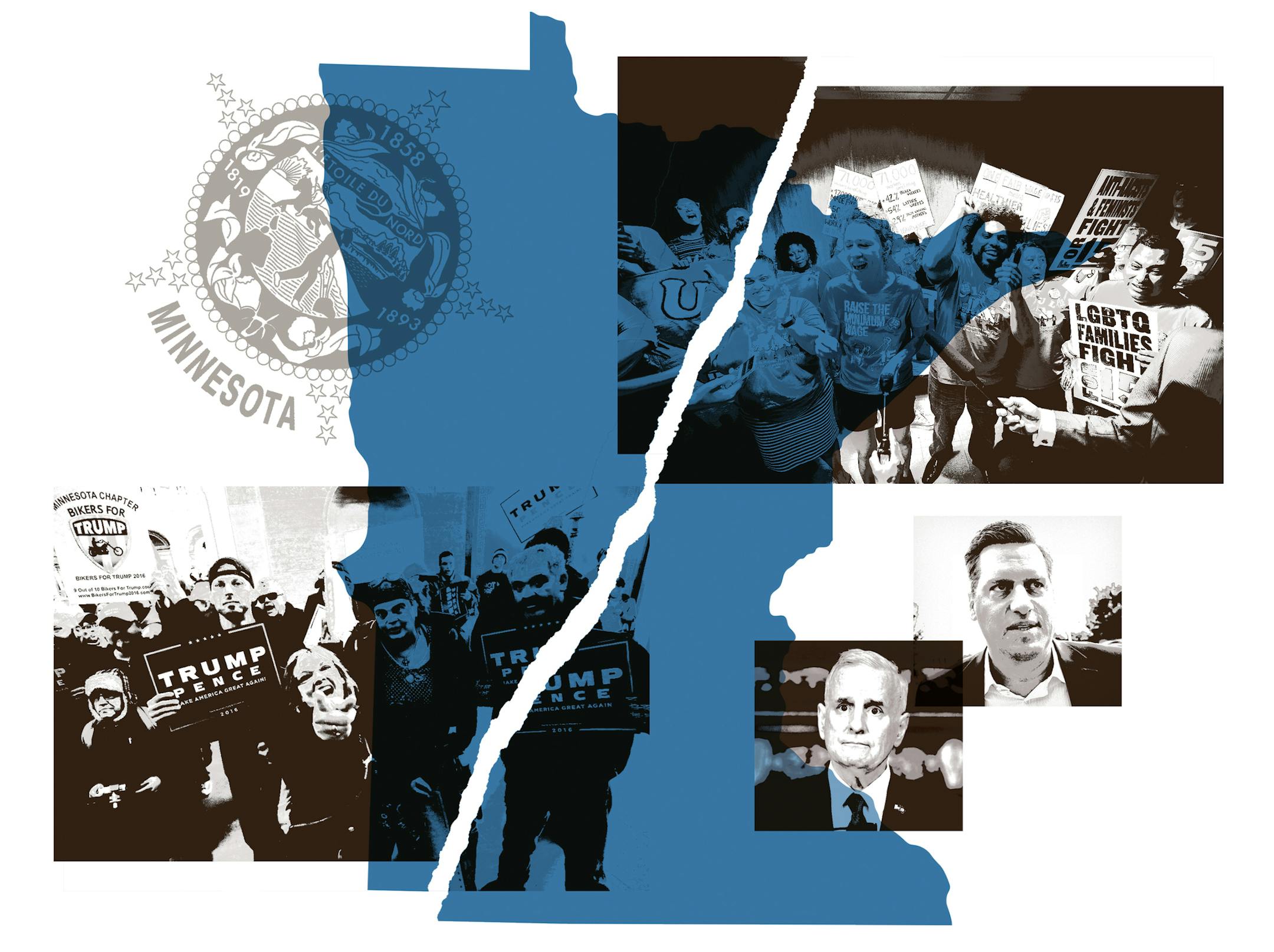
Is Minnesota split into rival regions — a liberal island in the Twin Cities and a vast conservative sea in greater Minnesota?
Simple question, contentious answer. We will find out over the next 18 months through a fiery political fight over today's most combustible issues: ideology and race. (Reader discretion recommended.)
The big battle not only pits Democrats against Republicans but rages within the parties — especially the DFL.
The stakes are big: the 2018 gubernatorial contest (yes, it's upon us already) and the future direction of each party. Prepare for bare-knuckle political fights among activists, organizers and elected officials — clashes that were previewed for me by well-placed sources on the promise of anonymity.
A "Tea Party" on the left?
I recently moderated — with Star Tribune business columnist Lee Schafer — a conversation among Minneapolis candidates for mayor and was impressed by their near-unanimity on the usually acrimonious issue of raising the minimum wage. The main difference arose over whether the city's march to $15 per hour was adequate; one candidate mentioned $23 per hour.
Reality check: $15 per hour is unprecedented; $9.50 was recently approved as a statewide minimum by the Minnesota Legislature, but it took a yearslong fight. No city in the U.S. has yet reached $15, though several are en route.
What happened to quiet the usual fractiousness over such a sharp departure? Credit a tight-knit, supremely confident coalition that prides itself on orchestrating "s--tstorms on the streets" and goes by the name "Minnesotans for a Fair Economy," or MFE. It consists of the Service Employees International Union Local 26, TakeAction Minnesota, Neighborhoods Organizing for Change and the faith-based group ISAIAH. You may have caught glimpses of MFE's loud, in-your-face rallies and marches in Minneapolis to "take on corporate wealth and power." Rallying communities of color and partners, these ultraprogressives hit Wells Fargo and U.S. Bank for foreclosures and stormed Target, fast-food restaurants and airlines over wages.
Political viability in Minneapolis now requires some degree of fidelity to MFE's ultra-progressive agenda on wages, paid sick leave and regulations on scheduling. Former Mayor R.T. Rybak is a marker for the shift to the left. He won election in 2001, 2005 and 2009, but his "acceptance of the worst racial disparities in the country" ensured that Rybak "could not win today," one MFE leader predicted matter-of-factly.


