

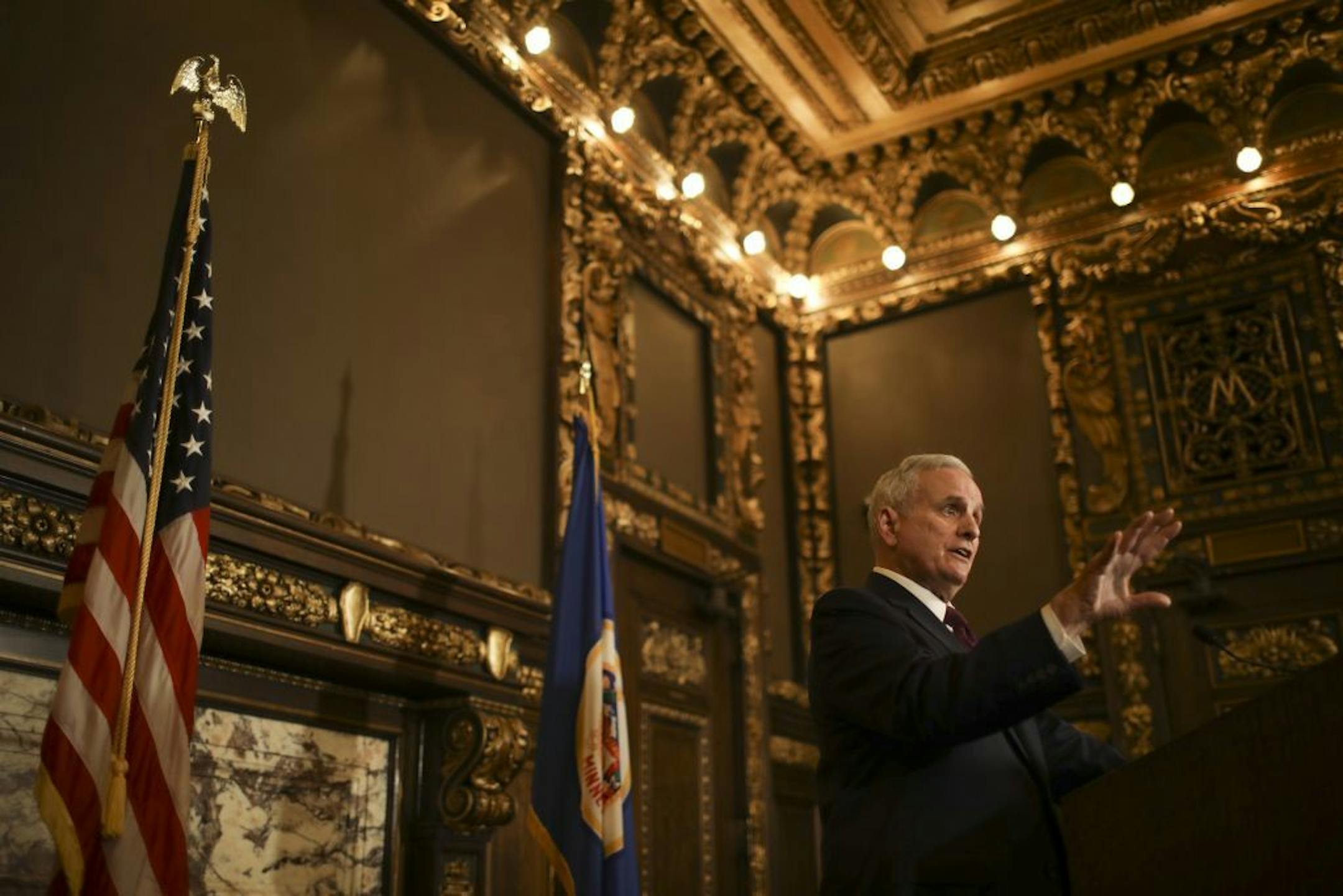
A growing legal brawl between Minnesota's Legislature and its governor has cast the state's elected leader into uncharted waters with no clear path to settling a fundamental dispute about the state constitution and the exercise of political power.
But Minnesota is far from the only state where political dysfunction is confounding civic progress — or spilling into the courtroom. In recent years, the kind of bare-knuckle clash that fomented Minnesota's current crisis has become commonplace around the country as state-level politicians grapple with the same kind of vehement partisanship that also prevails in Washington.
DFL Gov. Mark Dayton's recent line-item veto of legislative funding is a first for Minnesota, as is the Republican-controlled Legislature's subsequent lawsuit asking a judge to undo the governor's action. But a very similar fight is playing out in New Mexico, where spending squabbles between a Republican governor and Democratic legislators led the governor to veto the Legislature's funding. Just like in Minnesota, legislators sued; in that case, the state Supreme Court ordered the two other branches of government to fix their self-created problems.
"The challenges that Minnesota and New Mexico are facing, in my view, reflect growing partisan polarization in state legislatures around the country, which has led to lack of consensus," said Gabriel Sanchez, a political-science professor at the University of New Mexico.
Even short of the lawsuit now at the center of Minnesota's dispute, the obstacles that dragged Minnesota's most recent legislative session into overtime and threatened to force a government shutdown are far from unique.
Illinois has gone two years without a state budget and spent $6 billion more than it has taken in during that time. Washington state lawmakers, ordered two years ago by a court to resolve an education-funding dispute, are now muddling through a second special session — and being fined $100,000 per day for failing to meet the court's demands. The Alaska Legislature, which typically passes its budgets by April, is still at work and edging toward a July 1 government shutdown.
For many states, including Minnesota, it's frequently the unpredictable choices of voters that create the potential for dysfunction. Divided government, with the executive branch led by one party and the Legislature controlled by the other, has become a recipe for statehouse stalemate in Minnesota and elsewhere.
Dayton and lawmakers did settle a $46 billion, two-year budget this year. But the ensuing lawsuit could linger for months.


