You enter through darkness. The room is pitch-black, except for a single light on a single vase. For five minutes you and a small group of other visitors will sit in the dark, as if waiting for a play to begin.
You're either consumed by your thoughts or trying to rid yourself of them. Maybe you will meditate. Maybe you don't know how to meditate. Maybe you will sit on the rough wooden bench and wish you knew how to meditate. Or you can just stand in the dark for five minutes and decide not to care.
Whatever you do, you won't have long to revel in "Darkness," the first of 10 mini-installations/theatrical experiences that make up "Power and Beauty in China's Last Dynasty," on view at the Minneapolis Institute of Art through May 27. This is the kind of show that, like improv, is best experienced live and in the moment.
The exhibition was conceived by designer/director Robert Wilson, known for such experimental theater works as "Einstein on the Beach." In this case, Wilson is staging artifacts of the Qing Dynasty (pronounced "ching") rather than actors and singers. Each room is its own production, further heightened by olfactory and auditory experiences that add visceral depth to the exhibition.
Wilson said he designed the show around the numeral 2, with the aim of using "counterpoint" to highlight dualities throughout. Indeed, the exhibit ends with "Lightness." It all suggests yin/yang, a Chinese notion that's been appropriated by American pop culture (and stoner culture).
So it is somewhat awkward, in this political moment, to see a cis white man staging a reimagined idea of Chinese life. It also feels disingenuous, and potentially patronizing, to apply broad, vague labels such as "Prosperity" to a room's worth of objects that hold many other deeper, intrinsic meanings. That said, the exhibit is a collaboration with the institute's curator of Chinese art, Liu Yang, so at least there's some "yin" to what could have been a very problematic "yang."
There's some history to this weird imagined journey through the Qing Dynasty (1644-1912): It was China's last imperial dynasty, ending with the 1911 Xinhai Revolution, and a new nationalist government. But you wouldn't know any of that from the exhibition itself — this is information you'll have to google later on.
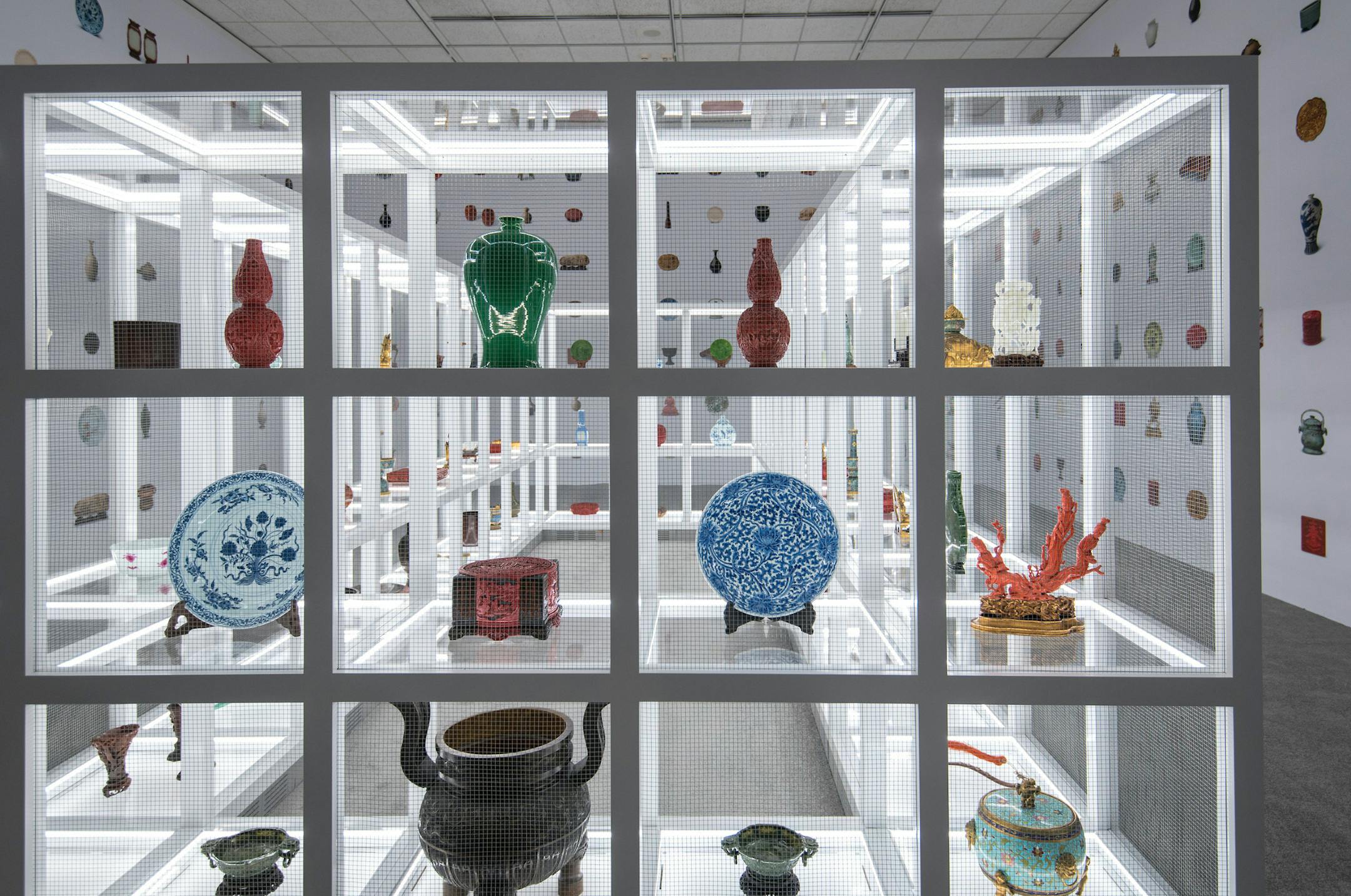
Case in point: the "Prosperity" room, which is the first thing you see after emerging from "Darkness." It reminded me of a fancy high-end shop in SoHo. A green vase, an ornate blue-and-white patterned plate, bright red sculptures and many other objects are encased in a grid-like display case behind glass and steel mesh, and lit with fluorescent lights. A goofy soundtrack of a honking-sorta-noise, interrupted by shattering, plays on a loop.