Before my first trip to Milwaukee this summer, I had only a few references to help me get a handle on what makes the city tick. There was (and still is) beer, of course, a legacy of one of this country's strongest German heritages. And there were the iconic TV comedies, "Happy Days" (check out the bronze statue of the Fonz on the walkway alongside the Milwaukee River) and its spin-off "Laverne and Shirley."
That pretty much covered what I knew about Milwaukee. However, following a few days in this vibrant city, I have a store of new knowledge to add to my repertoire. I learned that the Wisconsin Cheese Mart on Old World Third Street has 200 varieties of cheese and that Cafe Benelux, a hot spot for rooftop dining, has 47 pages of beers.
I learned that the city, which became home to resourceful immigrants from Germany, Poland, Ireland and Italy, was known as "the machine shop of the world" in the late 19th and early 20th centuries.
I learned that Milwaukee was once home to the Big Four of beers — Pabst, Miller, Schlitz and Blatz — and that during the 7th-inning stretch at Brewers baseball games, it's not "Take Me Out to the Ballgame" but "Roll Out the Barrel" that fans still exuberantly sing.
But most of all, I learned that the city's top two attractions are museums, which although polar opposites, provide visitors with a top-quality experience.
Milwaukee Art Museum
At the stroke of noon on a sunny day with springlike temperatures, I am standing — along with a throng of people — on the pedestrian bridge outside the Milwaukee Art Museum. We are reverently silent, as if awaiting a heavenly visitation, which, in a sense, we are.
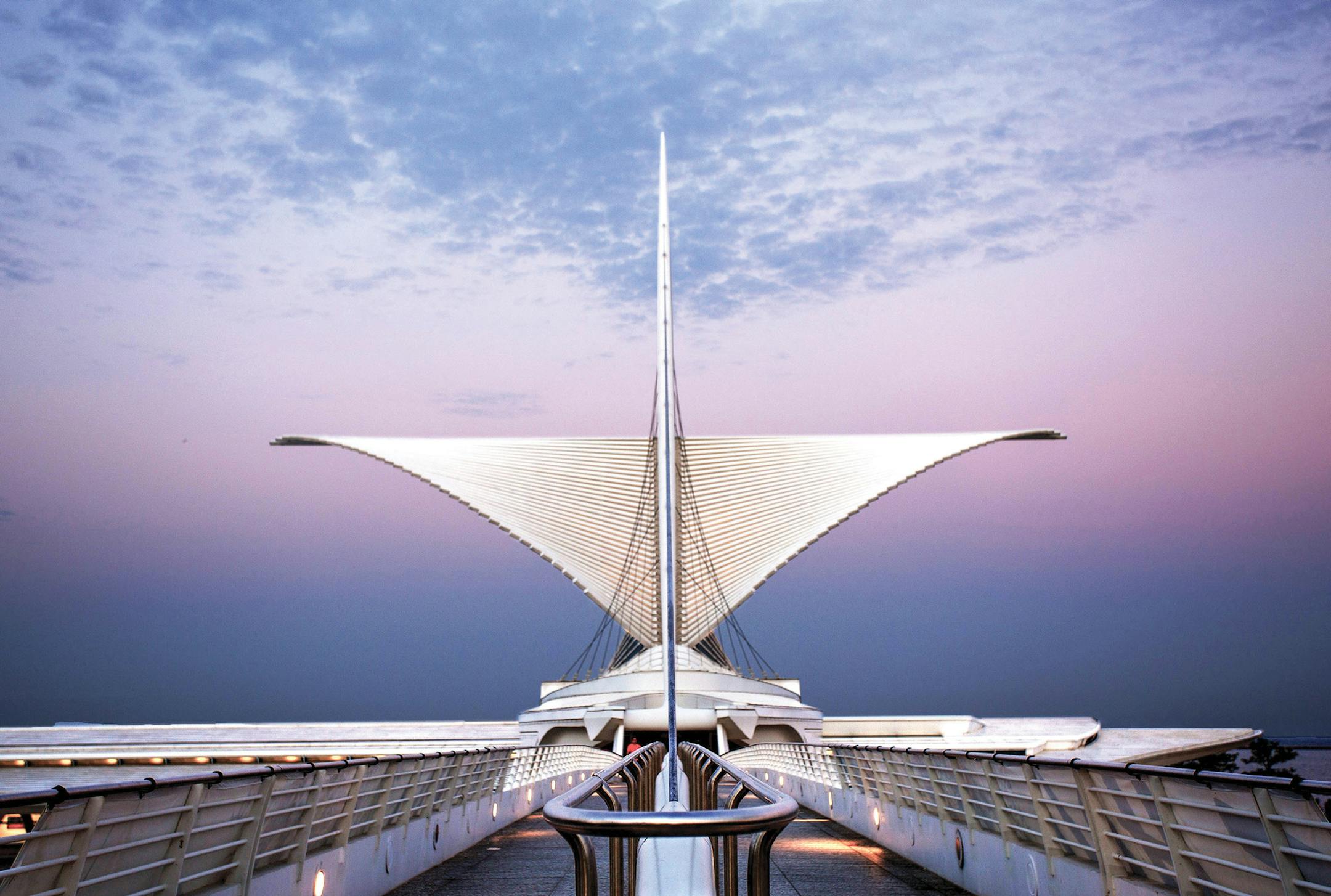
One feature of the six-year, $34 million redesign by noted Spanish architect Santiago Calatrava is the angel wings sculpture atop the museum. Composed of 72 steel fins with a 217-foot wingspan, the "wings" open and close several times a day. The spectacle takes 3 ½ minutes and always attracts an admiring audience.
The building's architectural design can best be described as a combination of the Sydney Opera House and a Gothic Cathedral complete with flying buttresses and ribbed vaults. The total effect appears that of a structure floating over Lake Michigan.