

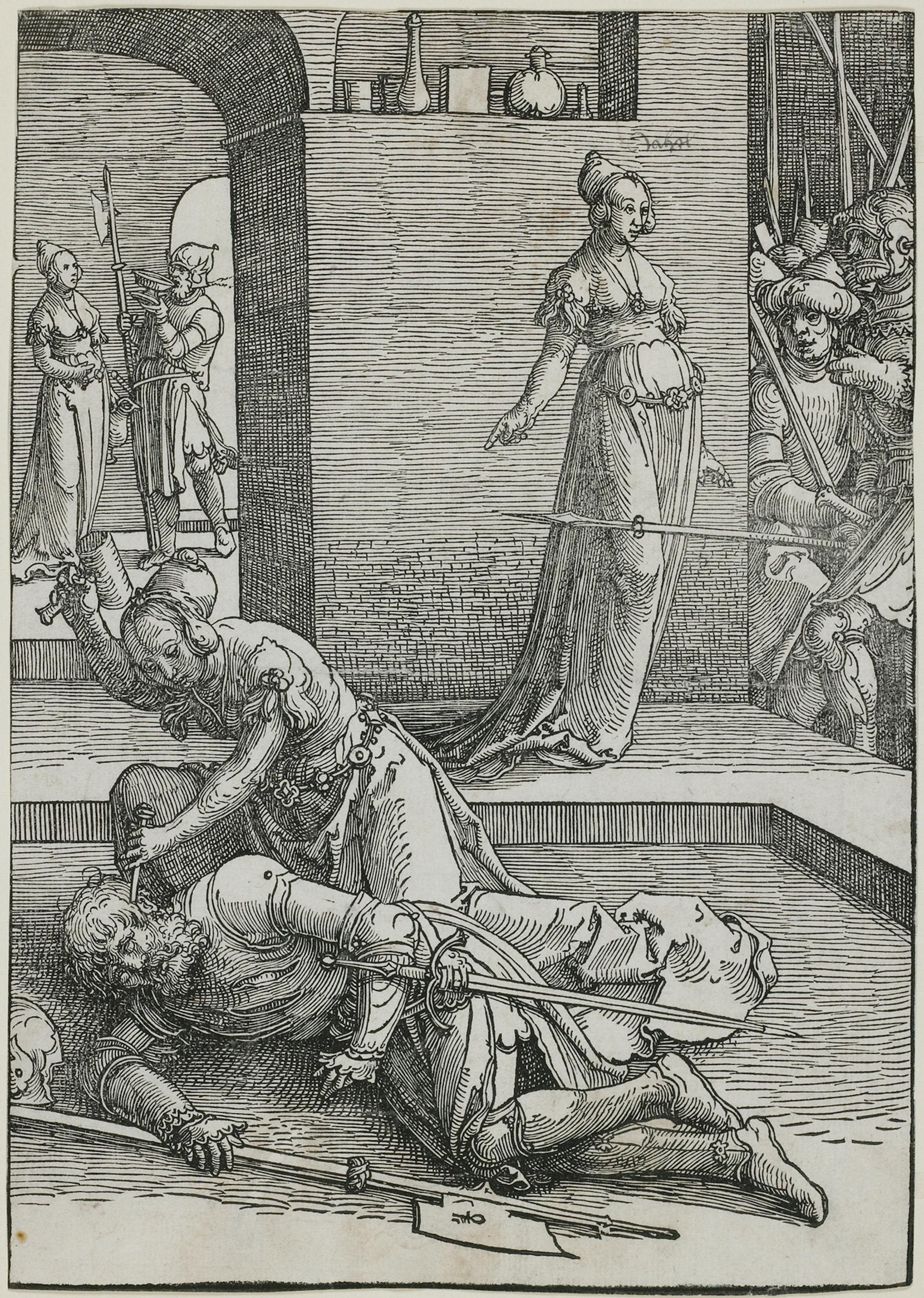
When it comes to murder, there are so many options — strangulation, hanging, drowning, poison, knives, guns, arrows, hatchets, rocks. Plus such old-time favorites as beheading and crucifixion that have, unfortunately, been much in the news lately.
They're all on display in "The Art of Murder," a visually fascinating, psychologically rich and politically provocative show on view through April 19 at the Minneapolis Institute of Arts. Virtually all of the 51 prints, drawings, photos and special-edition books are owned by the museum, augmented with a few loans from private collections.
Given the centrality of murder in human history, it's no surprise that many of the greatest European and American artists have depicted murders or their aftermath, from Dürer and Rembrandt among Old Masters to Warhol, Rauschenberg and civil rights photographer Danny Lyon in the 20th century. Work by several Minnesotans is featured, too, notably Tom Arndt's 1985 photo of uneasy visitors touring the "Crematoria, Dachau"; David Rathman's etching of a frontier sheriff ambling away from a hanging, and a comic "Frankie and Johnny" shootout by the late Malcolm Myers.
Murders present
Routine grist for history, legend, entertainment and newspapers, murder is a curious constant in human relations, a recurring confirmation of our inability to master emotions, resolve conflict and play nice with others. Curator Dennis Michael Jon wisely cast a broad net, arranging a room of Old Masters and another of current material, all augmented with smartly written background info.
Many of the late 20th-century images are resonant of recent history. An accordion-fold book by Chilean artist Maria Veronica San Martin evokes in etchings and woodcuts the brutalized "Memory and Landscape" of her homeland during the 17-year dictatorship of Gen. Augusto Pinochet (1973-1990), who overthrew the democratically elected president and then murdered 3,200 citizens and imprisoned 4,000 more for their political beliefs.
There are few, if any, images of actual violence in the contemporary section, but its shadow is everywhere: in the grainy blur of Richard Hamilton's 1970 screen print of an unarmed Kent State University freshman killed by the Ohio National Guard for protesting the U.S. invasion of Cambodia; in the steely composure of the Rev. Martin Luther King Jr. at the 1963 funeral of four black girls killed by a white supremacist's bomb at a church in Birmingham, Ala.; in the bitter resignation in the eyes of a black woman whose husband was lynched in Irwinton, Ga., in 1949, and in Robert Capa's close-up 1950 photo of a grizzled Jewish mourner with the ashes of 200,000 who died in Nazi concentration camps.
Warhol, Rauschenberg, Joe Tilson and other artists incorporate images of JFK, Che Guevara, Janis Joplin, astronaut Buzz Aldrin, actor James Cagney and others to recall the turbulence of the midcentury decades.
Murders past
Christianity, classical mythology and ancient history provide the gore that enlivens the murderous art of earlier centuries. It appears that humans have been slaughtering one another with zeal ever since Cain killed his brother Abel in a jealous squabble over whom God loved most. Austrian artist Albert Paris von Gütersloh gives their primal spat a strangely modern art deco treatment in a pair of 1924 lithographs that include Adam and Eve gazing skyward in dismay amid a ruined temple that likely references World War I devastation.


