

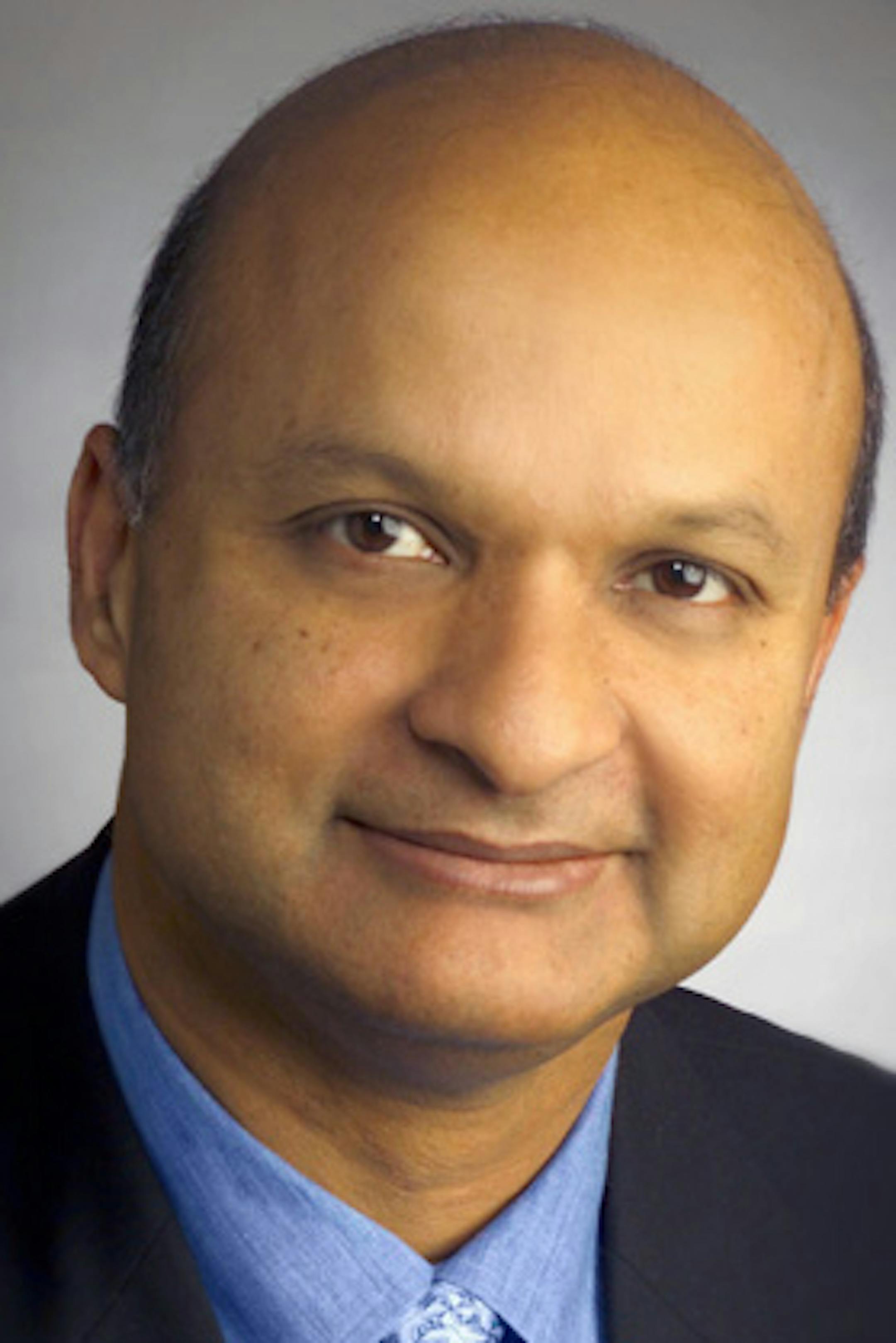
Omar Ishrak, chief executive of homegrown medical technology giant Medtronic, displayed a slide for a Minneapolis banquet-hall audience that showed many of his company's most exciting advances in the fast-moving world of health tech.
There's a pacemaker called the Micra that is narrower than a blood vessel. There's an insulin pump known as the 670G that automatically adjusts doses based on real-time blood-sugar readings. There's a heart pump called the HeartWare that can push a person's blood supply using a form of "maglev" technology to magnetically levitate a moving component and reduce blood friction.
"The only thing I can promise you about this page is it will be obsolete in 20 years," Ishrak told an audience of several hundred people Wednesday at a meeting of the Economic Club of Minnesota. "But we're really excited about it right now."
Ishrak played for laughs, and got them, with his lighthearted comment about Medtronic's most advanced devices in 2018. But his point was that medical technology iterates at a rapid pace, as product engineering and scientific understanding of the human body advance, and it's up to manufacturers like Medtronic to put that technology to good use for humanity.
When Earl Bakken co-founded Medtronic as a family business in a northeast Minneapolis garage in 1949, pacemakers were machines that plugged into the wall. That left patients vulnerable to power failures, as was famously demonstrated when a baby on a pacemaker at the University of Minnesota died during a blackout on Halloween in 1957. Bakken was invited to invent the first battery-powered, portable pacemaker as a result, which he did.
Decades later, Medtronic engineers invented the Micra, a pacemaker that fits entirely inside a heart chamber and is implanted via a tube narrow enough to be inserted into a blood vessel. It attaches directly to heart tissue so that it doesn't need thin insulated wires called leads to deliver current to the heart. Leads are the source of many problems with modern pacemakers.
But the Micra is only a single-chamber pacemaker — a relatively simple device that interacts with one of the heart's four chambers. Ishrak said Wednesday that Medtronic engineers are now at work on "leadless" versions of more complex heart devices, including some that could deliver mild current to pace multiple chambers of the heart, as well as leadless defibrillators that could deliver powerful jolts to disrupt fatal heart rhythms.
"There's a sequence of activities there, some of which are more possible with today's technology and knowledge, and others are still probably further out," Ishrak said in comments after his speech. "The vision here is to convert heart devices to all leadless over a period of time. I'm talking decades here, I'm not talking about tomorrow."


