

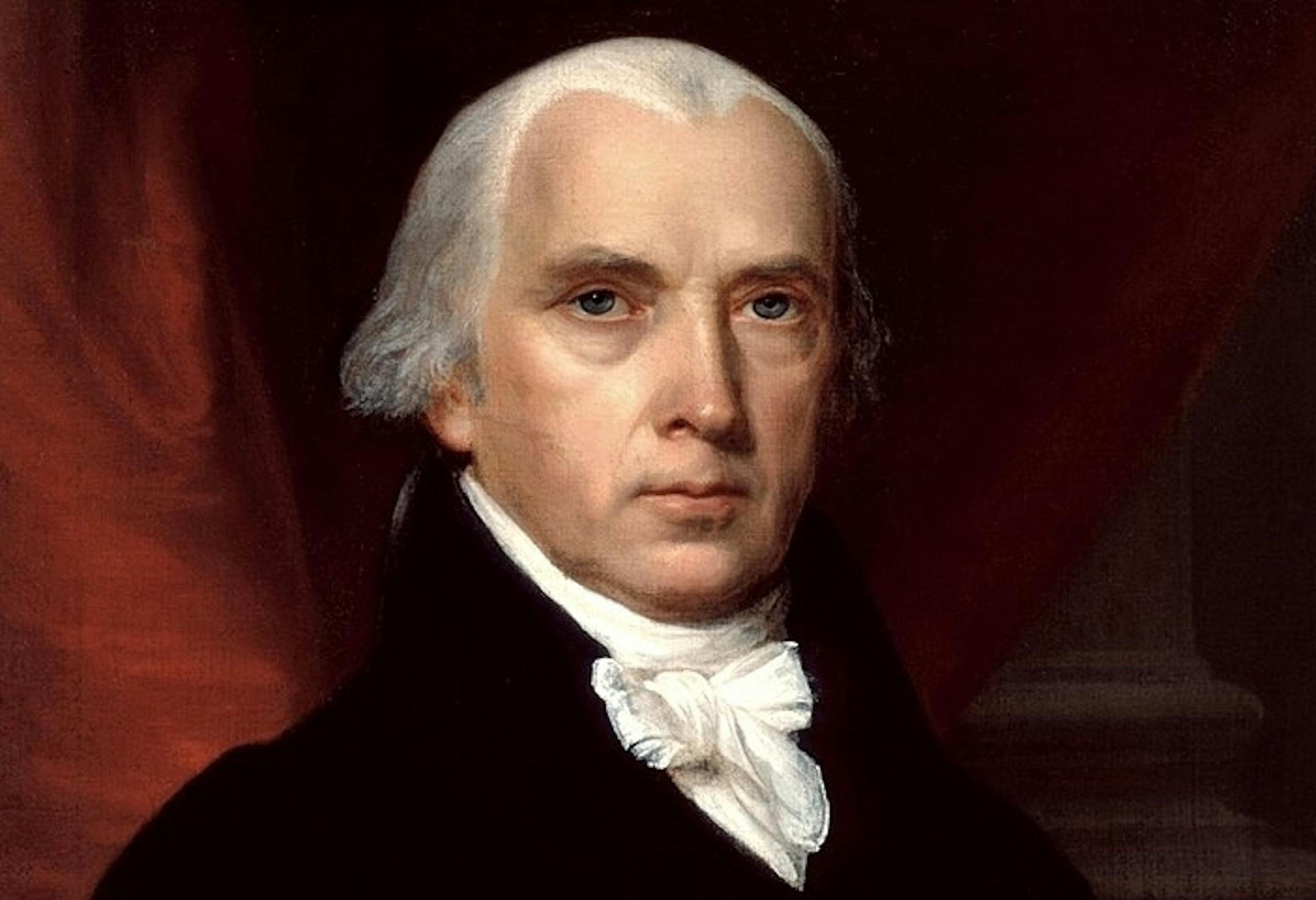
As Speaker Nancy Pelosi, D-Calif., urged the House of Representatives to draw up articles of impeachment against President Donald Trump, she implied that James Madison — the "Father of the Constitution" — would have demanded Trump's impeachment for betraying the national trust to a foreign power. It's no small irony, then, that congressional Democrats voted for an article of impeachment that would have imperiled Madison's own presidency. Although the specifics differ, Trump's dealings with Ukraine in 2019 closely parallel Madison's engagement of France in 1812. The similarities offer a powerful lesson for today: Rashly accusing our political opponents of criminal behavior makes our nation vulnerable to foreign interference and creates a downward spiral that could lead to catastrophic consequences.
In 1812, Madison presided over a nation bitterly divided between two political parties — Federalists and Democratic-Republicans. As war raged between Britain and France in Europe, the parties disagreed over foreign policy and staked out opposing sides of the conflict. Federalists accused Democratic-Republicans of serving French interests, and Democratic-Republicans charged Federalists with inviting British dominion over the United States.
Early in the year, John Henry, a former British spy embittered by his poor compensation, decided to exact revenge on Britain by selling secret British documents to Madison's Democratic-Republican administration. The documents purportedly contained incriminating information about Federalists who conspired with the British government against the United States.
Henry worked through a French national named Paul-Émile Soubiron, a sleazy con artist who helped Henry recruit the favor of the French ambassador in Washington. Hoping that the documents would compel the United States to join France in war against Britain, the ambassador used Soubiron as a sort of shadow representative. Like Russian agents who peddle conspiracy theories of Ukraine's collusion with Democrats, the ambassador hoped to convince the president that they shared a British enemy who cooperated with a supposedly debased opposition party in America.
Madison took the bait, jumping at the opportunity to confirm his suspicions about his political adversaries. He spent $50,000 of State Department money to obtain the documents. The administration asked Henry to write a misleading cover letter that implied that he donated the documents to the government, withholding the fact that Madison had paid the entire balance of the contingent foreign intercourse budget to receive them.
Initially, the papers did embarrass the president's political adversaries after he argued that they proved Federalist collusion with Britain. Madison's ally Thomas Jefferson privately gloated that the information prostrated Federalists. In reality, however, while the documents showed that some Federalists harbored antipathy for the union and sympathy for Britain, they yielded no legally damaging information.
Federalists' embarrassment turned to outrage after they learned how Madison obtained the documents. They charged that he had paid a vast sum of public money to foreign nationals for his personal political benefit. Madison admitted in a private letter that the documents did not legally implicate Federalists even though they proved that Britain had tried to enlist Federalists' help.
In June, Madison referenced the papers as a reason to declare war on Britain, claiming that they at least revealed British malfeasance for attempting to interfere in U.S. politics and recruit disaffected Americans.


