

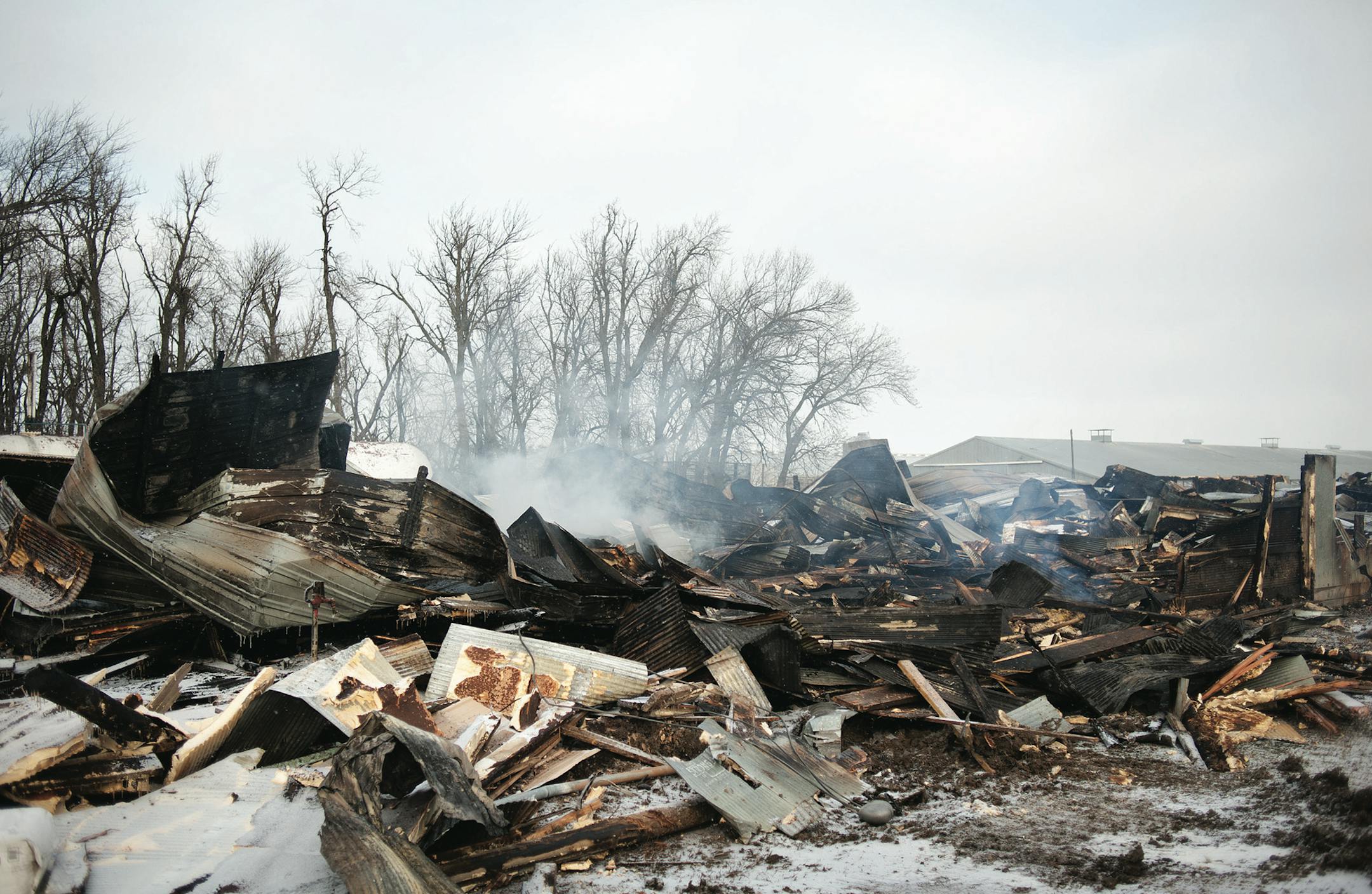
Fires roaring through Minnesota farms this year have left a trail of charred barns and more than 25,000 animal carcasses.
Last week alone, 7,500 turkeys and about 200 hogs perished in separate blazes in southern Minnesota.
While such fires are a long-standing scourge of farm life, livestock building blazes in the state reached their highest point in five years in 2013.
Massive casualties in the Upper Midwest, the heart of the nation's livestock production, have surprised even longtime professionals: 300,000 hens perished in La Grange, Wis., in a winter fire that was the largest the town's fire chief had ever fought; 150,000 hens died in a Galt, Iowa, fire this spring; and a blaze that consumed 13,000 hogs near Truman, Minn., in October was the worst that a consultant for the state's Board of Animal Health had come across in his 40 years on the job.
"The numbers are just astronomical," said Karen Davis, president of United Poultry Concerns, a Virginia-based nonprofit that promotes respectful treatment of animals.
The increasingly large scale of farms means more animals are vulnerable to dying when a disaster strikes. Yet how much protection livestock should receive from fires has stirred a debate among producers and national animal rights activists in recent years, even as insurance companies have worked with farmers to improve safety in barns.
In 2012, concerns over animal safety led a committee of the National Fire Protection Association to propose a requirement that farmers install sprinkler and smoke control systems in livestock housing, prompting pushback from major poultry and dairy producers.
The equipment is already required for animals that are more dangerous or difficult to move, such as elephants.


