

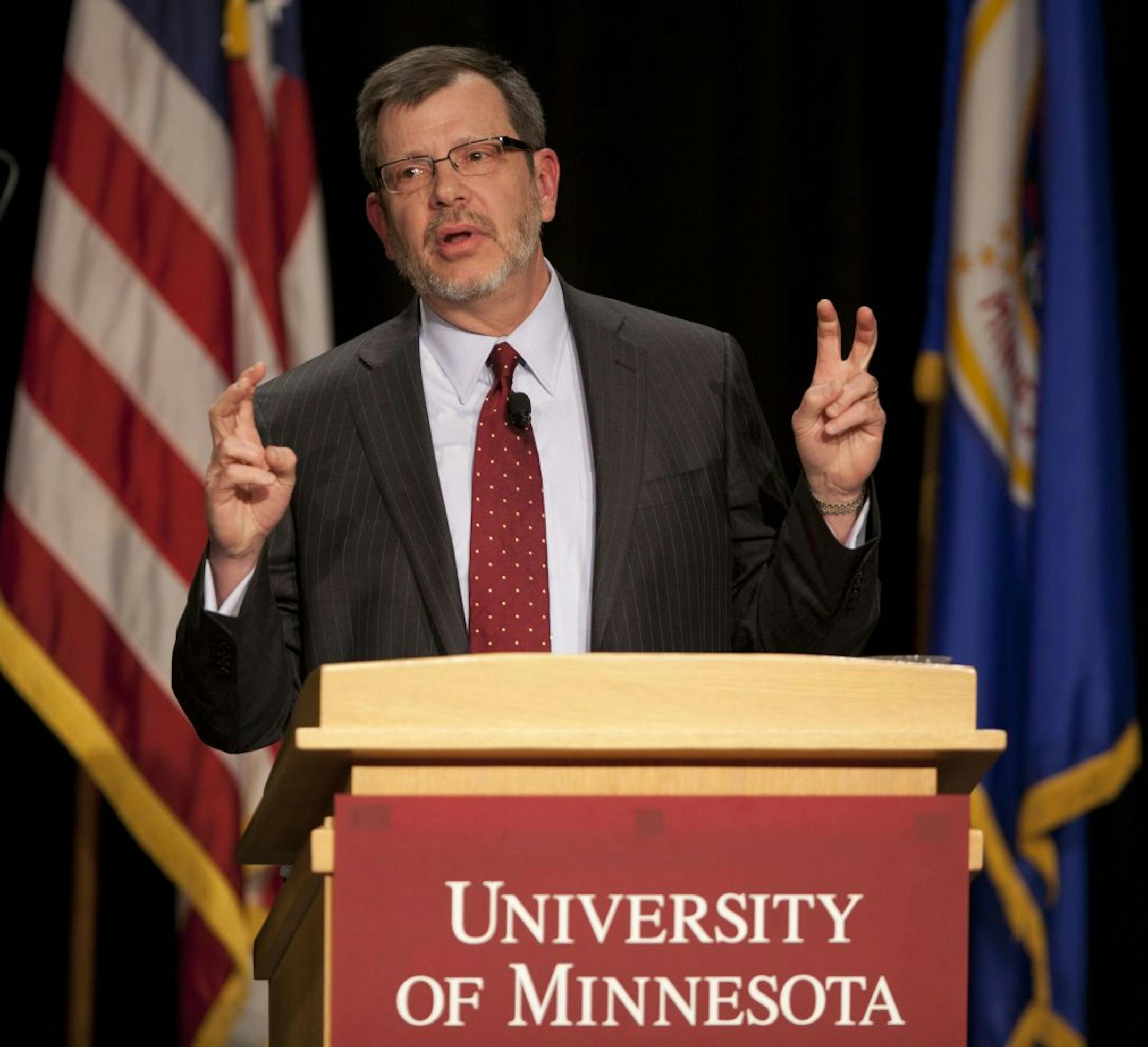
WASHINGTON - University of Minnesota President Eric Kaler appeared in the nation's capital Monday to talk about something that is not often the byword of academia:
Entrepreneurship.
Kaler came at the invitation of the U.S. Department of Commerce, not the Department of Education. His message to federal officials and other academics at a private program called "The Innovative and Entrepreneurial University: Higher Education, Innovation and Entrepreneurship in Focus" was simple. Turning campus research into community businesses fits "right in the breadbasket of a land grant university's mission."
"We were established to serve the needs of the people of the state," Kaler said in an interview.
Among the innovations that drew interest from the Obama administration were Minnesota's use of businesspeople, not academics, to staff its Office of Technology Commercialization and a program to streamline the sale of intellectual property rights from academic discoveries to commercial companies.
A former Honeywell executive runs the technology commercialization office. And intellectual property rights cost a flat $15,000 or 10 percent of the value of a commercial contract, whichever is greater. Companies with over $20 million in annual sales also pay a 1 percent royalty to the university.
Seventeen companies, including Boston Scientific Corp., have bought into the intellectual property program so far. Kaler sees them as a critical mass in changing academic culture. Several universities inquired about the program after his presentation.
"In the old days -- a decade ago -- we were considered laggards on the tech transfer front," Kaler told the commerce forum, "not only because peer institutions were ahead of us, but because the vibrant business community in Minnesota saw us as unresponsive and uncreative. We didn't do business relations well. Like many universities, we felt we didn't have to."


