

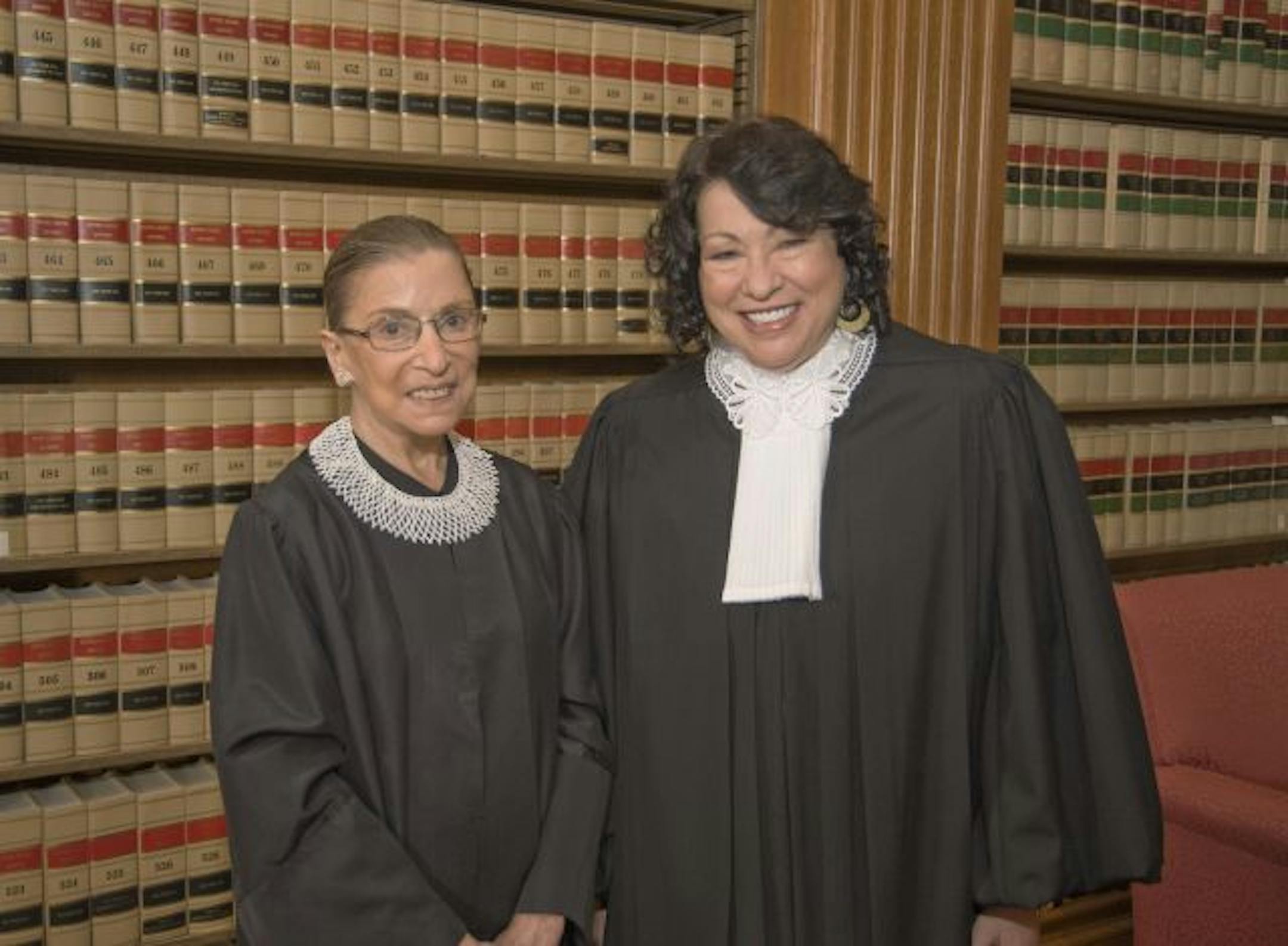
With two same-sex marriage cases before the Supreme Court, numerous commentators have latched on to remarks by Justice Ruth Bader Ginsburg critical of the court's 1973 Roe v. Wade decision that legalized abortion nationwide.
It is not the judgment that was wrong, but "it moved too far, too fast," she said at Columbia Law School last year, a view she has expressed in various speeches and law review articles.
As one of the court's moderate liberals and a champion of women's rights, she is now being routinely cited to argue for a timid resolution on the issue of same-sex marriage that would strike down California's ban on such marriages, but would leave prohibitions standing in about 40 other states.
How Ginsburg will vote on same-sex marriage is unknown. But her comments misread the legal and political landscape at the time of the Roe decision and have been used to bolster the inaccurate notion that the court's ruling on abortion rights somehow short-circuited a political process that was moving in the states to end criminalization of abortion.
Some now argue that a toxic multidecade backlash against abortion rights could have been avoided if the court had given states more time to act -- supposedly a cautionary lesson for marriage equality.
The real story, as explained by Linda Greenhouse, a former New York Times reporter who now teaches at Yale Law School, and Reva Siegel, a professor there, is that political conflict over abortion was escalating before the Roe decision, and that state progress on decriminalization had reached a standstill in the face of opposition from the Catholic Church.
In 1970, a measure legalizing abortion in New York cleared the state Assembly by just a single vote. Only a veto by the state's Republican governor, Nelson Rockefeller, blocked its partial repeal two years later. Had the Supreme Court waited for the states to move, women in a large portion of the country would still be denied the fundamental right to make their own childbearing decisions.
The claim that the court invited a backlash by getting too far ahead of public opinion does not hold. At the time of the ruling, a Gallup poll showed a substantial majority of Americans favored letting the abortion decision be made "solely by a woman and her physician," with more Republicans than Democrats in favor.


