

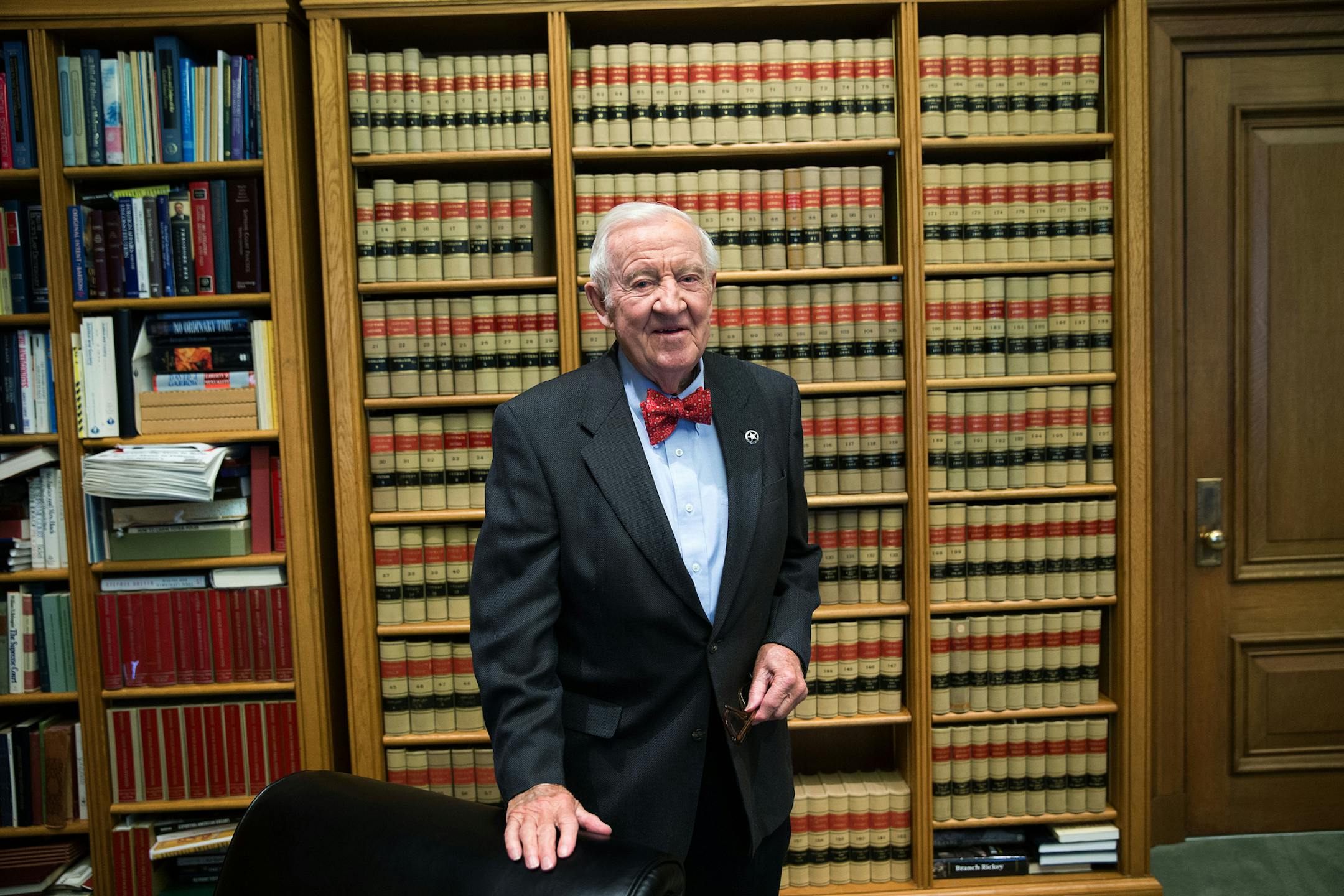
Justice John Paul Stevens loved to tell the story of seeing, as a boy of 12, Babe Ruth's famous "called shot" home run in the 1932 World Series game between Stevens' beloved Chicago Cubs and the New York Yankees.
Watching Stevens perform his duties as a Supreme Court justice was a comparable experience — seeing one of the greats perform at the height of his abilities, exceeding expectations in every situation, no matter how historic or pressured.
If there is a Supreme Court hall of fame, he surely has a prominent place. Stevens was the rule-of-law justice. He taught us that no person is above the law, sometimes to the dismay of those on both sides of the political spectrum.
When he ruled that Paula Jones' lawsuit against President Bill Clinton could proceed, he enraged many on the left. When he vigorously dissented from the court's fiasco of a decision in Bush v. Gore and proclaimed that the real loser in the case was the nation's confidence in the judiciary as an impartial arbiter, he enraged many on the right.
But he could not abide the court's short-circuiting of the selection of a president, the most serious business of our democracy.
Stevens also taught us that nobody is below the law. Not the reviled detainees at Guantanamo Bay — he led the court in rejecting the Bush administration's attempt to establish a law-free zone of absolute executive power in the isolated island prison. And certainly not criminal defendants — he defended their constitutional rights on issues ranging from the evil of police deception of lawyers to the availability of habeas corpus.
He vividly remembered his own representation of a convicted defendant who turned out to be innocent. And he had the searing memory of his father being unjustly convicted of fraud during the Depression — and of his father's conviction being overturned by a court committed to the rule of law.
Stevens also taught us what the substance of that rule of law should contain. His dissent in the court's notorious 1986 decision permitting the criminalization of gay sex led directly to a Supreme Court decision 17 years later enshrining the previous Stevens dissent as the law of the land.


