

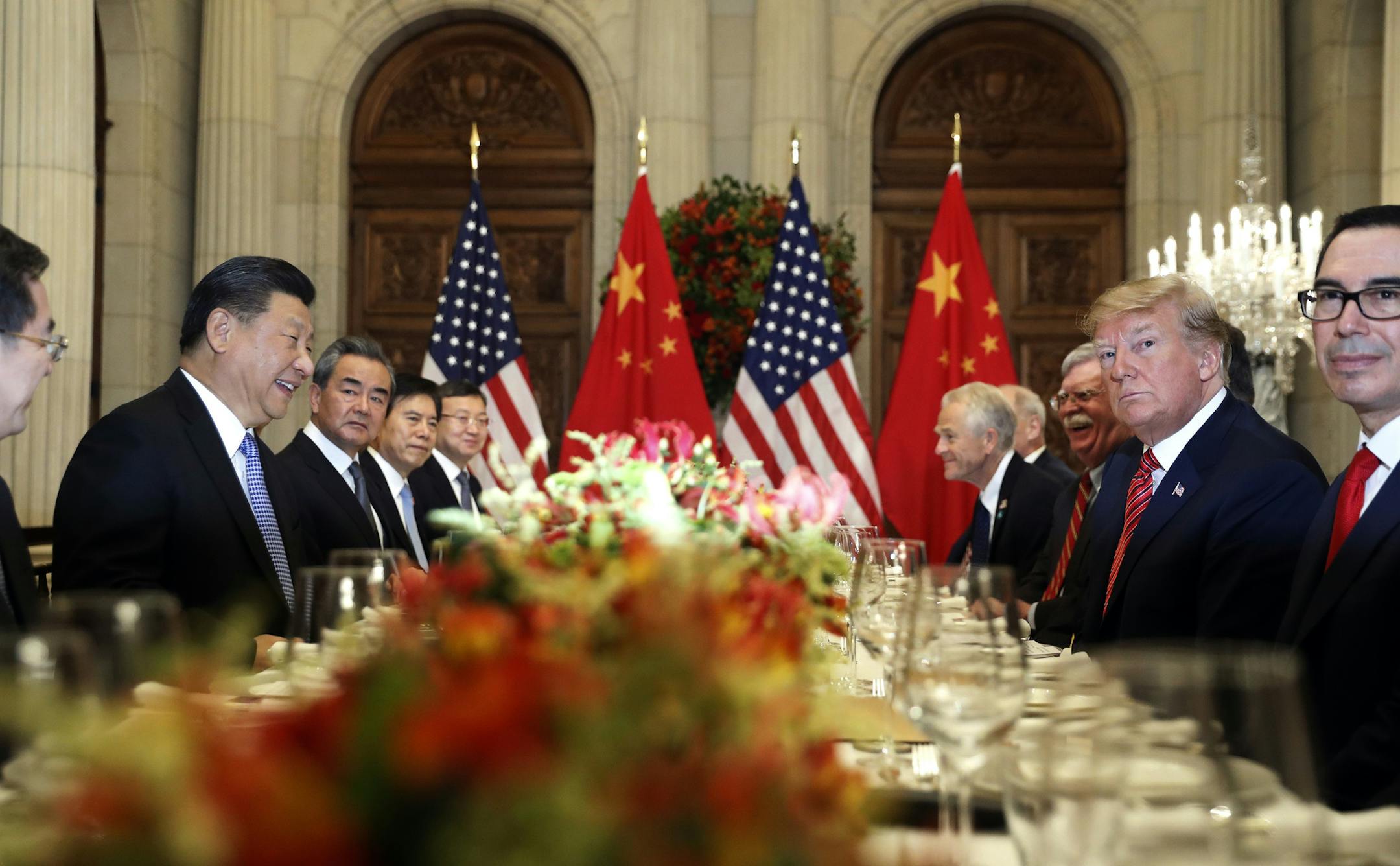
Just because the U.S. and China have agreed to call a truce in their trade war, that doesn't mean that it's over: This was a classic exercise in can-kicking. Nonetheless, most cans have quite a few kicks in them, and overall this is good news for the global economy. Instead of sweeping everything under the rug, as was the case before Donald Trump took office, America and China have found a new way of addressing conflict by talking openly.
Let's consider the announcement itself. The U.S. has pledged to postpone raising tariffs to 25 percent on $200 billion of Chinese goods. China in turn has pledged to buy more U.S. goods, and the two countries have 90 days to reach a broader trade agreement, which is supposed to cover forced technology transfer and cyberattacks in addition to typical trade issues. That's not enough time to allow the bureaucracies to work out the relevant details, but extensions can and probably will be granted.
The symbolic elements of the deal are at least as important. First, China has acknowledged that exports of fentanyl, a highly addictive synthetic drug, are a very real problem for the U. S., and has pledged to ban them. In addition to the benefits of the ban itself, simply getting China used to the idea of accepting blame — for anything — counts as a step forward. It's a sign that China will start conducting its diplomacy less defensively and more like a normal member of the global community.
Another symbolically important detail: White House trade adviser Peter Navarro, a trade hawk, attended the meetings and participated in the process. Maybe he's unhappy with the temporary deal, but still this is a sign that Navarro and a Chinese trade agreement — even if only a can-kicking one — can coexist. If Trump sees this deal as beneficial to him politically, Navarro's protectionist influence may be reduced.
Perhaps most important, both the Chinese government and public opinion are not in a downward-spiraling, negative dynamic. I'm fully aware that giving China points for not getting worse is not the best way to keep score. Still, the Trump administration has managed to send China a real warning on trade, more than it received under previous U.S. administrations, without destroying relations. That, too, has to count as a victory.
Some observers have pointed out that the American and Chinese summaries of the deal offer somewhat different emphases. I see that as a feature of the deal rather than a bug, and one that is hardly uncommon for can-kicking arrangements. Each side can present this agreement to domestic interest groups in a way that will shore up political support. The relevant alternatives on the table, most of all an escalation of trade tensions, were far worse.
So what is the most likely outcome from here?
The basic problem with any U.S.-China trade conflict is that there is not very much the Chinese are interested in offering, and their intransigence is more than just a bargaining stance. They are willing to buy more American soybeans and manufactured goods (and probably wish to anyway), and they might give U.S. financial institutions freer rein within China. But they won't dismantle their system of state-owned enterprises, as those companies are among China's most powerful special interest groups. Nor will China give the major U.S. tech companies free rein in China, if only for reasons of national security and China's desire to build a surveillance state based on data controlled by China.


