

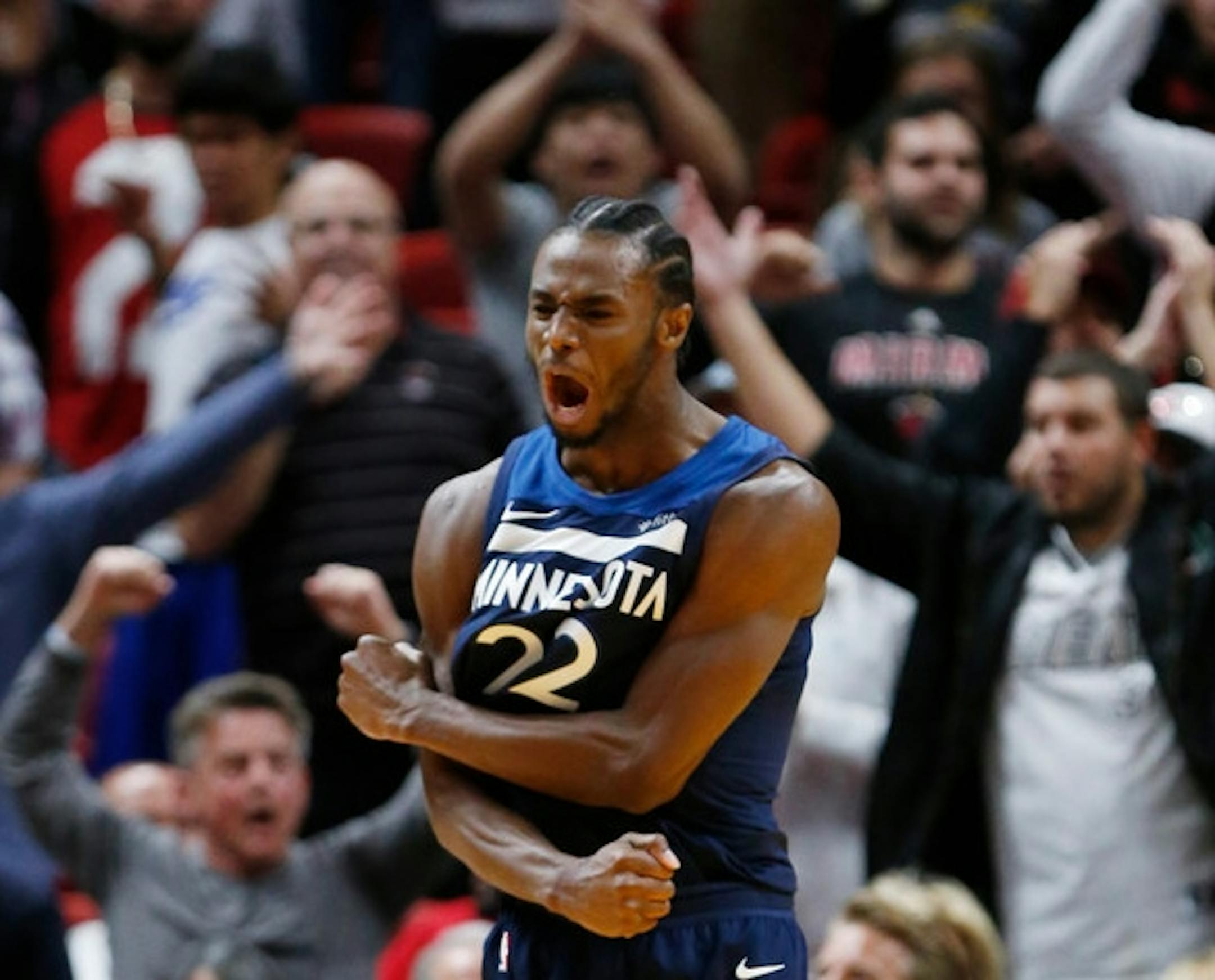
If you've watched all or even some of the Timberwolves' first seven games this season, including Monday's 125-122 overtime victory at Miami, you might be a little confused.
See, this year's Wolves appear very similar to last year's Wolves in a lot of ways so far. Their offense is great (fourth in offensive rating). Their defense has been suspect (last in the league in defensive rating). Their bench still isn't contributing much, while their starters are logging heavy minutes. They're getting leads, then giving them back.
But these Wolves have also played five toss-up games — all five in which Jimmy Butler has played. The other two, when he didn't play because of a respiratory infection, were blowout losses that make their defensive marks look particularly bad.
In the first toss-up game at San Antonio, the Wolves didn't execute down the stretch and lost by eight. But in the last four of those, they've secured three three-point wins and a two-point win. The three-point wins all ended with their opponent missing a three-pointer at the final horn. The two-point win came with Andrew Wiggins making a buzzer-beating three-pointer.
Considering last year's Timberwolves lost their first 10 games that were decided by four points or fewer and didn't win their first such game until their 43rd game of the season, this is a pretty significant difference.
How do we make sense of a team that is so very much the same for most of the game and yet so completely different at the end? Let's take a look at some contributing factors:
*The first 44 minutes or so of Wolves games look the same largely because the defense is still very much a work in progress. You can see flashes of it getting better. Towns and Wiggins seem more actively engaged in the process of trying to get stops. There was a hug between Towns and Taj Gibson on Monday after good help defense by Towns led to an errant pass and a turnover. But until the defense is consistently good, teams are going to make runs at the Wolves and get back into games.
*The flow of games also looks the same because the Wolves' bench, while sporting some better players than in years past, is still not producing much. Signing Gibson meant Gorgui Dieng became a reserve. Nemanja Bjelica has played quality minutes. Jamal Crawford is a veteran the Wolves have lacked. Shabazz Muhammad came back on a low-money deal. Tyus Jones has been the primary backup point guard. Those are the reserves in the regular rotation.


