

Inequality is a growing global concern. But it's not just income: Information inequality, in the form of a free press, increasingly separates societies, too.
Two reports released this week — "World Press Freedom Index 2014," from Reporters Without Borders, and "Attacks on the Press: Journalism on the Front Lines 2013," from the Committee to Protect Journalists — reveal the growing gaps in free press protections.
Reporters Without Borders' press-freedom index ranked 180 nations, and again found that the highly developed democracies of Western Europe were the world's free-press epicenter. Conversely, a press-repression crescent of the world's worst offenders stretched from Southeast Asia to Central Asia to sub-Saharan Africa. While each nation's experience is unique, four major trends were identified in the report. The first — press repression related to armed conflict — is not new. But the intensity seems to be, especially in Syria (no. 177 on the list), the world's most dangerous place for journalists. And like the vicious civil war, crackdowns on media freedoms know no borders. Neighboring nations like Lebanon (106) fell four spots from last year's study, and the sectarian nature of the conflict spurred Jordan (153rd, -2) to constrict media freedoms, too.
In Africa, the violent spirals in Somalia (176, unchanged from last year), the Democratic Republic of the Congo (151st, -8), Mali (122, -22) and the Central African Republic (109th, -34) eroded already-scant press freedoms.
Beyond state-sponsored repression, nonstate actors like Libyan militias have privatized press repression, too. Most notably, post-coup Egypt (159) has picked up where former President Hosni Mubarak — and the Muslim Brotherhood — left off: harassing the media. In January, 20 Al Jazeera journalists were charged by the military-led government. The State Department has appropriately protested, but this should be a bigger priority for President Obama, especially considering the billions in U.S. aid sent over the years.
Within this crescent is China (175th, -1), which stands as an example of another troubling trend: regional models in decline. The size and scope of nations like Russia (148th, +1) impact neighboring nations, which are all too often keen on replicating the repression.
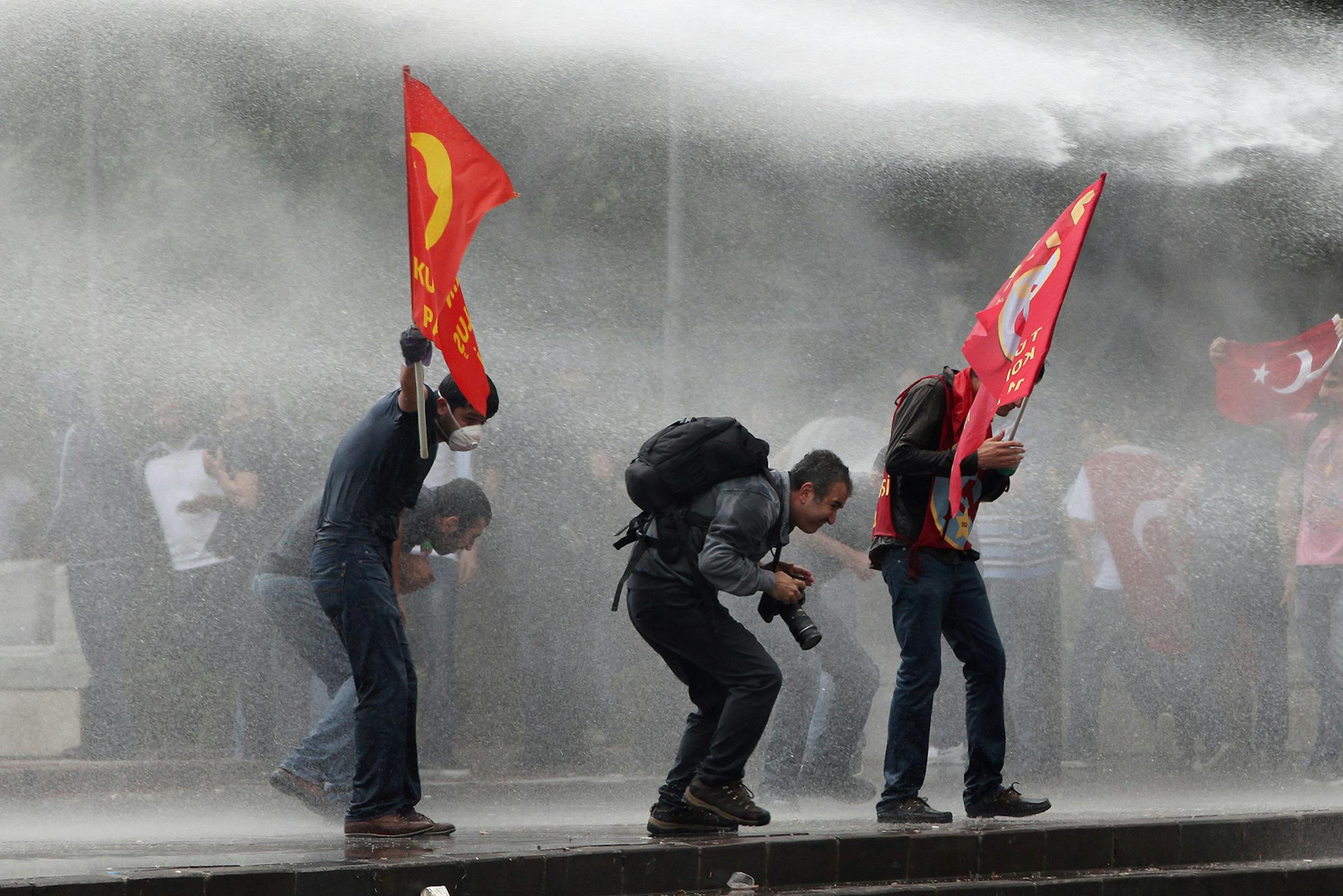
Another trend stems from freedom of information "that is too often sacrificed to an overly broad and abusive interpretation of national security needs, making a disturbing retreat from democratic processes," the report stated. In fact, this is the trend of the year, according to Delphine Halgand, U.S. director for Reporters Without Borders. Turkey (154), for one, uses the rubric of the war on terror to target the press. Just this week, a photo of a TV reporter targeted by a police water cannon went viral, sparking outrage.
National security is the main reason that the United States suffered a dizzying drop of 13 points to 46th — right below Romania and above Haiti. The lower ranking is "really a serious, significant decline for a democracy," said Halgand. And of course, the United States isn't just any democracy.


