

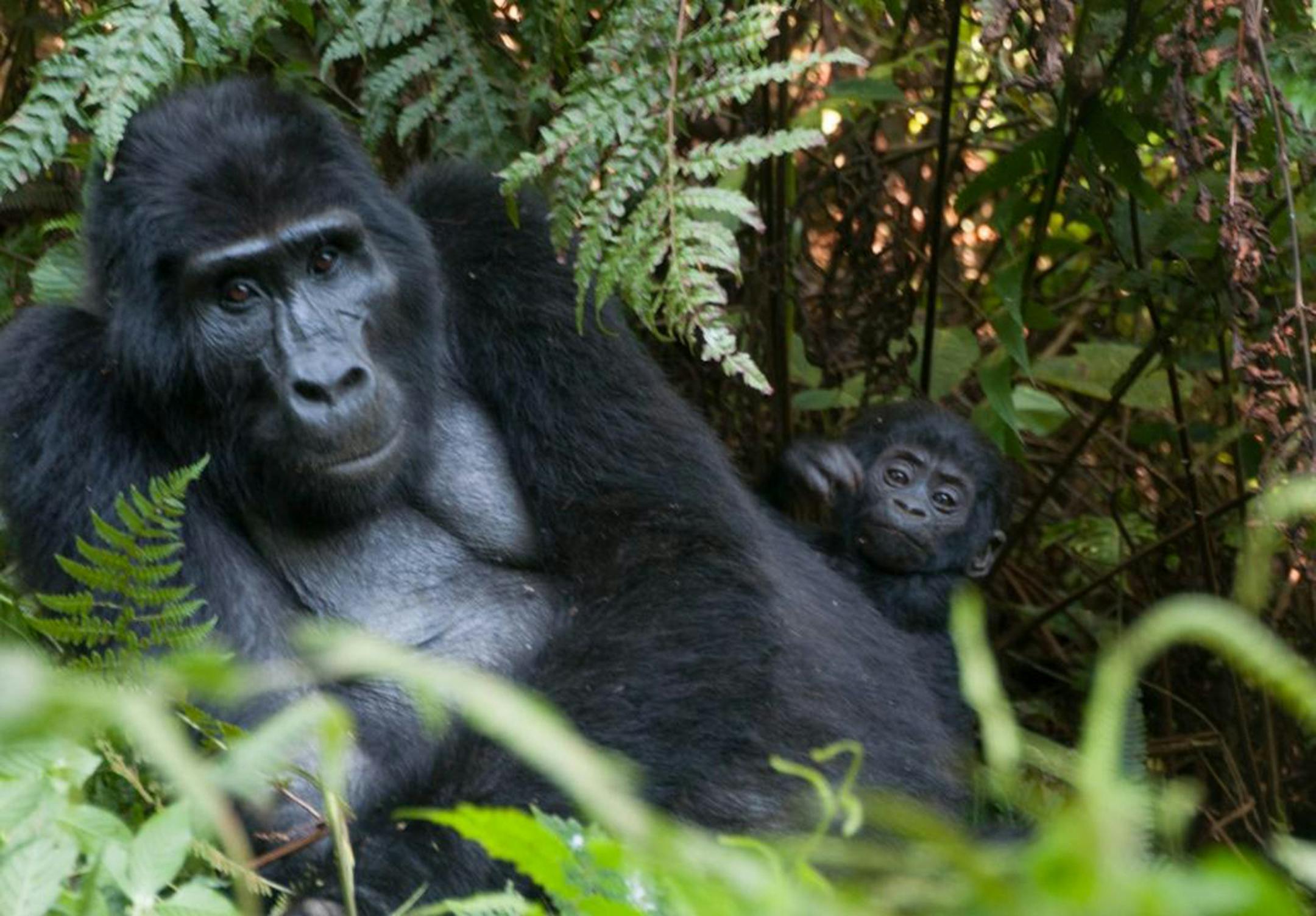
Inside Uganda's Bwindi Impenetrable National Forest, a gorilla brushes against my leg on her way to a new perch.
I'm trying to keep the proscribed distance of 20 feet, but the family of 15 gorillas ignores the theoretical boundary. When a female suddenly moves out of the thick green bush, there's no time to scramble out of the way. My group's ranger tells me to stand still until she passes, then beckons me out of the way lest she reverse course.
Even without that brush, our encounter with the gorillas is far closer than we had imagined — just as their total disregard for our presence is far greater. We might share 98.4 percent DNA with these linebacker-sized cousins, but by most appearances, they couldn't have cared less.
The opportunity to spend an hour in the wild with one of the world's estimated 35 gorilla families drew about 40,000 trekkers last year to Uganda, home to more than 50 percent of the mountain gorilla population.
I am glad I was one of them.
Gorilla-viewing tourism was launched in the late 1990s to create alternative employment to poaching. In Uganda, 20 percent of every permit fee — or $180 per visitor — goes to the local community. Jobs as hotel staff, drivers, rangers, guides and porters all go to locals.
Despite some persistent poaching and habitat loss, the plan seems to be working: Between 1989 and 2011, the number of individual gorillas grew from about 620 to about 880, according to Bas Huijbregts, African species manager for the World Wildlife Fund's Wildlife Conservation Program. Data from the most recent census, in 2015-16, are still being analyzed, he says.
Gorilla-zone governments get their share: Uganda charges $600 per person per day for the highly coveted, date-specific permits. Rwanda recently doubled its fee from $750 to $1,500, with $150 per permit now going to the local community. The Democratic Republic of Congo charges only $450, but instability in the region makes it the least popular of the three, and the U.S. State Department warns Americans against visiting.


