

Imagine being blamed for defending your integrity. Then understand that being attacked for speaking up is part of daily life for black women. See April Ryan, Maxine Waters, Kamala Harris, Susan Rice and Michelle Obama for a few examples of how black women have been admonished for their public statements. Somehow it seems to happen when we challenge male authority.
It has happened before to Serena Williams, in collisions with tennis' ruling organizations, but never as dramatically as in the women's final of the U.S. Open on Saturday.
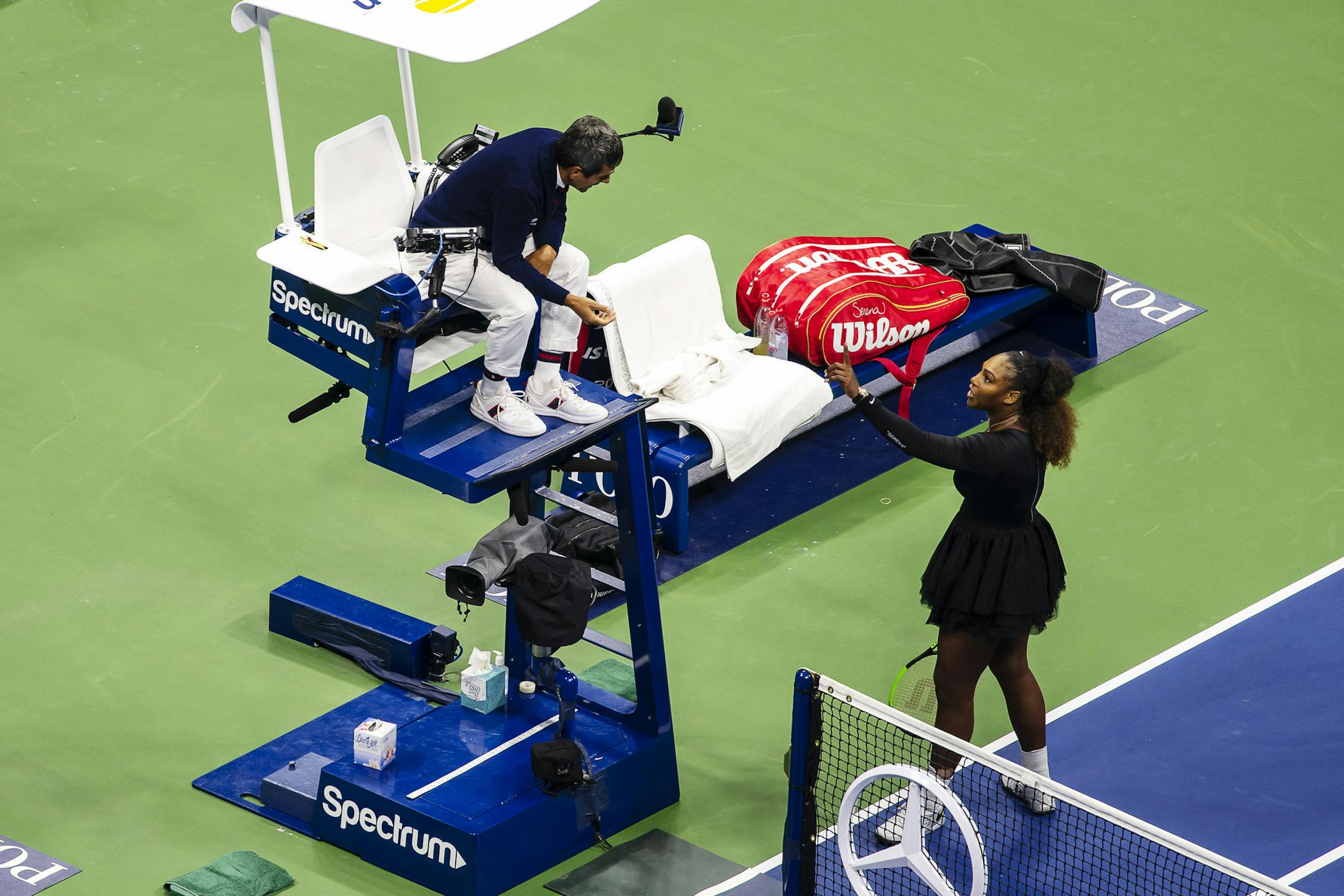
I had a bad feeling from the moment that Williams walked over to chair umpire Carlos Ramos during the second set of her match against Naomi Osaka, defending herself against his accusation that she was being guided by coach Patrick Mouratoglou from a courtside box. This would be a turning point in the match, I sensed, and not a good one for Williams.
Ramos did not openly state that Williams was cheating, but the implication of the umpire's decision left little room for doubt that he believed she was trying to gain an unfair advantage. Williams insisted, "I'm telling you I don't cheat to win, I'd rather lose, and I'm just letting you know." The crowd's effusive applause after the exchange made clear that the spectators thought she was in the right.
Yet, instead of warning Mouratoglou, Ramos had penalized Williams — a professional athlete with 23 Grand Slam singles titles, and therefore well versed in tennis rules and regulations — for her male coach's faux pas. Mouratoglou later admitted that he had been gesturing to Williams and was mystified that a common practice among coaches at tennis tournaments was suddenly being punished. Not only did Williams have to bear the brunt of the umpire's decision, but she also had to accept that it was a violation not of her doing.
And it was a turning point. Distressed and frustrated, Williams clearly lost her concentration. She broke her racket after badly misplaying a shot — and was penalized for it, the only justified ruling against her in what turned out to be a fateful trio. With two violations, she was assessed a one-point penalty, in a match where every point was vital.
During a break, Williams was still waiting for Ramos to acknowledge that she had not cheated: "You're attacking my character. Yes you are. You owe me an apology." She did not want her integrity to be tainted by a man's false characterization. Ramos could have defused the situation simply by saying that he understood her point — and then warning her that if she continued to speak, he would penalize her for a third time.
Instead, he let Williams go on, until she made the apparently unforgivable point that Ramos was a "thief" for stealing a point from her. No one listening would seriously believe that Williams was literally accusing him of theft, yet at that instant Ramos — defending his integrity — assessed a third violation. That automatically meant a one-game penalty against Williams, a disaster in a match where she was trying to come back from dropping the first set. Losing the second set meant losing the match, and she did.


