'Where should we ski today, Switzerland or France?" I ask Peter, my husband.
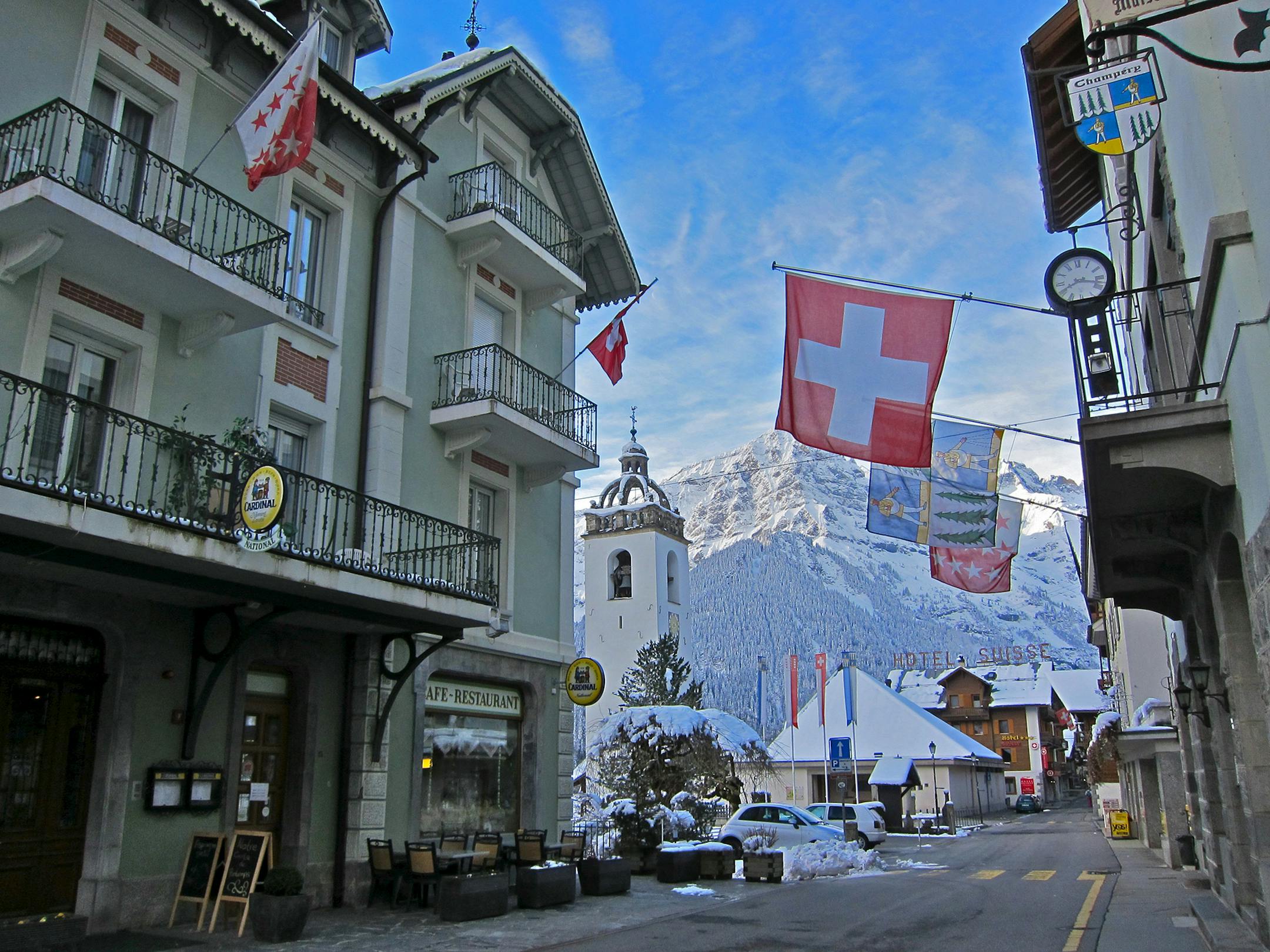
We don't have a private jet at our disposal. In fact, we're 75 miles from the nearest international airport, eating breakfast in a cobblestone mountain village where the "new" church — built in 1725 to replace the original 1436 chapel — has a steeple shaped like a crown and carved doors accent wooden chalets.
The town is Champéry, Switzerland. Looming above us are the Alps. And the jaunty red tram that scales the vertical walls above our valley opens onto the Portes du Soleil, one of the largest ski areas in the world.
Portes du Soleil (which translates as "gateway to the sun") encompasses 12 interlinked resorts that sprawl between Mont Blanc in France and Lake Geneva in Switzerland. The resulting climatic confluence generates lots of snow. Four ski areas lie on the Swiss side and eight on the French. All can be accessed with one affordable lift pass.
The statistics stagger the mind. Nearly 300 ski runs stretch for 400 miles, with 200 lifts strung across 14 valleys. The terrain encompasses 150 square miles. (Whistler Blackcomb in British Columbia, North America's largest ski resort, holds a mere 13 square miles.)
Portes du Soleil delivers two parallel ski universes. Nearly 80 percent of the marked runs are easy to intermediate. But adrenaline-seeking experts can swoosh through powder bowls and hurtle from cornices into gravity-defying couloirs in off-piste areas.
Despite the expanse, we find it surprisingly easy to schuss from country to country. As in the Paris Métro, trail signs point in the direction of each resort — Champéry, Les Crosets, Morzine, Morgins, Avoriaz, Zermatt and so on. You ski, then ski some more, changing language, currency, country, altitude and attitude.
Our ski adventures begin inauspiciously.