1:17
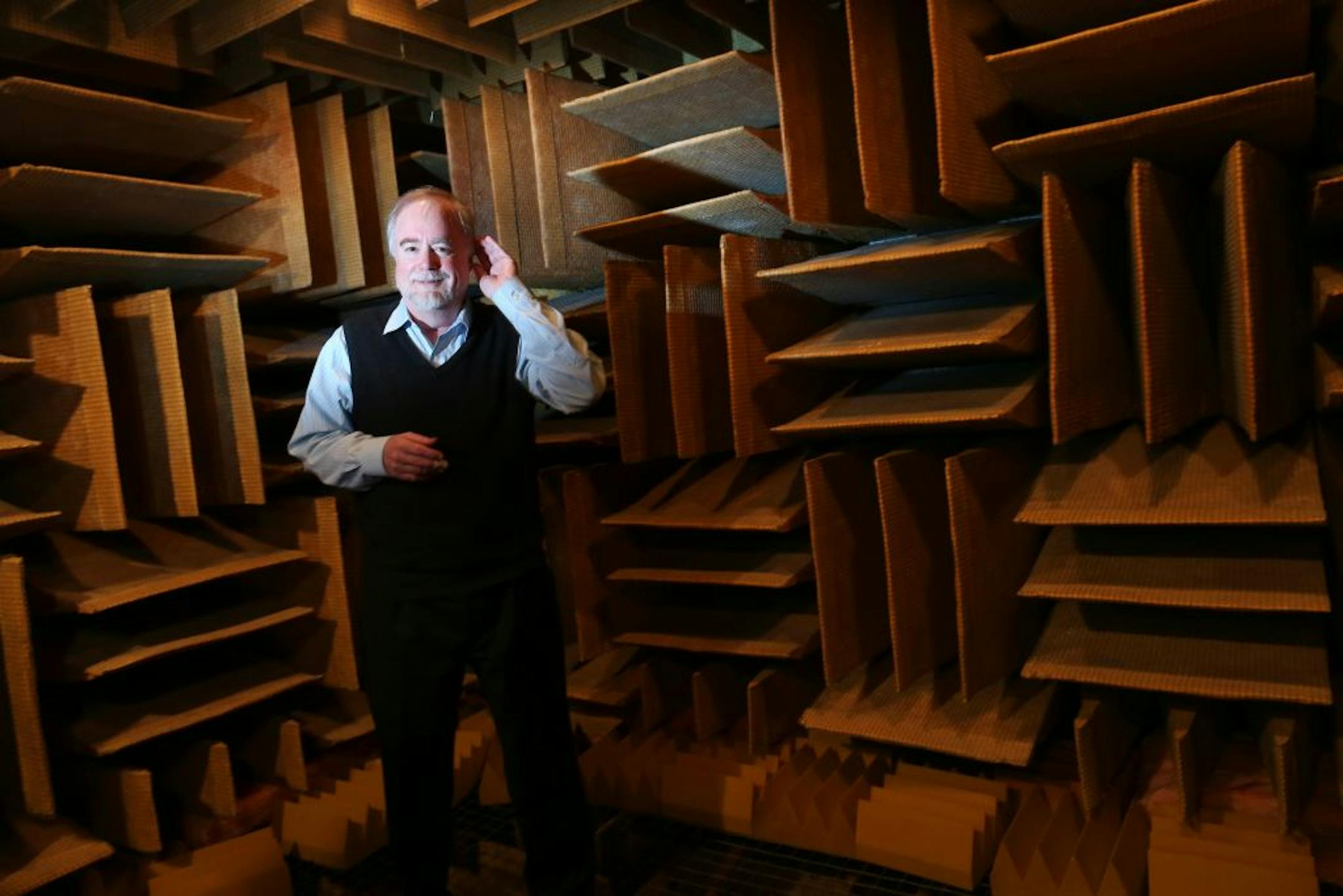
1:17In the world's quietest room, conversation sounds more like a stage whisper. In fact, the minus-9.4-decibel anechoic chamber "is the one place where what you hear is my actual voice," Steve Orfield said, barely audible from 3 feet away.
Surrounded by double walls of concrete and insulated steel covered by 3.3-foot-thick wedges of fiberglass, the south Minneapolis space is perfectly suited not only for the Guinness World Records book but also a boatload of business applications.
Thanks in part to the anechoic chamber, Orfield Laboratories has helped Harley-Davidson, Cessna, Whirlpool and Black & Decker redefine the sounds of their products. It is also working with restaurants on noise issues (inside and outside), and devising the first nursing home designed entirely for the perceptual abilities of a 90-year-old.
All of which makes it hardly surprising to hear how Orfield feels about noise. "I think noise is pollution," he said. "You have no right to do that to others any more than smokers do. I think the noise that you make is the only noise you should hear."
That hasn't stopped him from also creating one of the Twin Cities' loudest rooms, a reverberation chamber with bowed aluminum panels in which he sounds the same from 300 feet away as 3 feet away. It's one of several chambers in which the lab's tests take place.
"The reverb room is perfectly diffuse," he said, "and the quiet room perfectly absorbent."
And perfectly disorienting, if a visitor is not careful. Besides being able to hear one's own heart, stomach and even inner ear, or the sounds emitted by a cellphone's display, first-timers in the quiet room find their other senses discombobulated by "cross-modal" perceptual effects.
"Your eyes don't feel as comfortable in this room," Orfield correctly pointed out, adding that some visitors have had hallucinations during or after a spell in there. "You lose your touchstones."