

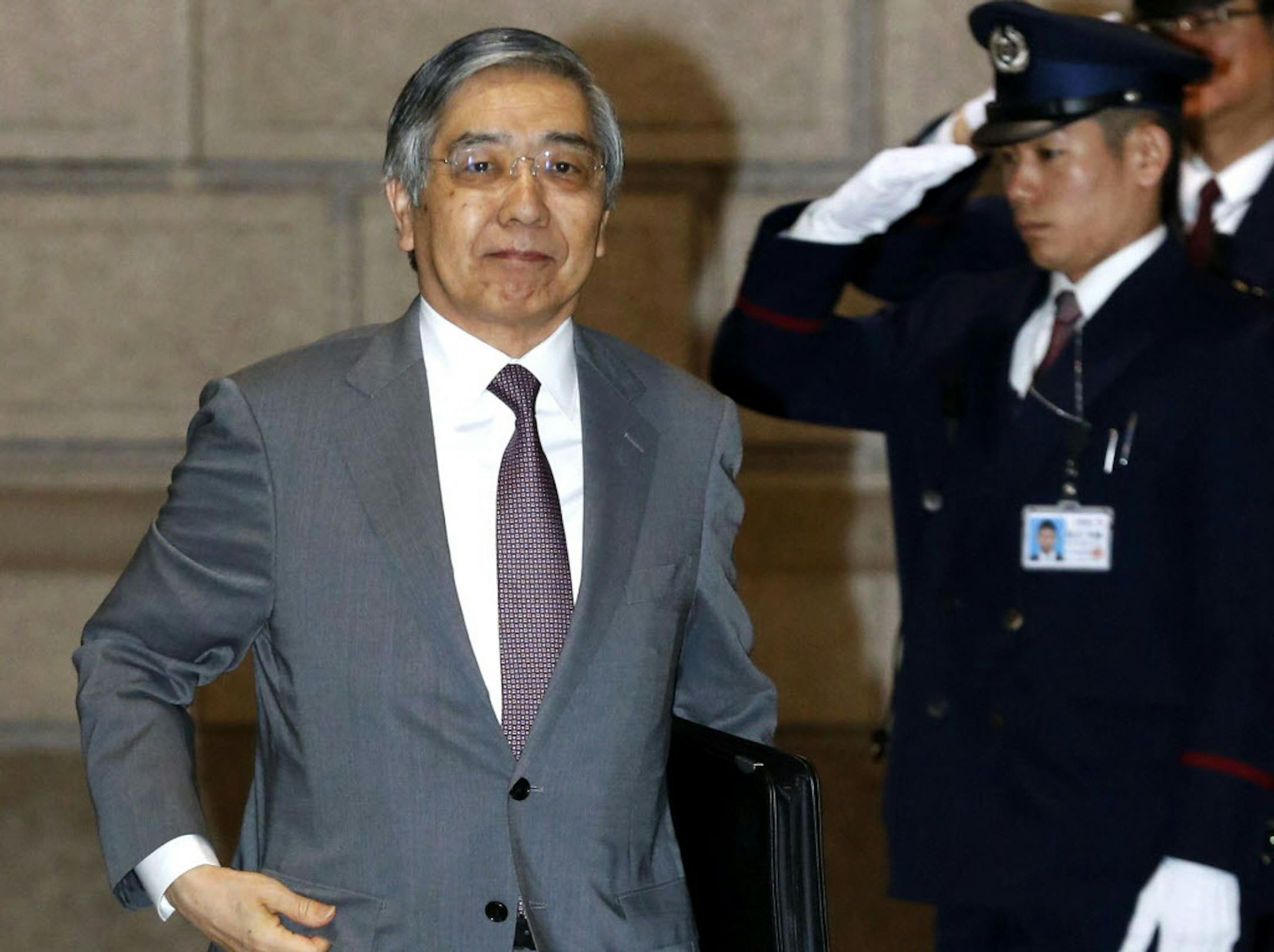
An early strength of Abenomics, the plan of Shinzo Abe, the prime minister, to revive Japan's economy, was the tight bond between Abe and his hand-picked central bank governor, Haruhiko Kuroda.
Former chiefs of the Bank of Japan had adopted a defeatist stance toward Japan's deflationary morass. Kuroda, the prime minister believed, was a champion of his desire to revitalize Japan in large part through unorthodox monetary loosening. In early 2013, soon after Abe took office, the central bank duly launched a radical program of quantitative easing.
But now the two men appear at loggerheads.
The main point of contention is fiscal policy, which to date has been very loose, with a primary budget deficit (that is, excluding interest payments on debt) of 6.6 percent of GDP.
Kuroda is making it clear he does not believe Abe is trying hard enough to bring the deficit down. The government, meanwhile, would prefer him to confine his remarks to the bank's monetary remit.
A second and related difference is emerging over monetary easing itself. In the quest to rid Japan of deflation, Kuroda promised whatever it took to push inflation up to 2 percent. The Bank of Japan may not be doing enough to achieve this. Prices are at a standstill. Yet the government appears to be signaling that a fresh bout of bond buying might be too much of a good thing. Having ordained the inflation target, Abe now appears to be undermining Kuroda's ability to reach it.
For businesses and households alike, such discord is itself a cause of anxiety. At first, Abenomics appeared to be going well. While the bank printed money, the government spent more to help ease the pain of a long-planned rise in the consumption tax, from 5 percent to 8 percent in April 2014.
Stronger growth resulting from structural reforms was supposed to soften the effect of a planned second rise in the consumption tax, to 10 percent, this autumn. The government would then gradually fulfill a long-standing commitment to achieve a primary budget surplus by 2020-21. Japan's gross national debt, at around 240 percent of GDP, is easily the rich world's highest.


