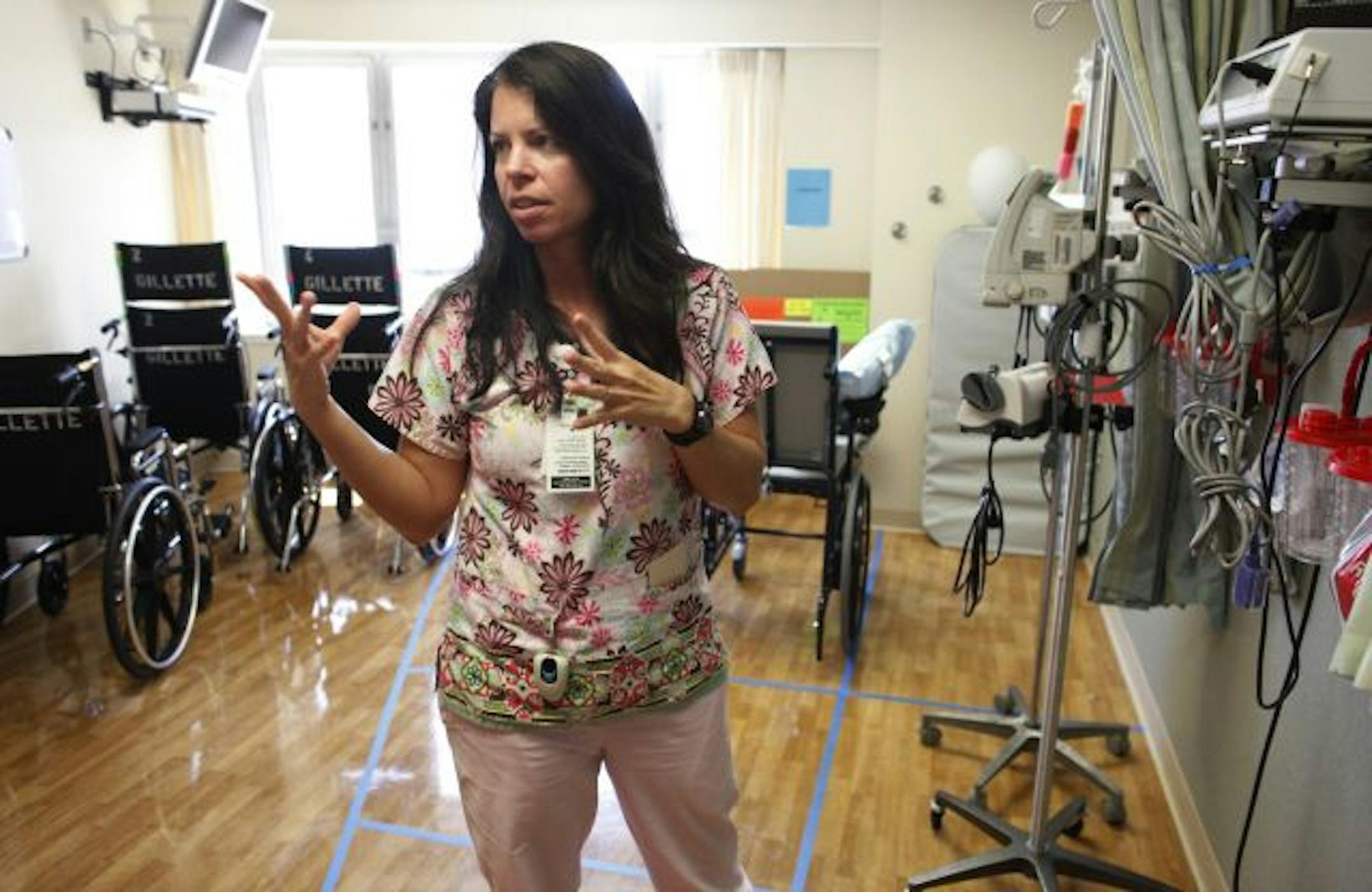
Not long ago, it wasn't unusual for nurse Kristin Liehr to roam the hallways of her St. Paul hospital searching for a wheelchair. Or a crib. Or a cart. Or dash out of a patient's room for bandages or syringes. It would happen, she says, more than a dozen times a day.
Nursing experts call it "hunting and gathering." And studies suggest that it can consume more of a nurse's time than actual patient care.
"It's such a frustration," said Liehr, who works with children recovering from surgery at Gillette Children's Specialty Healthcare.
But last year, Liehr's unit -- 4 West -- became part of a national project called Transforming Care at the Bedside. She and her colleagues discovered they could save a lot of time and "a ton of aggravation" with some modest innovations -- such as relocating the supplies they use most.
For four bitter months, nurses and managers at other Twin Cities hospitals have clashed publicly over how many nurses are needed at the bedside, as part of a bitter labor dispute that ended last week. The Minnesota Nurses Association tried and failed to get strict staffing ratios, arguing that hospitals are dangerously understaffed, and some members have called on the Legislature to impose staffing rules.
But behind the scenes, dozens of Minnesota hospitals, such as Gillette, have quietly been looking at ways to ease the burden on nurses by streamlining their workload rather than adding staff.
"One theory is, if the quality of care is better with more nursing care, let's hire more nurses," said Pat Rutherford, who helped launch the project at the Institute for Healthcare Improvement in Cambridge, Mass.
But in practice, she said, nurses at most hospitals struggle with "chaotic, inefficient" systems that keep them away from their patients for much of the day. "It's irresponsible to just add numbers without getting rid of the waste," she said.