

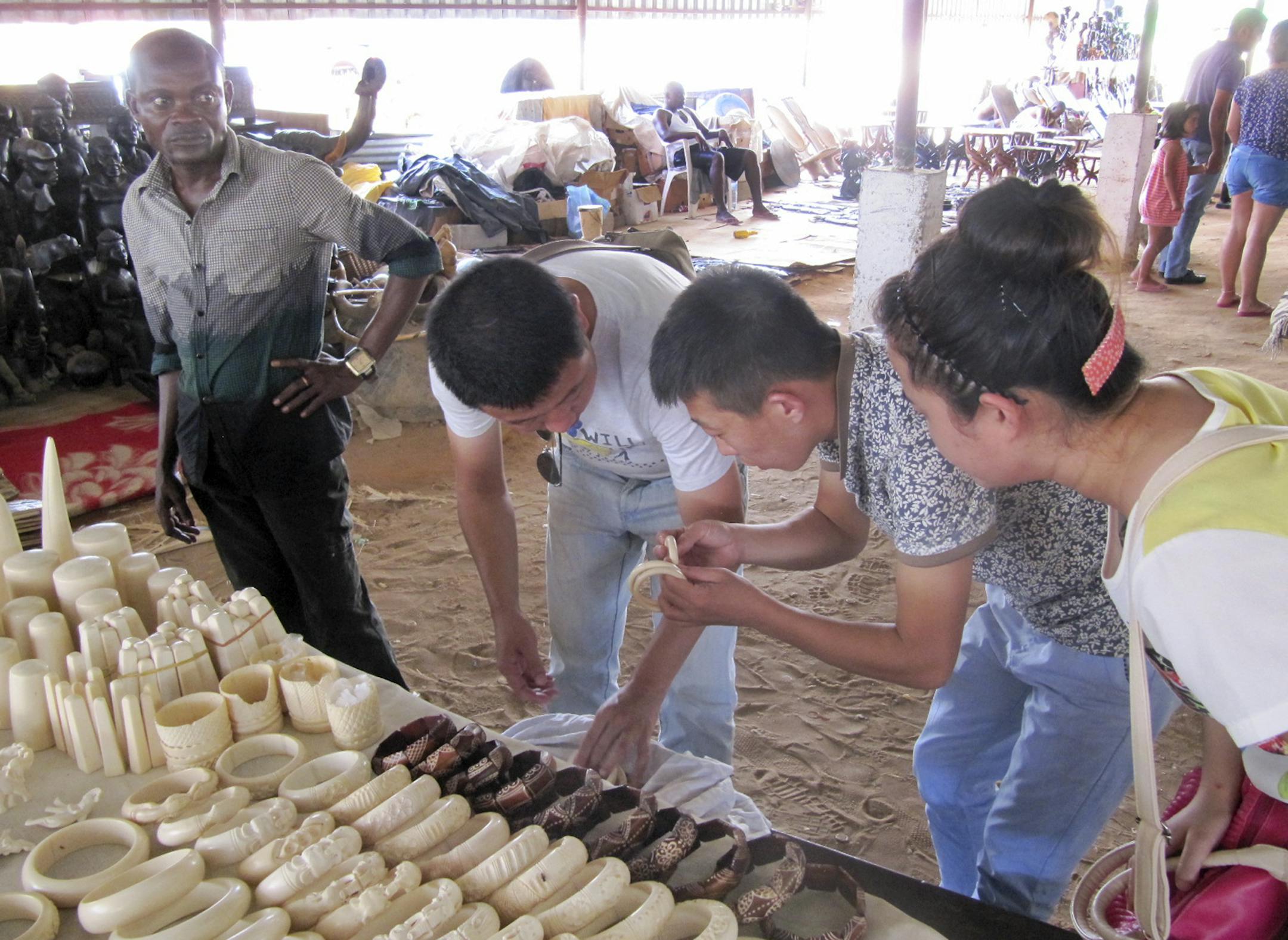
LUANDA, Angola – At Benfica Market, south of the Angolan capital, Luanda, tables are stacked with carved ivory items from elephants illegally hunted in the forests of central Africa.
The buyers are from China's 250,000-strong expatriate community, as estimated by Chinese Premier Li Keqiang in May, in Africa's second-biggest oil producer.
At the cement block and dirt floor market about 10,000 ivory pieces, mostly from the Democratic Republic of Congo and the Republic of Congo, are on offer, according to Esmond Martin, a wildlife trade researcher based in Kenya who visited the site in March. The ivory is carved into Asian designs of Buddhas, dragon bracelets and necklaces to attract buyers.
"I was shocked," Martin, 73, said in a July 2 telephone interview from Nairobi, Kenya's capital. "It's very rare to see so much ivory for sale in one specific small market. Underneath the tables were 10 trunks with more."
The illegal trade in ivory stretches across Africa to Asia: From Kenya where poachers hacked the tusks off two of the country's oldest elephants last month, to China where smugglers supply a growing middle class eager to display new wealth. Benfica is second only as a public ivory seller in Africa to Nigeria's Lekki market in Lagos. Together, Nigeria and Angola have fewer than 3,000 elephants, according to the United Nations.
Angolan craftsmen buy wholesale ivory for $150 to $200 a kilogram (2.2 pounds) while the price in Beijing is $2,100 per kilogram, said Martin, who has visited the Chinese capital.
"We have some internal issues as to who should be responsible for monitoring and evaluating this kind of illegal trade," Soke Kudikuenda, head of biodiversity and conservation at the Angolan Ministry of Environment, said in a telephone interview in Luanda. "We have submitted documents to the Council of Ministers to determine whether this should be under our umbrella or under the umbrella of the Ministry of Agriculture."
Angola last year joined the UN's Convention on International Trade in Endangered Species of Wild Fauna and Flora, according to its website. The 180-member group began in 1973 and tries to protect more than 35,000 species, it said.


