

Democrats now control the House for the first time since 2010. Yet they still have no discernible national political leader or a sweeping political program.
They can solve these problems quickly, however, if they take inspiration from Hubert Humphrey, a former senator from Minnesota, vice president and 1968 Democratic presidential nominee. Despite never occupying the White House, Humphrey earned serious accolades. House Speaker Tip O'Neill, D-Mass. called him "the most genuine liberal the nation has ever produced," and former Vice President Walter Mondale labeled him "the country's conscience." And in 1978, more than 1,000 congressional aides and newsmen voted Humphrey the most successful lawmaker of the 20th century.
Humphrey's clear principles and legislative proposals on topics such as civil rights and health care offer a path to a robust and moral Democratic agenda — one that can propel the party to success again.
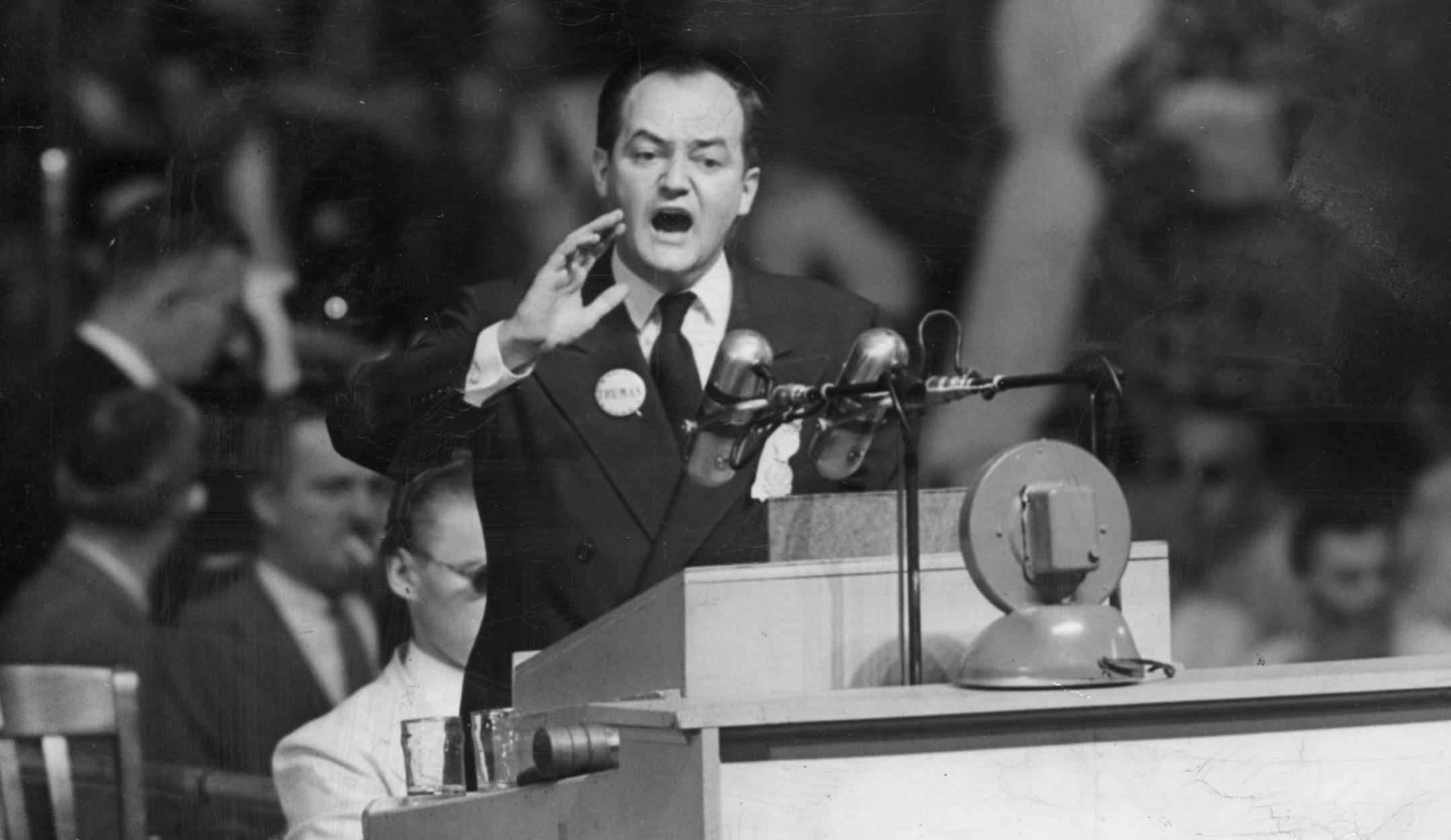
Humphrey is perhaps best remembered for his dramatic speech at the 1948 Democratic National Convention, exhorting his colleagues to "walk out from under the shadow of states' rights and into the bright sunshine of human rights." The speech caused Southern Democrats to bolt the convention and form the Dixiecrat Party, but it also energized President Harry Truman's lackluster campaign and led to his stunning upset of Republican Thomas E. Dewey. Most important, Humphrey put civil rights on his party's, and the nation's, agenda, where they have remained to the present day.
Humphrey won a resounding victory that year over conservative Republican Sen. Joseph Ball, campaigning for "health care for all" and insisting that it was time for someone in Congress "to raise his voice for the underprivileged and oppressed." He won significant support from the middle class, laborers and farmers.
Although ostracized by long-serving Southern Democratic senators, a move that left him feeling "lonely, bitter and broke" (his family always lacked money), Humphrey remained committed to his positions, aggressively pursuing the agenda that drove his immense legislative and political success for the next three decades. In 1949, he co-sponsored bills to create national health insurance. He also proposed federal loans and grants to help build and equip consumer cooperatives that would contract with doctors to provide members with prepaid medical coverage, with the hope that good salaries would attract doctors to work in group practices in less populous areas. Although these bills did not become law, they animated the liberal push for universal health insurance that has remained a top Democratic priority.
The coming of the Korean War in 1950 and the election of Republican Dwight Eisenhower in 1952 forestalled most liberal legislation, but an undeterred Humphrey soon experienced his first legislative triumph: the 1954 Agricultural Trade Development Assistance Act, which promoted sale of "surplus" agriculture at below-market prices to poorer nations. In 1957, the same year he announced to his colleagues, "I am a liberal without apology," Humphrey led the successful crusade to enact the first Civil Rights Act since Reconstruction. The law, although limited in scope, made it a federal offense to interfere with a person's right to vote in federal elections. Humphrey declared, presciently, that it was "only the beginning" of civil-rights legislation.
During the early 1960s, Humphrey agreed to serve as majority whip to round up the votes for President John F. Kennedy's New Frontier legislation, much of which he sponsored. This included the Food for Peace Act (which dispensed food on a humanitarian basis), the Peace Corps (perhaps the administration's most popular legislation), the establishment of the Arms Control and Disarmament Agency to reduce the spread of nuclear weapons and the landmark 1963 Limited Nuclear Test Ban treaty, which prohibited underwater and atmospheric atomic testing.


