

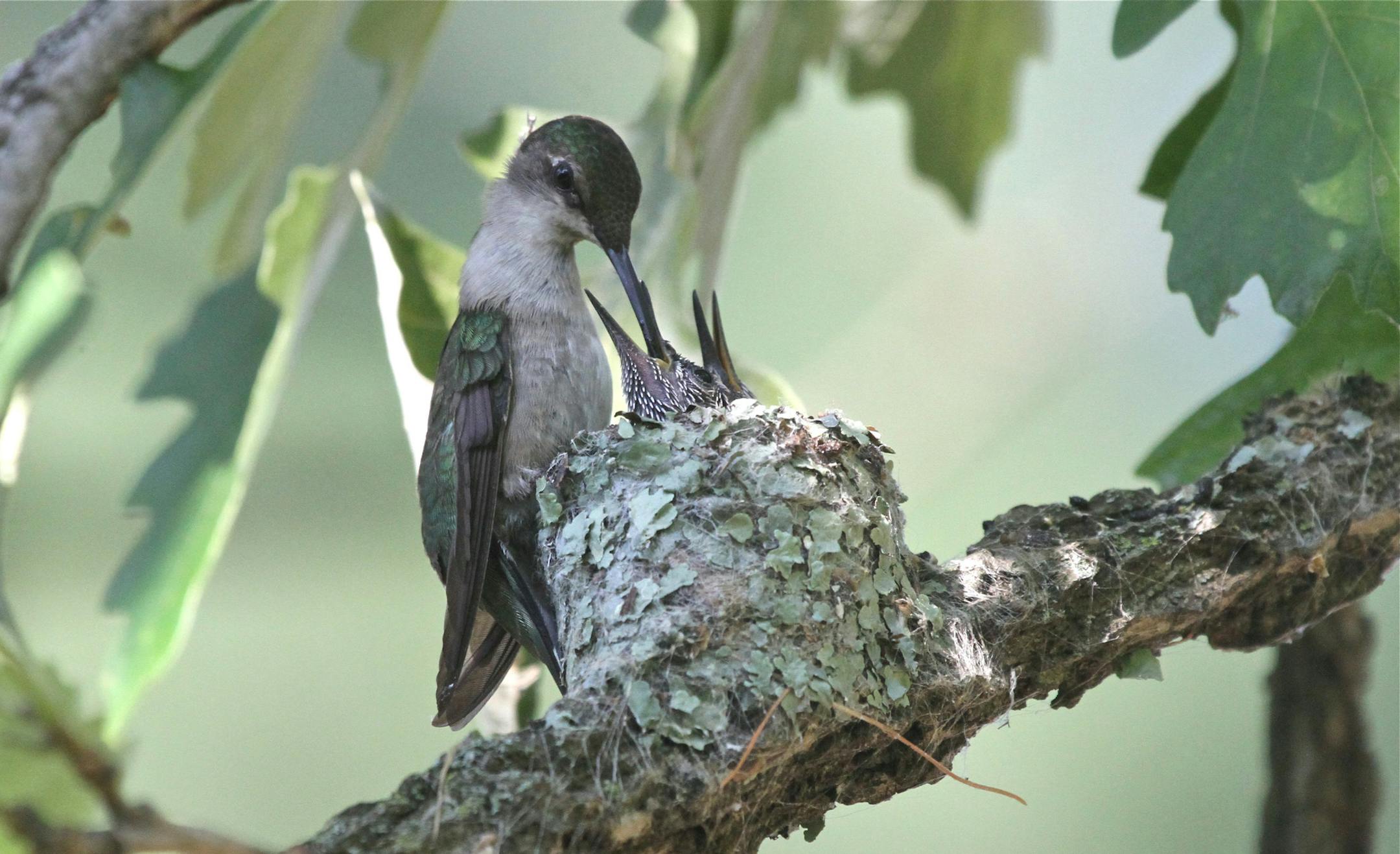
We admire ruby-throated hummingbirds for their beauty, their feistiness and their amazing flight abilities. But how many of us know that they're arguably the hardest-working parents in the bird world? (We're talking about the females here, as the males aren't much help at all.)
After an arduous journey up from Central America, including a 500-mile flight over the Gulf of Mexico, tiny ruby-throats begin arriving in our area in early May — you could think of them as the May Day bird. The males arrive first and stake out a feeding territory, then work to attract a mate through dramatic courtship flights, featuring amazing aerial antics in the form of a series of looping, U-shaped dives.
Once a male and female have mated, the male's involvement ends. He has no further interaction with the female hummingbird as she builds a nest, lays her two eggs and raises twin nestlings, all by herself.
Setting up housekeeping
Once she has selected a nest site — and this may be in the same deciduous tree or even the same branch she used the previous year — the female ruby-throat gets busy. Like most birds, she uses construction materials that are close at hand (or beak). She snatches up plant down, often from dandelions and thistles, drops it onto a branch, then stamps it with her tiny feet to form a firm base. This platform will become the only unyielding part of the nest.
Then she gathers up plant material such as bud scales and lichens, as well as more beaksful of fluffy plant down, to form the soft sides of the nest (since the tiny hatchlings won't have feathers for many days, their bare skin needs to be protected from prickly things). These natural materials are both strong and waterproof, and won't hold water after a rainstorm. As the female builds the nest walls, she weaves everything together with spider silk that she steals from active webs.
This is the most ingenious thing about a hummingbird's nest: Spider webbing is elastic and will expand under pressure. As hummingbird youngsters grow, the nest walls will expand to accommodate them. By the time the chicks have spent two weeks in the nest, however, they've reached the limits of nest elasticity and are often perched on its lip for the last few days.
The mother bird incubates her eggs for about two weeks, taking only very short breaks to feed herself. Once the eggs hatch into demanding youngsters, she's run ragged trying to keep up with their needs for food.
Nearly invisible nests
Tiny birds create tiny nests, about the size of half a walnut shell, so it's a challenge to spot such a small structure hidden behind leaves in a tree or shrub. Few of us ever see a hummingbird nest, and those who do most likely are lucky enough to notice a mother hummingbird coming or going from her brood.


