

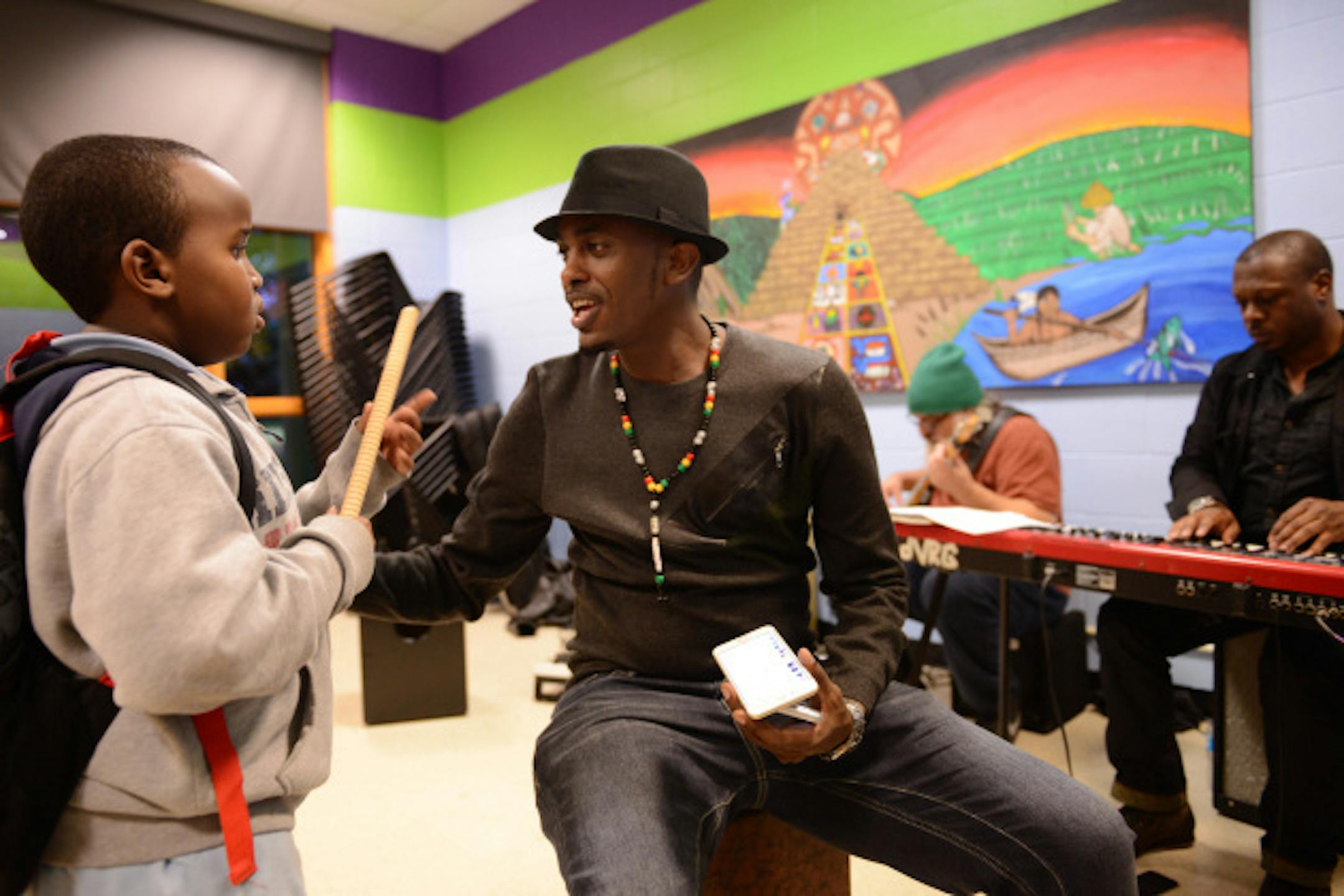
![Artist Dalmar Yare gave some pointers to eight-year-old Samir Muse. ] Mark Vancleave - mark.vancleave@startribune.com * Members of the Somali hip-hop collective Waayaha Cusub engaged kids at the Brian Coyle Center with songs and writing exercises Monday, Oct. 17, 2016.](https://arc.stimg.co/startribunemedia/7ENBU3A6GY4PE3NZJ6OFAGBO64.jpg?&w=1080)
Above: Minnesota artist Dalmar Yare, a member of the Somali hip-hop collective Waayaha Cusub, participated in the Cedar's fall 2016 Midnimo residency.
Artists and museums around the country (and the world) are reporting confusion in light of President Trump's executive order on immigration. So how has the ban affected artists and arts groups in Minnesota?
Spokespeople from the Minneapolis Institute of Art and the Walker Art Center said their organizations are unaffected by the ban for at least the near future.
The ban is most likely to affect the Cedar Cultural Center, a nonprofit performing arts organization located in the Cedar-Riverside neighborhood, which is home to the largest Somali population in the United States.
The Cedar launched a program in 2014 with the ambitious name of "Midnimo." Translation? Midnimo is Somali for "unity."
The program specifically invites Somali musicians to Minnesota for multi-week residences. Thanks to partnerships with universities and arts groups across Greater Minnesota, Midnimo artists get to perform at venues in Minneapolis, Mankato and St. Cloud. For many Midnimo artists, it is their first opportunity to perform with a full band -- and their first chance to perform for audiences outside the Somali community.
Midnimo has not, however, managed to bring artists directly from Somalia, even before Trump's ban. "In spring of 2016, we tried to bring a group of artists directly from Somalia and the visas were all denied," said the Cedar's executive director, Adrienne Dorn.
Instead the program has drawn from Somali populations in Amsterdam, Toronto, London and Minneapolis. The Star Tribune wrote about the Cedar's most recent Midnimo residents, a Somali hip-hop collective called Waayaha Cusub whose members are scattered across the globe.


