

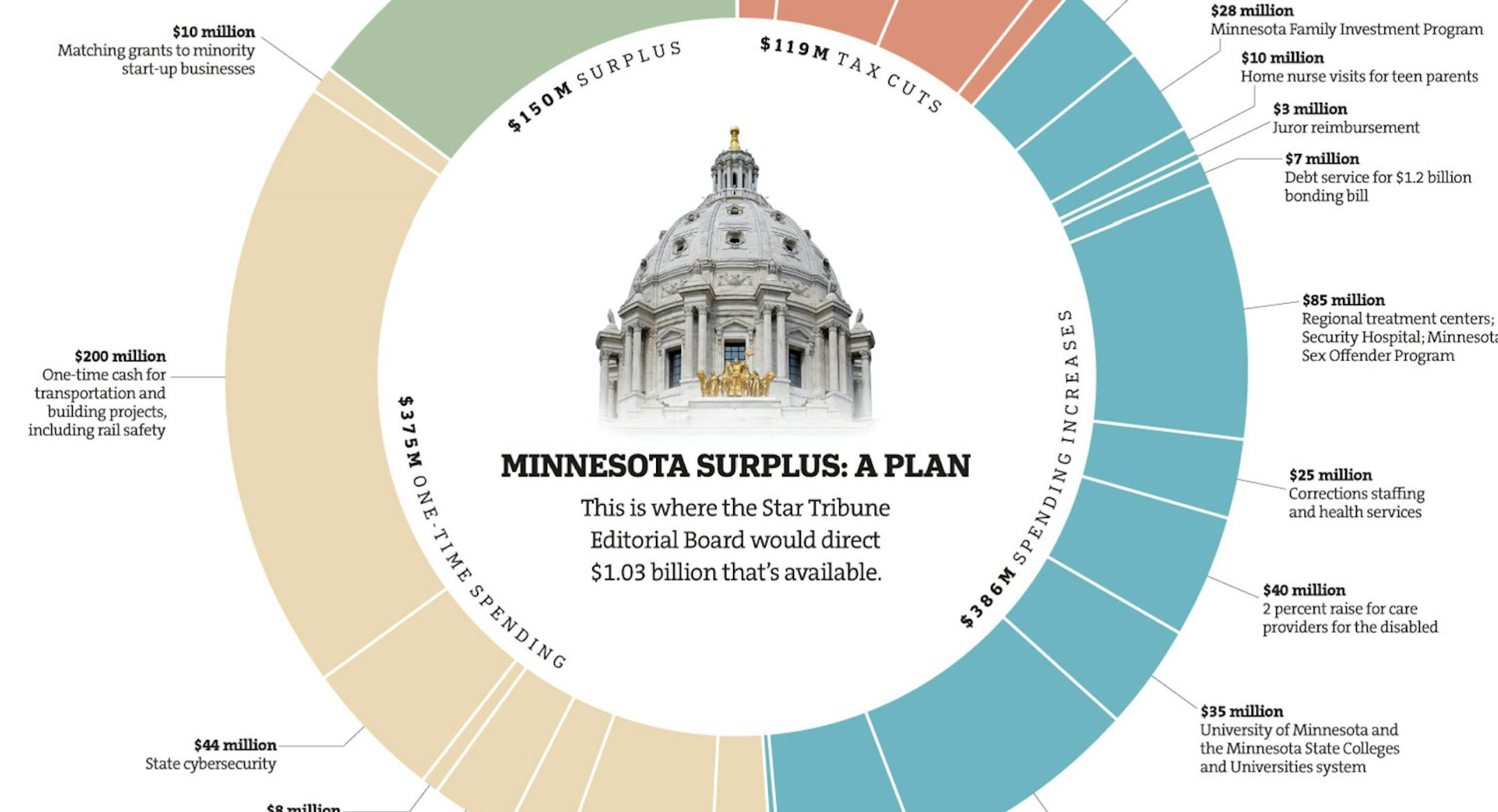
Directions: On desktop displays, use your mouse wheel to zoom into the graphic. On mobile devices and tablets, use pinch to zoom.
'Nothing needs to happen at the 2016 Legislature." That's what state lawmakers have been telling each other as they prepare to drive hard bargains with their partisan opponents. In one sense, they are right. No government shutdown or breakdown will ensue if this spring's state lawmaking exercise comes a cropper.
But for Minnesota to thrive in years ahead, much should happen before the mandatory May 23 adjournment date. A forecast $900 million surplus through mid-2017 presents an opportunity for long-term gain that's too good to waste. What's more, the problems caused by insufficient state funding of transportation, services for the disabled, corrections, broadband and more will impede Minnesota's progress if they are ignored.
Here's how the Star Tribune Editorial Board would amend the state's 2016-17 budget:
• Starting point: $1.03 billion. That's the sum of the $900 million forecast surplus for the current two-year budget plus $130 million transferred to the general fund from the health care access fund, as Gov. Mark Dayton recommends. His argument for making the transfer is strong: The health fund has a robust $610 million surplus, and the general fund is bearing some costs for low-income adults that the 24-year-old health fund was intended to cover.
• Safety first: Leave $150 million on the bottom line. A slowing global economy and Minnesota's tightening labor supply augurs caution. So does the urging of state budget director Margaret Kelly that no more than $500 million in fiscal 2017 should be devoted to measures that recur in 2018-19. Awareness that spending "tails" often turn out to be longer than expected should inspire legislators to favor one-time spending when possible.
• Let's make a deal: $128 million ongoing, $200 million one-time. The transportation and tax bills that stalled last session should get moving — though with surplus dollars scarcer than expected, those bills can't go as far as once hoped. Our plan yields in part to GOP desires to transfer transportation-related sales taxes from the general fund to the highway trust fund. We shift $75 million in vehicle rental and leasing taxes in fiscal 2017, and urge that this fall's voters be asked to make that change permanent, via constitutional amendment.
Republicans in turn should yield to calls for a modest boost in transportation-related fees and taxes. And lawmakers should seize this year's opportunity to spend one-time money on either transportation or building projects, including railroad safety measures. Our plan directs $210 million to that end. (We'll address transportation funding more fully in a subsequent editorial.)


