

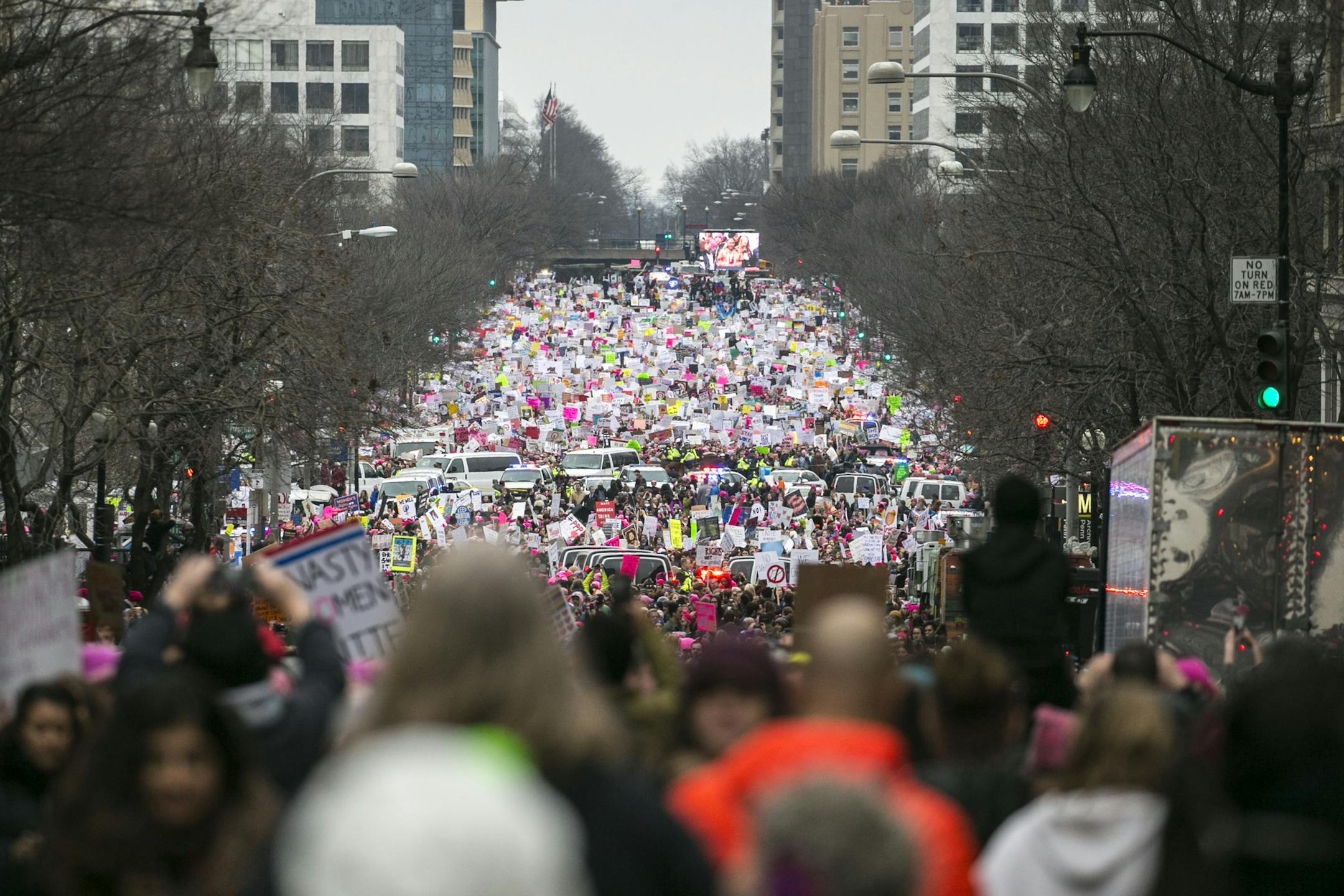
It's what everyone wants to know — but is literally impossible to answer: How many people took to the streets Saturday in the women's marches across the United States?
Initial reports in the Associated Press settled for an inconclusive "more than 1 million." But a project this week by two professors to sum up the tallies at 680 marches across the country was pushing estimates as high as 5 million and beyond.
Never before has the size of a crowd been so contentious — yet so hard to count.
Crowd counting is an imperfect, laborious and contentious endeavor, ranging from rigorous science to random guesswork. And, as President Donald Trump's weekend fit over the reported size of his inauguration turnout shows, sometimes it's influenced by politics.
Counting swarms of restless humans is like trying to estimate the size of schools of sardine in the sea or herds of wildebeests migrating across the African savanna.
Official Women's March estimates in some cities, such as Oakland, Calif.'s 100,000, relied on aerial photos and analytics. Others enlisted block-by-block head counts. San Jose, Calif., based its 25,000 count on comparisons to similar-sized crowds with reliable counts. San Francisco police, "for reasons of public safety," calculate a tally — but do not publicly disclose it.
A lot is at stake: Does a cause have widespread popular support, or not?
University of Connecticut professor Jeremy Pressman and University of Denver professor Erica Chenoweth are "crowd sourcing" figures — both high and low estimates — for marches across the world, including 554 in the U.S. As of Monday evening, their tally for U.S. marchers ranged from 3.16 million to 4.68 million. Included are reports of marches where the only source is the marchers themselves — such as 11 marchers in Beaufort, N.C.

