

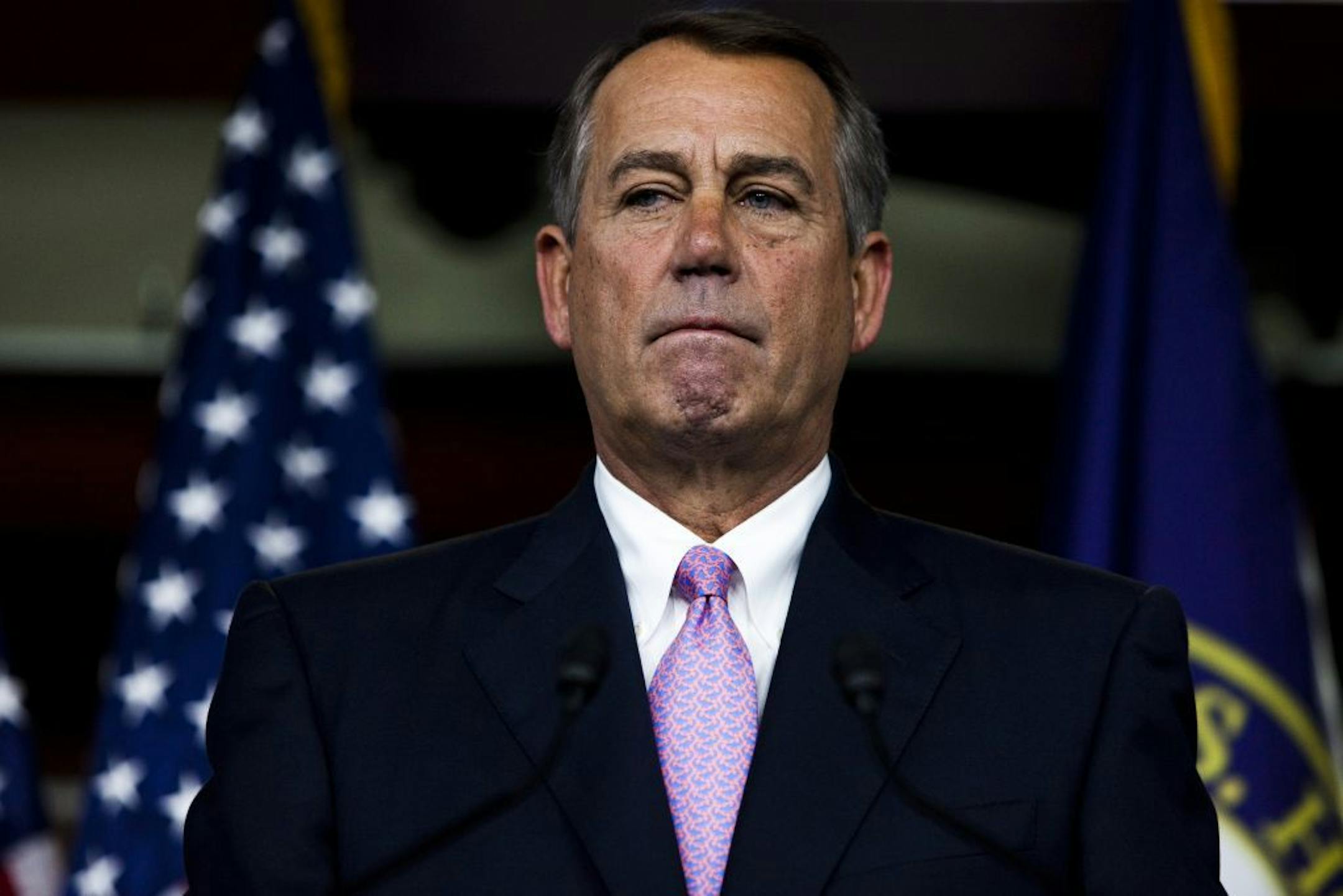
When John Boehner was sworn in as speaker of the House, he was handed an enormous gavel. But when he was recently describing his role as a legislative leader, it sounded like a shepherd's crook would be more useful. In an interview on "Face the Nation" recently, Boehner said his job was not to dictate to Republican members what legislation they should support but merely to "facilitate" a process where they found their own outcome.
He didn't dare offer an opinion about comprehensive immigration reform because it would interfere.
"It's not about me," the speaker told Bob Schieffer. "It's not about what I want. What I've committed to, when I became speaker, was to a more open and fair process. And as difficult as this issue is, me taking a hard position for or against some of these issues will make it harder for us to get a bill . . . If I come out and say, 'I'm for this' and 'I'm for that,' all I'm doing is making my job harder."
It's a shame that Barack Obama and John Boehner don't talk much, because they'd have a lot to commiserate over. Though the two men have very different jobs, responsibilities and powers, they both face the same challenge: how to assert their will in an office circumscribed by the Constitution and circumstance.
They also each face frequent criticism - sometimes from each other - that they are weaklings, unable to wield the powers granted to them. In the end, both men face one of two evaluations: They either did the best they could with the blunt tools of office in a unique time of partisanship, or they fell short of greatness because they could not adapt and use the tools of the job to overcome the partisan conditions.
Republicans snicker at the idea of Obama "leading from behind," so it was surprising to hear Boehner give such a rousing defense of the practice. The term was used by an Obama aide in a New Yorker profile to describe his approach for intervening in Libya.
When used by the president's critics, it is meant to show just how clueless the president is about leadership. Leaders always lead from the front, so the critique goes. That is the essence of the word. The notion of "leading from behind" is as silly as saying "batting from the clubhouse."
But that's wrong. Leading from behind is simply a different style of leadership. If done well, it can be a sign of intelligence and adaptation, and it can be far more effective in achieving an objective than the action-hero vision of leadership we all enjoyed during King Henry V's speech at Agincourt. So the question shouldn't be whether a leader is correct in trying to achieve his objective this way, but whether he's applying this method at the right moment.


