
How Facebook's tiny China sales floor helps generate big ad money

Using a local partner, Facebook quietly builds an ad-selling presence.

The New York Times
February 9, 2019 at 4:57AM
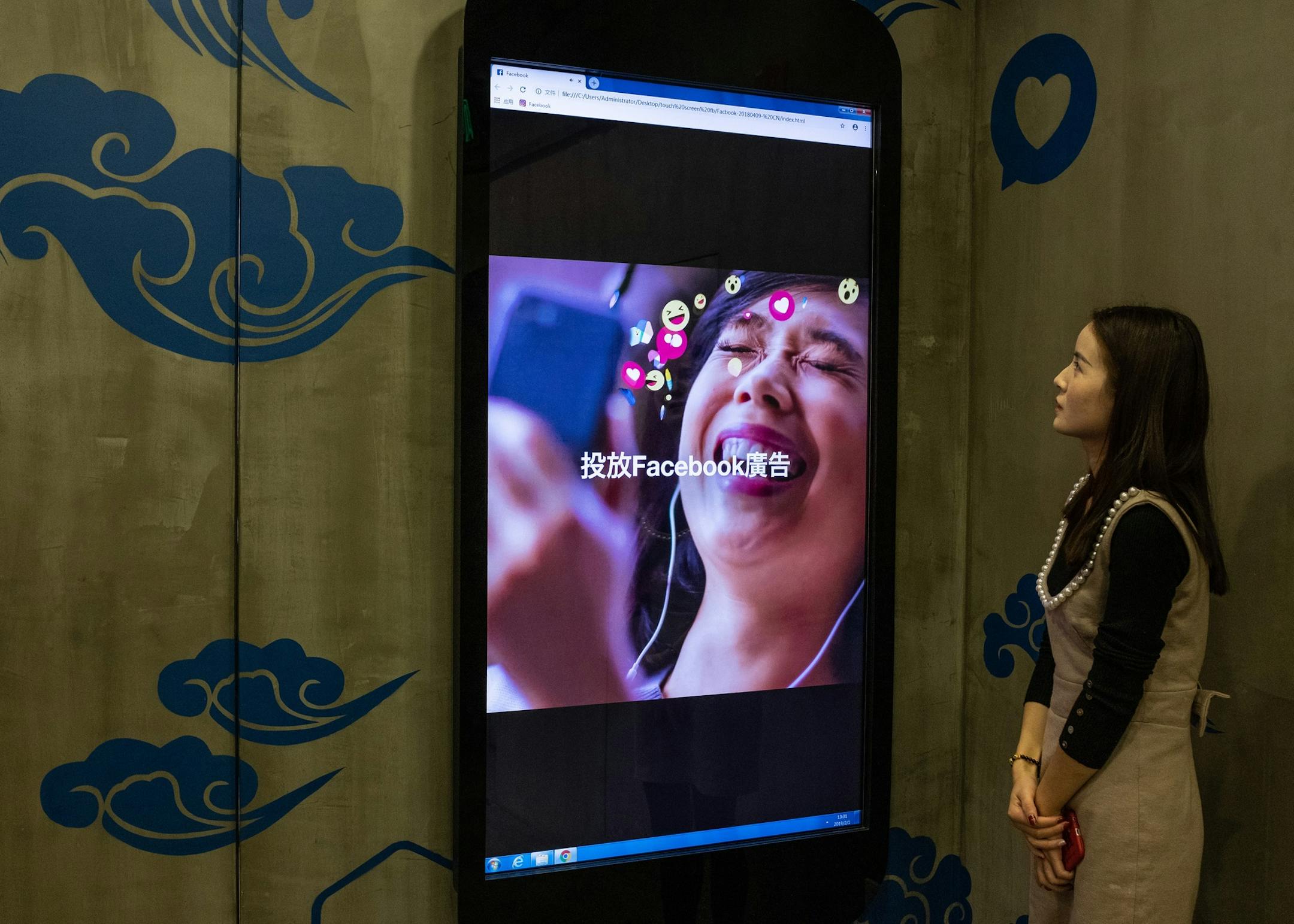
A staffer at the Facebook Experience, a sort of corporate embassy for the social network, in Shenzhen, China, Feb.1, 2019. The desire by Chinese companies and other entities to get in front of people internationally has unexpectedly turned China into one of Facebook’s largest sources of advertising revenue, even though the social network itself is not available in the country. (Lam Yik Fei/The New York Times) ORG XMIT: XNYT264
The Facebook Experience center functions as sort of a corporate embassy for the social network in Shenzhen, China. (The Minnesota Star Tribune)

SHENZHEN, China — Facebook's apps and websites have been blocked in China for years. The company has no office in the country that supports its social networking services. And its attempts to open a subsidiary have been quickly snuffed out.

But here in the southern Chinese city of Shenzhen, Facebook has managed to quietly build a presence with the help of a local partner.

In Shenzhen's Futian district, on the ninth floor of a concrete tower, there is an open-air sales floor that works as a sort of corporate embassy for the social network. The 5,000-square-foot space is run by the local partner, called Meet Social, but has been designed with Facebook's guidance. It functions as an experience center for the Silicon Valley giant — the only one of its type in the world.

Its smallish size belies a crucial, and often overlooked, part of Facebook's business. The center — which looks as if it fell out of Silicon Valley, with stenciled paintings of chat boxes on the walls, a lit-up heart icon and a pristine billiards table — hosts prospective clients and curious customers who wish to advertise on Facebook to reach the network's 2.3 billion users, most of whom live outside China.

The desire by Chinese companies and other entities to get in front of people internationally has unexpectedly turned China into one of Facebook's largest sources of advertising revenue, even though the social network itself is not available in the country. Charles Shen, chief executive of Meet Social, said his company anticipated doing $1 billion to $2 billion in ad sales on Facebook and Insta­gram this year. Each day, he added, Meet Social's software puts up about 20,000 Chinese ads on Facebook.

In total, Facebook's revenue from Chinese-based advertisers reached an estimated $5 billion in 2018, or about 10 percent of its total sales, according to Pivotal Research Group. That would be enough to rank Facebook somewhere around the seventh-largest listed internet company in China.

The experience center is also a strange testament to the borders that China has drawn across the internet. With its "Great Firewall" of internet filters that Beijing used to block Facebook in 2009, the Chinese government has cut the digital abstractions of a global information network along geographic lines. That has necessitated Facebook's creation of the center, where Chinese who have hardly any experience with the social network can learn about it and figure out how to advertise on it.

"The experience center is for inviting potential clients to see how Facebook ads work," Shen said in an interview, adding that Facebook provided much of the materials in the office, while his company staffed it.


Meet Social, an advertising agency, worked with Facebook to open the center last spring. While many Chinese have not used Facebook, that does not prevent them from knowing about it, Shen said. He said his company got plenty of inbound interest from clients, even though it does little advertising about itself.

"Most of the time, it's them who come to us," Shen said. He said his firm had set up a system so that Chinese clients didn't have to leap the Great Firewall to register an advertising account on Facebook. To do so, it uses a service provided by a state-run telecom company to legally jump the internet filters.

Facebook employees come to the center to give talks, Shen said. Since many Chinese cannot access facebook.com — even if they type it into their phones while in the experience center, the site remains blocked — Meet Social provides videos on giant phone-shaped screens so people can get a better sense of Facebook's ad offerings. Examples of paid posts from Chinese brands are framed on the walls. Training in marketing and advertising strategies on Facebook's platforms is also offered.

Jeffery Hong, a sales director at a wig company, said he first thought of advertising on Facebook when he went to a salon run by Meet Social in Shenzhen in 2015.

Hong previously had mostly done overseas sales through Alibaba, China's biggest e-commerce site. In the years that followed, he attended training sessions and talks by Facebook employees, including at the experience center, on an array of subjects including how to offer a good user experience and how to make ads.

Now Facebook ads attract buyers to his company's site that account for about 10 percent of sales. While the company manages its own Facebook site, it also allows Meet Social to take over the page and to troubleshoot difficulties and keep up with ad trends.

"We want to establish our brand, let more and more people know about us," Hong said.

Meet Social is one of seven official Facebook advertising resellers in China. Others serve much the same role. Often their presence is welcome because doing business across the Great Firewall can be tricky.

Ben Liu, 35, an entrepreneur and a former Alibaba employee, said the Facebook page he had set up for his electric skateboard company, Maxfind, was blocked in 2017 by the social network. He suspects that his employees signed in and out of the company's Facebook account from personal accounts, and all of that activity caused the company's page to be flagged as suspicious.

Now Liu uses a Facebook agent similar to Meet Social. Maxfind spends anywhere from $100 to $200 a day on Facebook and has considered shelling out more for a U.S. ad agency to spiff up its brand-building, he said.

But so dominant are local internet companies that even when discussing ads placed on Facebook, Maxfind's employees find it easier to do so using WeChat, the ubiquitous social media app run by the Chinese internet giant Tencent.

Advertising on Facebook has also shown him how much of a cultural gap can exist between China and the rest of the world. One of Maxfind's Facebook ads fell afoul of copyright claims for music it used in the ad, he said. And Liu said he was surprised when another of his ads on the social network was blocked by the company for being discriminatory. The ad had used the term "fat."

about the writers

about the writers

Paul Mozur

Lin Qiqing

More from Business

See More
card image
Jeremy Olson/The Minnesota Star Tribune

Triage unit treats many children without ever taking them into the actual ER, freeing up time for the rest of the emergency medical staff.

card image
card image