

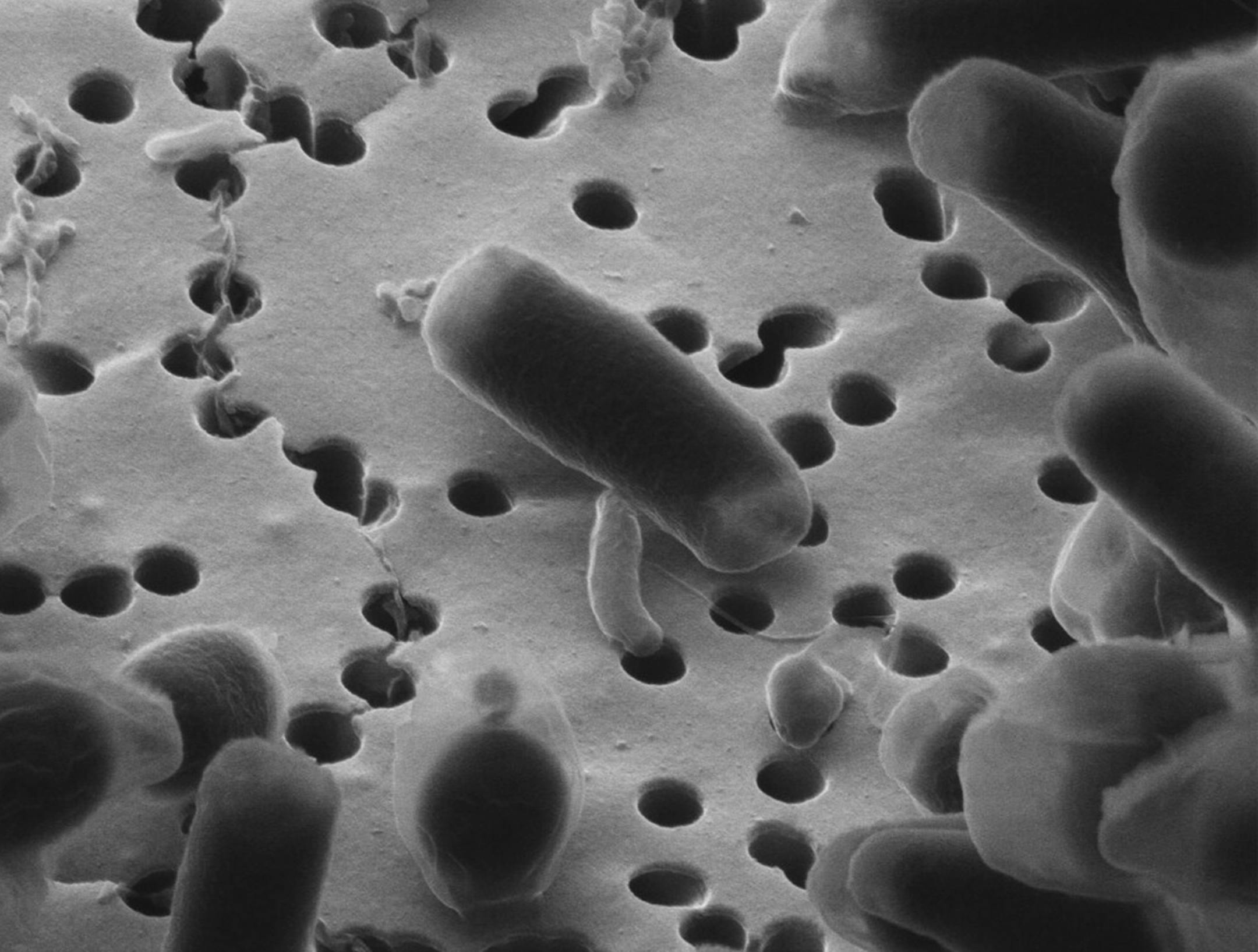
Henry N. Williams' favorite movie-action sequence unfolds on a strip of glass just a few millimeters across.
It's a cinematic showdown between two bacterial cells: Vibrio coralliilyticus, a large, rod-shaped marine microbe, and a petite pursuant, Halobacteriovorax, that has latched onto the bigger bacterium. The Vibrio, desperate to jettison its assailant, wriggles and whirls in futility before finally coming to a "screeching halt," as Williams described it.
Then the Halobacteriovorax starts its dirty work: It punctures the Vibrio's exterior and begins to bore inside, where it will gorge on its host, clone itself many times over and burst free to find its next meal. "Lions, sharks, tigers — these are all predators that have gotten our attention," said Williams, a microbiologist at Florida A&M University. "But there also exists a much smaller predator that is just as ferocious."
Predatory bacteria, a group of other microbial assassins, carry immense promise in an extraordinarily small package. Deployed under the right circumstances, they could help beat back harmful microbes in the environment, or purge pathogens from the food supply. Some experts think they could someday serve as a living therapeutic that could help clear drug-resistant germs from patients in whom all other treatments have failed.
But even the small community of researchers who study predatory bacteria have not figured out how these cells select and slaughter their hosts. Teasing out those answers could reveal ways to tackle stubborn infections, and provide a window onto predator-prey dynamics at their most microscopic.
To potentially use this group of microbes as "a living antibiotic, we need to know how it grows," said Terrens Saaki, a microbiologist at the de Duve Institute in Belgium. "We can't use it if we don't understand it."
Predatory bacteria were discovered by accident. Scientists stumbled upon them more than a half-century ago while hunting for another type of murderous microbe called a bacteriophage, or phage, a virus that can infect and kill bacteria. Before then, Williams said, "it was not known that a bacterium would prey on other bacteria in this fashion."
That predatory bacteria eluded detection for so long is somewhat surprising. Dozens of species teem in the seas and in clods of dirt. They are thought to be hardy enough to weather animal guts and seem to persist everywhere from raw sewage to the gills of crabs. "My students have isolated them from soil, from snails in freshwater streams, from the drain in a custodial closet down the hall from our lab," said Laura Williams, who studies predatory bacteria at Providence College in Rhode Island (and is not related to Henry Williams). "Anywhere there are bacteria, there are probably predatory bacteria trying to eat them."


