
Advertisement

High court to rule on health care, immigration

The Supreme Court is set to make big news this week, and for the Obama administration, rulings can't come soon enough.

The Washington Post
June 25, 2012 at 4:36AM
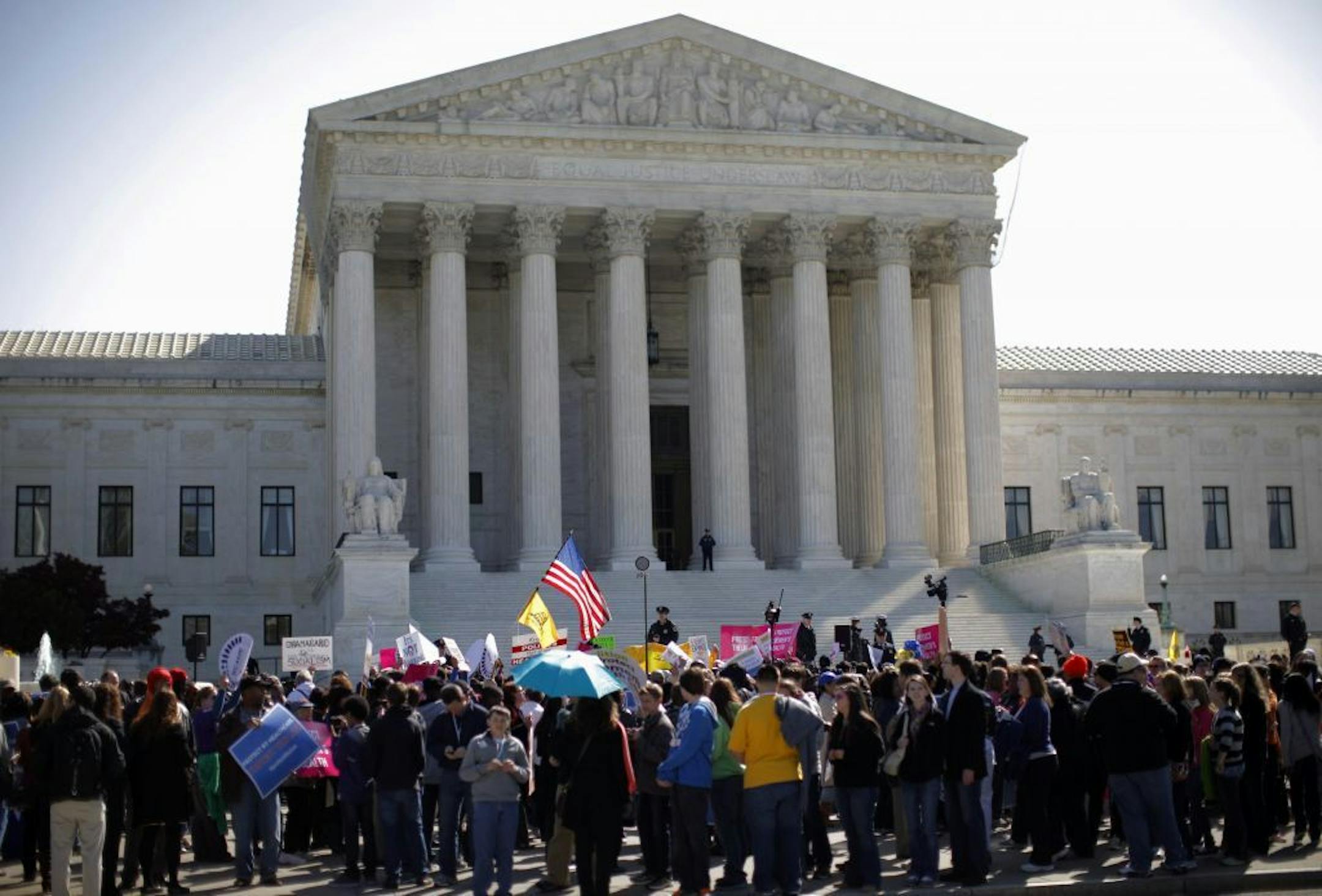
Supporters and opponents of health care reform rally in front of the Supreme Court in Washington, Tuesday, March 27, 2012,
Supporters and opponents of health care reform rally in front of the Supreme Court in Washington, Tuesday, March 27, 2012. (Associated Press/The Minnesota Star Tribune)
Advertisement

WASHINGTON - The Supreme Court this week will conclude its term by handing down much-anticipated rulings on health care and immigration, President Obama's remaining priorities before the justices. It is a finale that cannot come quickly enough for the administration, which has had a long year at the high court.

In a string of cases -- from the federal government's relationships with Indian tribes to enforcement of the Clean Water Act -- the court rejected the administration's legal arguments with lopsided votes.

The administration's win-loss record will sting a lot less, of course, if the court upholds the constitutionality of Obama's signature domestic achievement, the Affordable Care Act. That decision on health care, which will define the term, could come as early as Monday and almost certainly will be announced by Thursday.

The court also will decide the fate of Arizona's tough law on illegal immigrants, which the Obama administration challenged in court before it could take effect. The government's argument that the law conflicts with federal authority to decide immigration policy got a sour reception from the justices, but the government hopes for at least a split decision on other aspects of the measure.

The administration's ungainly portfolio at the Supreme Court this term has drawn attention from all points on the ideological spectrum.

Ilya Shapiro, a constitutional scholar at the libertarian Cato Institute, said the government is to blame for "outlandish claims of federal power" that the court was correct to reject.

High-profile losses

Adam Winkler, a liberal law professor at UCLA, recently wrote that the court headed by Chief Justice John Roberts has been "unusually hostile to the Obama administration." His conclusion: "This is the year of the Supreme Court's Obama smack-down."

Advertisement

It might also have something to do with the luck of the draw. It is the job of Solicitor General Donald Verrilli to defend the actions of Congress and the executive branch. In some of the government's high-profile losses, the administration was defending decisions made long before Obama took office.

But whatever the reasons, the losses so far cannot be blamed on the conflict between an increasingly conservative court and a progressive administration. For instance, the authors of the Indian cases that went against the government last week were Justices Sonia Sotomayor and Elena Kagan, Obama's choices for the court.

At least so far, 5-to-4 decisions that have divided the court along ideological lines have split fairly evenly between wins for liberals and for conservatives. And there have been a string of high-profile losses in which the government has failed to win the vote of a single justice -- liberal or conservative.

The court was unanimous in rejecting the government's arguments that federal discrimination laws protect employees of religious organizations who perform some duties central to the group's faith.

The justices in Hosanna-Tabor Evangelical Lutheran Church and School vs. EEOC for the first time recognized a "ministerial exception" to workplace discrimination laws. They dismissed the government's view that the fired employee's claim should be viewed as if she worked for a labor union or social club protected by the First Amendment's guarantee of free association.

A footnote or a harbinger

Advertisement

"We cannot accept the remarkable view that the Religion Clauses have nothing to say about a religious organization's freedom to select its own ministers," Roberts wrote.

In United States vs. Jones, the government argued that it did not need a warrant to attach a Global Positioning System device to a suspected drug dealer's car and monitor his movements for a month. The court again disagreed unanimously, although the justices split on other issues in the case.

And in Sackett vs. EPA, the court rejected the argument that property owners accused of violating the Clean Water Act do not have the right to quickly challenge those allegations in court.

It is a case in which the administration was defending a decades-old EPA enforcement technique upheld by lower courts. It was not indicative of any activism by the Obama environmental regime; Mike and Chantell Sackett's plan to build an Idaho lake house was stopped when George W. Bush was president.

This week's decisions in the Arizona immigration case and on the health care law will determine whether such cases are remembered as footnotes or harbingers.

about the writer

about the writer

ROBERT BARNES

Advertisement