

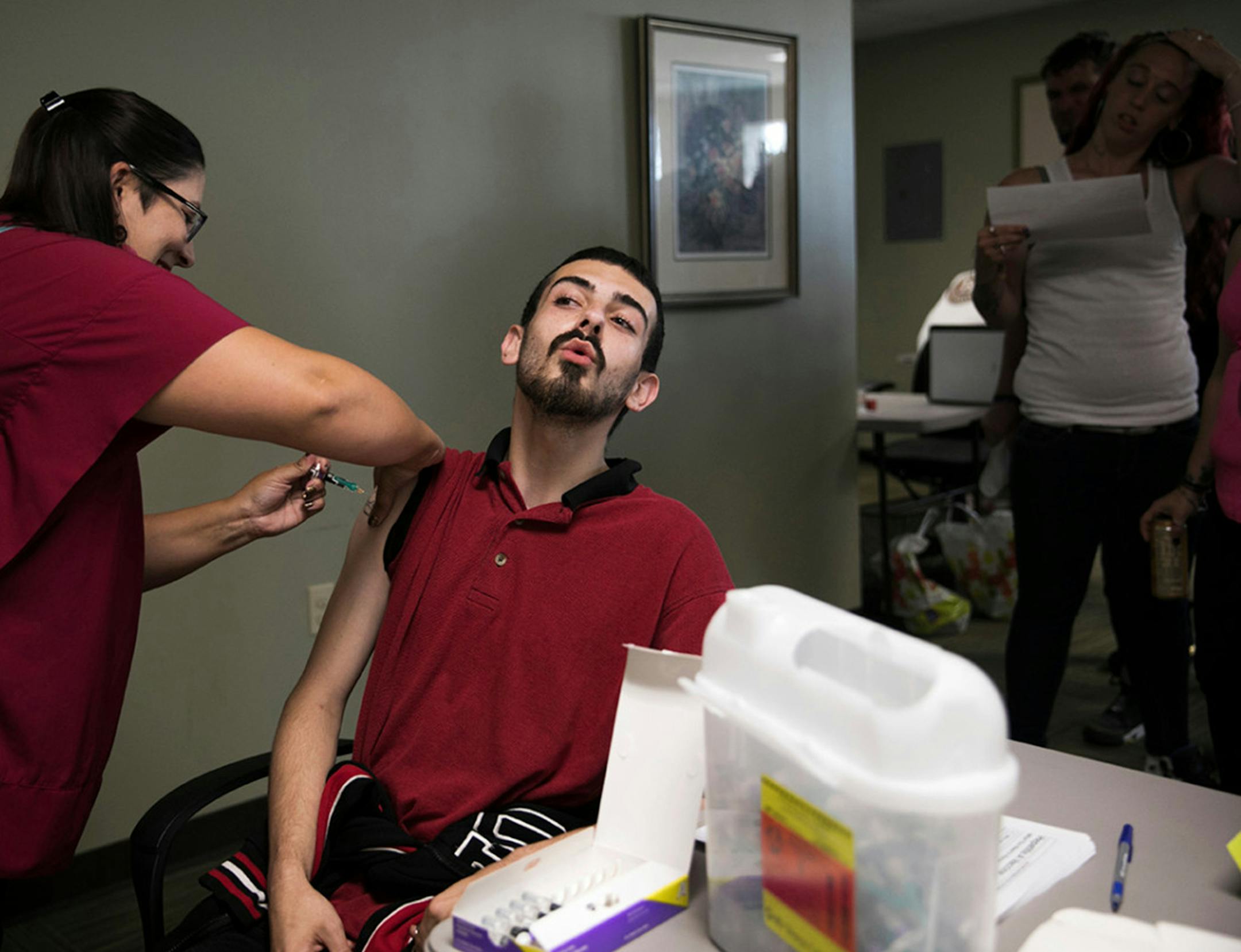
AKRON, Ohio – Just before July 4th, Trenton Burrell began feeling run-down and achy. Soon he could barely muster the energy to walk. A friend shared an alarming observation: "You're turning yellow."
Within days, the 40-year-old landed in the hospital, diagnosed with the highly contagious liver virus hepatitis A, which since 2016, has spawned outbreaks in at least 29 states. It has sickened more than 23,600 people, sent the majority to the hospital and killed more than 230. All but California's and Utah's outbreaks are ongoing, and experts expect to see the virus seep into every state.
Like a shadow, it follows the opioid epidemic, spreading mostly among drug users and the homeless. But anyone who hasn't been vaccinated can get hepatitis A.
"It's getting into the general public," said Tracy Rodriguez, communicable disease supervisor for Summit County Public Health. "It's scary."
Hepatitis A thrives in unsanitary conditions and spreads as easily as a stomach virus: People ingest minuscule amounts of an infected person's stool from food, drinks, drug equipment or objects as commonplace as doorknobs. Burrell believes he contracted the virus cleaning up trash left by fellow drug users and not wearing gloves.
The virus has stricken more people in Ohio than any other state but Kentucky, where it infected more than 4,800 people and killed at least 60. Kathleen Winter, a University of Kentucky epidemiologist, said more populous Ohio is on pace to surpass it as her state's outbreak wanes.
Relentlessly, the virus continues its march across the nation. Pennsylvania declared an outbreak as recently as May. In early August, Florida and Philadelphia declared public health emergencies, which, among other things, signal to health care providers the need to vaccinate the vulnerable. Case counts now exceed 1,000 in six states.
And as in Akron, the virus reaches beyond homeless people and drug users. One in 5 Kentuckians sickened from August 2017 through mid-2019 fit neither group. Nearly 40% of Florida's cases from 2018 and the first half of 2019 had no or unknown risk factors.


