

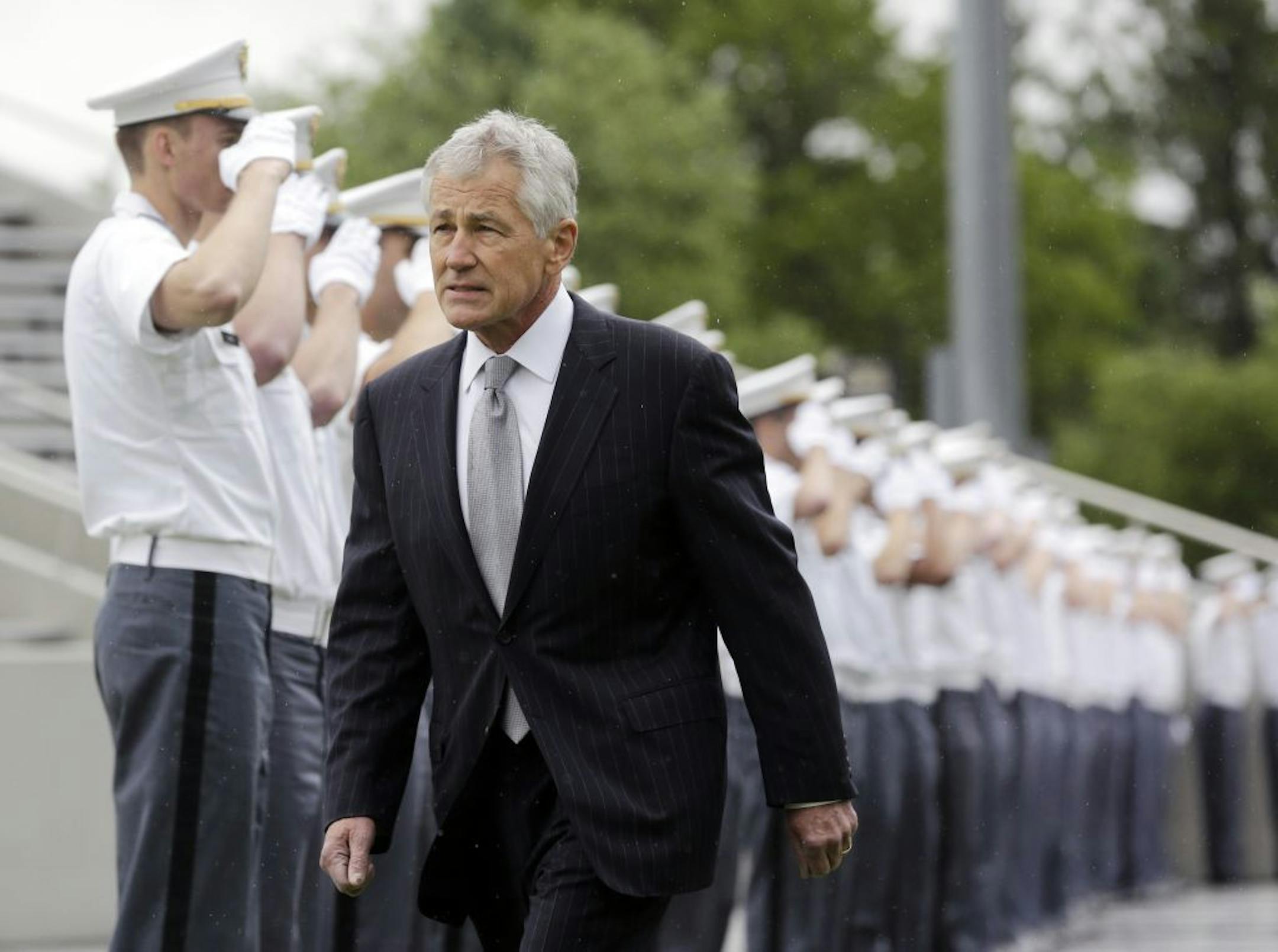
WEST POINT, N.Y. - Defense Secretary Chuck Hagel told cadets at the U.S. Military Academy at West Point on Saturday that they must stamp out the scourge of sexual assault in the military.
A day after President Barack Obama delivered a similar edict to U.S. Naval Academy graduates, Hagel's message comes amid a series of widespread incidents of sexual misconduct across the armed services in recent months and a new report showing that the problem is growing. The challenge is particularly poignant for West Point, since an Army sergeant was charged earlier in the week with secretly photographing and videotaping at least a dozen women at the upper New York state academy, including in a bathroom.
"Sexual harassment and sexual assault in the military are a profound betrayal — a profound betrayal — of sacred oaths and sacred trusts," Hagel told 1,007 graduating cadets during a cold, rainy outdoor ceremony. "This scourge must be stamped out. We are all accountable and responsible for ensuring that this happens. We cannot fail the Army or America. We cannot fail each other and we cannot fail the men and women that we lead."
Hagel, who served in the Army in Vietnam, took the opportunity to reflect on his own time in uniform and the lessons that he said must resonate as the soldiers take on the job of helping to transform the military. It was his first graduation address as defense chief.
The new second lieutenants, he said, must be the generation of leaders who will stop the debilitating and insidious threats of suicide, sexual assault and drug and alcohol abuse that are hurting the all-volunteer force.
Wounded twice during his roughly one year at war, Hagel has two Purple Hearts and is the first man to become secretary of defense after serving only in the enlisted corps. Reflecting on his military service, Hagel said his time in the Army shaped him forever.
"In Vietnam, I learned that combat is a furnace that can consume you, or it can forge you into something better and stronger than you were before," said Hagel, who took over the job as Pentagon chief at the end of February.
He also told the graduates that they must begin to build the future Army as the service recovers from the strains of more than a decade of war in Iraq and Afghanistan. Future conflicts, he said, will take on new and unfamiliar forms, and the military must be ready to face them even as budget cuts force the service to curtail training and trim the number of soldiers from a wartime high of about 570,000 to 490,000.


