

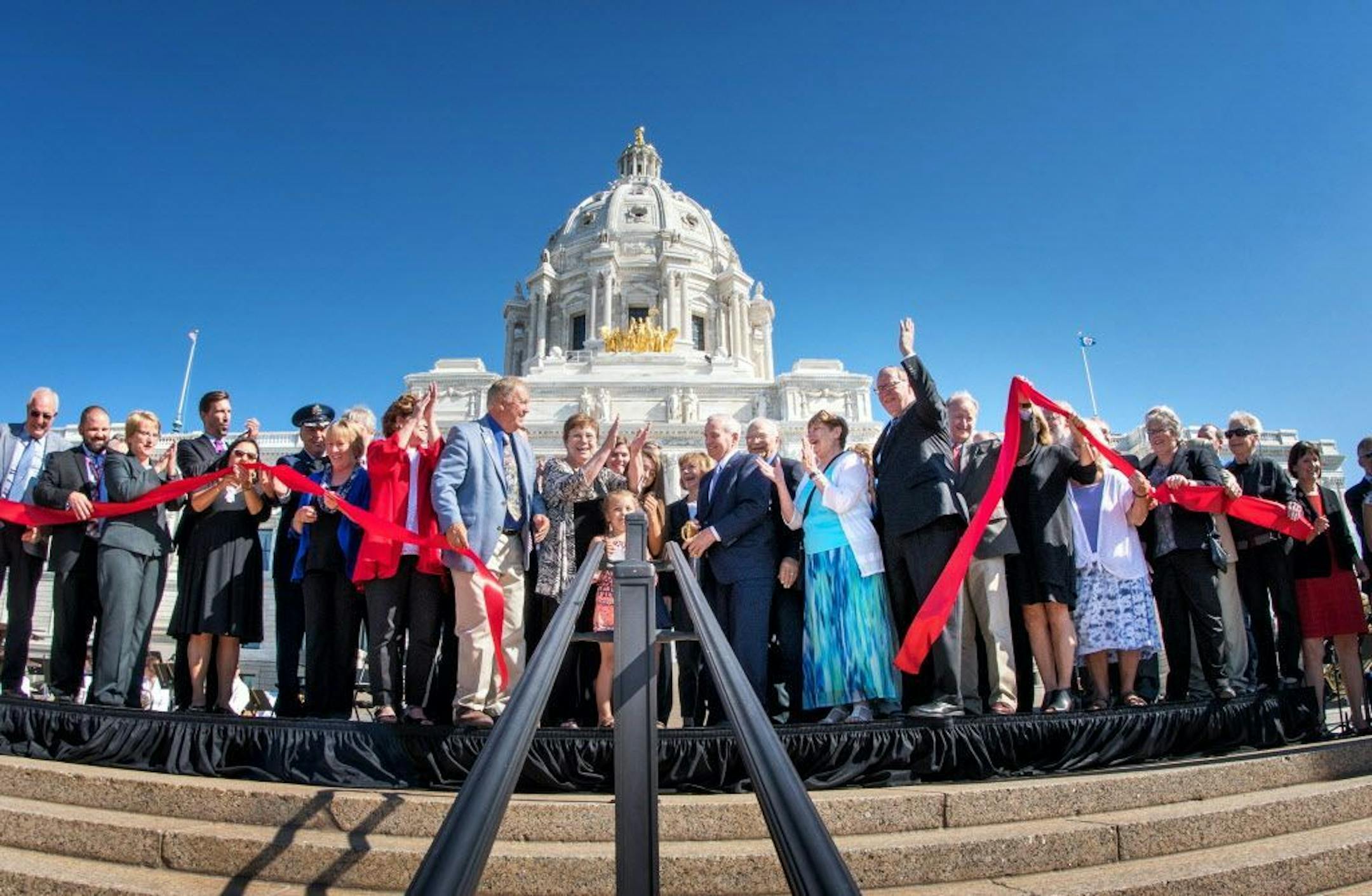
Before the governor had even cut the red ribbon with a giant pair of scissors, visitors were streaming into the Minnesota Capitol on Friday, ready to take part in a celebration more than 112 years in the making.
The three-day Minnesota Capitol Grand Opening, which continues through Sunday, marks the end of a nearly four-year, $310 million restoration project. But because the state never held an official grand opening when the Capitol made its debut in 1905, it also amounts to an unusual opportunity to celebrate Minnesota's past, present and future.
Speaking at the ribbon-cutting ceremony Friday morning, Gov. Mark Dayton applauded state lawmakers for working together "without rancor, without partisanship" to see the project through — and expressed hope that Minnesotans would continue to see the Capitol building as their own in the years to come.
"The most beautiful Capitol in the United States, the one that most closely approximates the U.S. Capitol, stands on this hill and says again, to the people of Minnesota: 'This is your government. This belongs to you,' " he said.
An estimated 50,000 to 60,000 people were expected to make the trek to St. Paul over the weekend to take part in festivities ranging from behind-the-scenes tours to live music and dance performances, historical discussions and fireworks.
On Friday, tour groups that swelled to 30 to 40 people took off every 30 minutes, with many visitors eager to get a look at parts of the Capitol that had been off-limits for years — or rarely opened to the public at all. The halls of the Capitol, largely quiet since the legislative session ended in May, echoed as both children and adults packed into the House, Senate and Supreme Court chambers and other corners of the building.
Some, like Tom and Rene Steger of Zumbrota, had visited the Capitol before, but said the renovations had transformed the place. Among the most visible updates were restorations to the paintings and artwork around the building, an expanded German-style cafeteria called the Rathskeller and a new elevator and stairway to help with emergency access. Workers also overhauled the Capitol's aging heating and cooling systems, making the building more energy efficient.
"It's amazing to think about all the work that went into this," Tom Steger said.
![Visitors to the Capitol were invited to put their faces into the forms of Supreme Court justices outside the newly renovated State Supreme Court Chamber. ] GLEN STUBBE • glen.stubbe@startribune.com Friday August 11, 2017 The Minnesota State Capitol is officially open. The grand opening ceremony started Friday and goes all weekend.](https://arc.stimg.co/startribunemedia/OH6BL2R7CTGW5NW4EBVMNAHM6Y.jpg?&w=1080)


