1:12
1:12It's a Monday night at the 331 Club in northeast Minneapolis, and about eight musicians toggle in and out of a horseshoe of chairs. They take turns strumming the bluegrass sounds of the Roe Family Singers. One of the few players who never subs out is Adam Wirtzfeld.
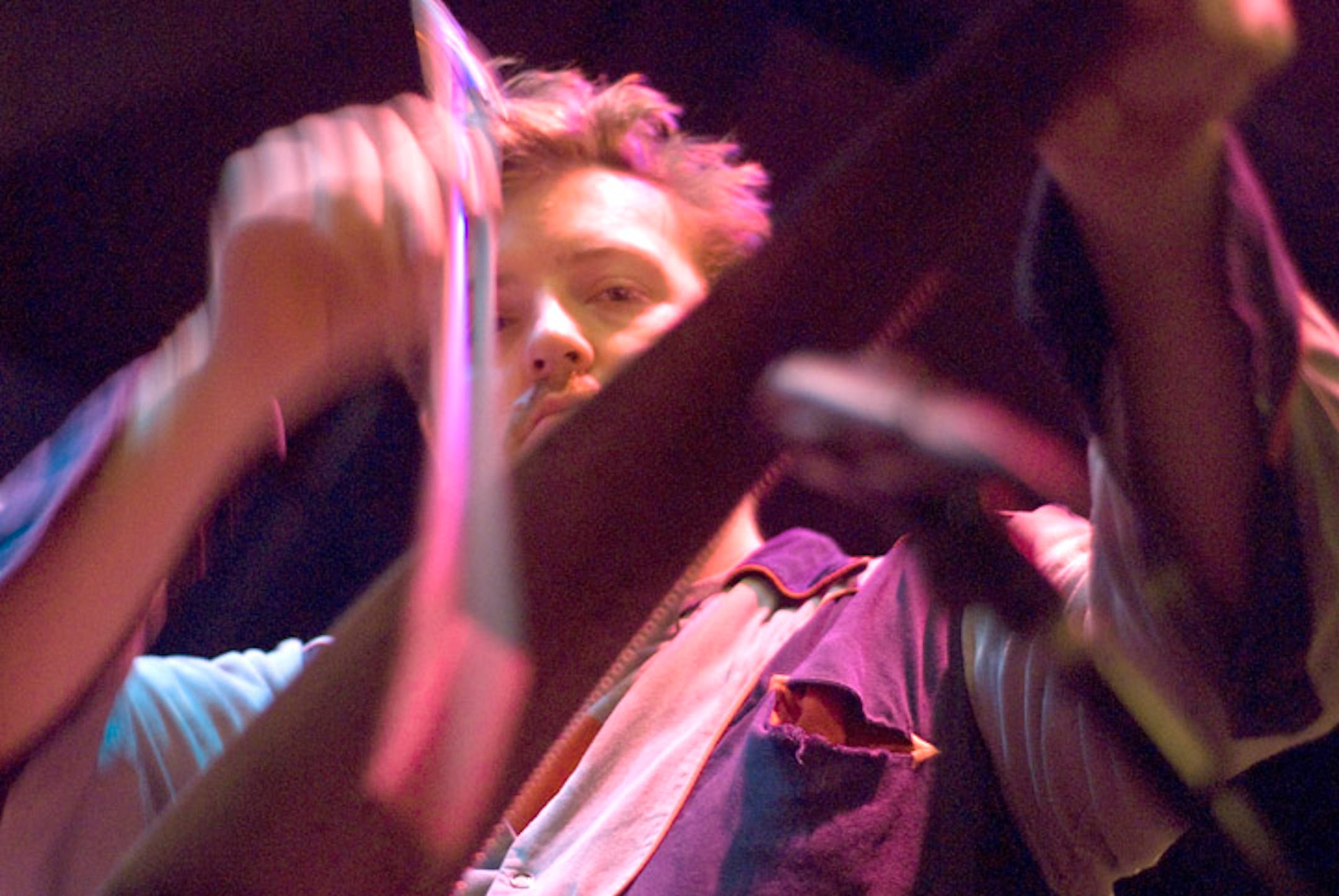
He's at one end of the arc, closest to the crowd, finessing a bow across his bent and vibrating musical saw. With the saw handle pinched between his legs and his left thumb pressing hard on the tip, Wirtzfeld draws the bow across to produce a sound that wobbles, whirs like an engine, soars like an operatic aria.
Wirtzfeld, like other area saw players, is self-taught and often the only saw player in the room. But this weekend the humble tool takes center stage as Wirtzfeld travels to Richmond, Minn., to teach a musical saw workshop at the Minnesota Bluegrass & Old-Time Music Festival, while fellow Minneapolis player Steve Cook travels to Felton, Calif., to compete at the International Musical Saw Association's annual festival.
"It was many years until I actually saw another saw player live," said Wirtzfeld, 32, who wanted to play stringed instruments as child, got stuck with piano and trumpet, and finally began bowing the saw after hearing it played in the popular recordings of Neutral Milk Hotel.
The instrument, which is used in bluegrass, old time, jazz and pop recordings, spans about one octave. But that doesn't stop the bow -- typically a sturdy cello bow -- from coaxing out a variety of voices. The musical saw can emit eerie screeches or soothing hums.
Some musicians learn to play from family members, but others learn alone before they snuggle their sound into songs appropriate for the saw's quirks. Then they wait for listener reactions and questions, which come without fail after almost every show.
"It's arresting," says Andy McCormick, 39, who plays weekly at the Bedlam Theatre with Dreamland Faces. "It's pure novelty and I love it."
McCormick's saw style is one of playful, dynamic and bizarre sound effects; some accompany silent film showings at the Bedlam Theatre and others accent the Dreamland Faces' aesthetic of accordions, tubas, mandolins and vocals projected through small megaphones. McCormick starts and stops and zips high, piercing notes more often than players like Wirtzfeld and Cook, who usually sustain melodies or counter melodies.