

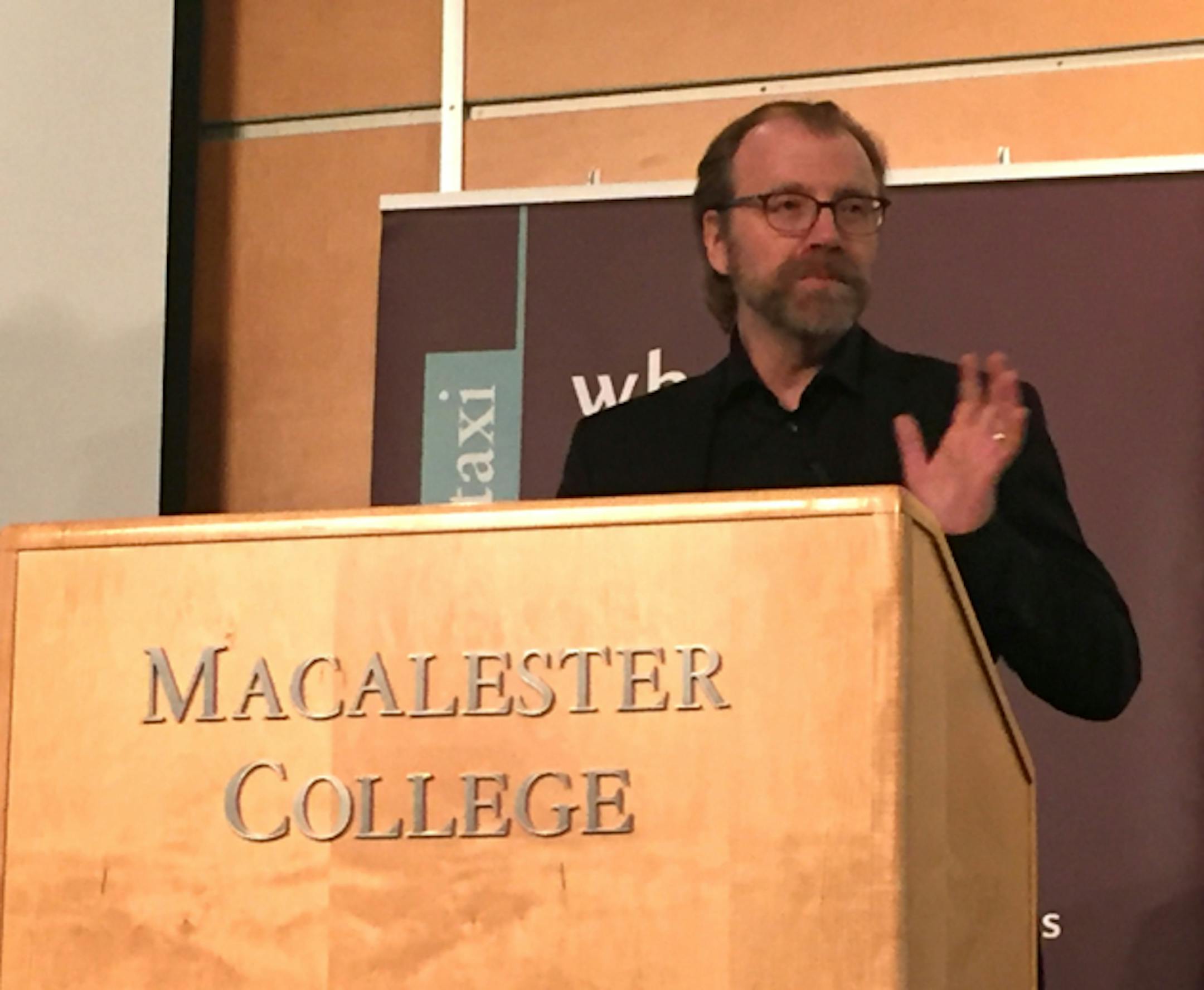
A few years ago, George Saunders had a dream in which he got up from his bed and looked out the back window. There in his yard he saw a line of women, dressed in white, dangling – happily—from a thin cord threaded through their heads.
This image became the core for Saunders' short story, "The Semplica Girl Diaries," published in the New Yorker and collected in his prize-winning book, "Tenth of December." He read this story (or part of it; it's 60 pages long) last night at Macalester College, and gosh it was funny—so much funnier than reading it on the page, where it is funny, but also dark and disturbing. Last night it was mostly just hilarious (Saunders is a good reader, and skilled at voices) though anyone familiar with the story just kept waiting for the darkness to hit.
Saunders was in town for the final event in a year-long string of fabulous events (AWP parties, visits from poet Eileen Myles, novelist Mark Z. Danielewski, the Twin Cities Book Festival, ) celebrating the 20th anniversary of Rain Taxi Review of Books.
Saunders was approachable, sensible, funny and profound—all things you might expect if you have read his stories and essays. He read from his newly re-released fable, "The Very Persistent Gappers of Frip," an all-ages story in the vein of James Thurber's "Thirteen Clocks" or Neil Gaiman's "Coraline."
(When "Gappers" was first released in 2000, Saunders said, "We decided to sell it to adults and to kids—because that's more! But bookstores said, you can't do that." But now that Saunders is better known, he probably can.)
Though it is a short book, he didn't read the whole thing but ended on a pivotal moment, telling the audience members if they want to know what happens next, the book is for sale in the back of the room. ("Hey, I'm here to move some books!" he said.)
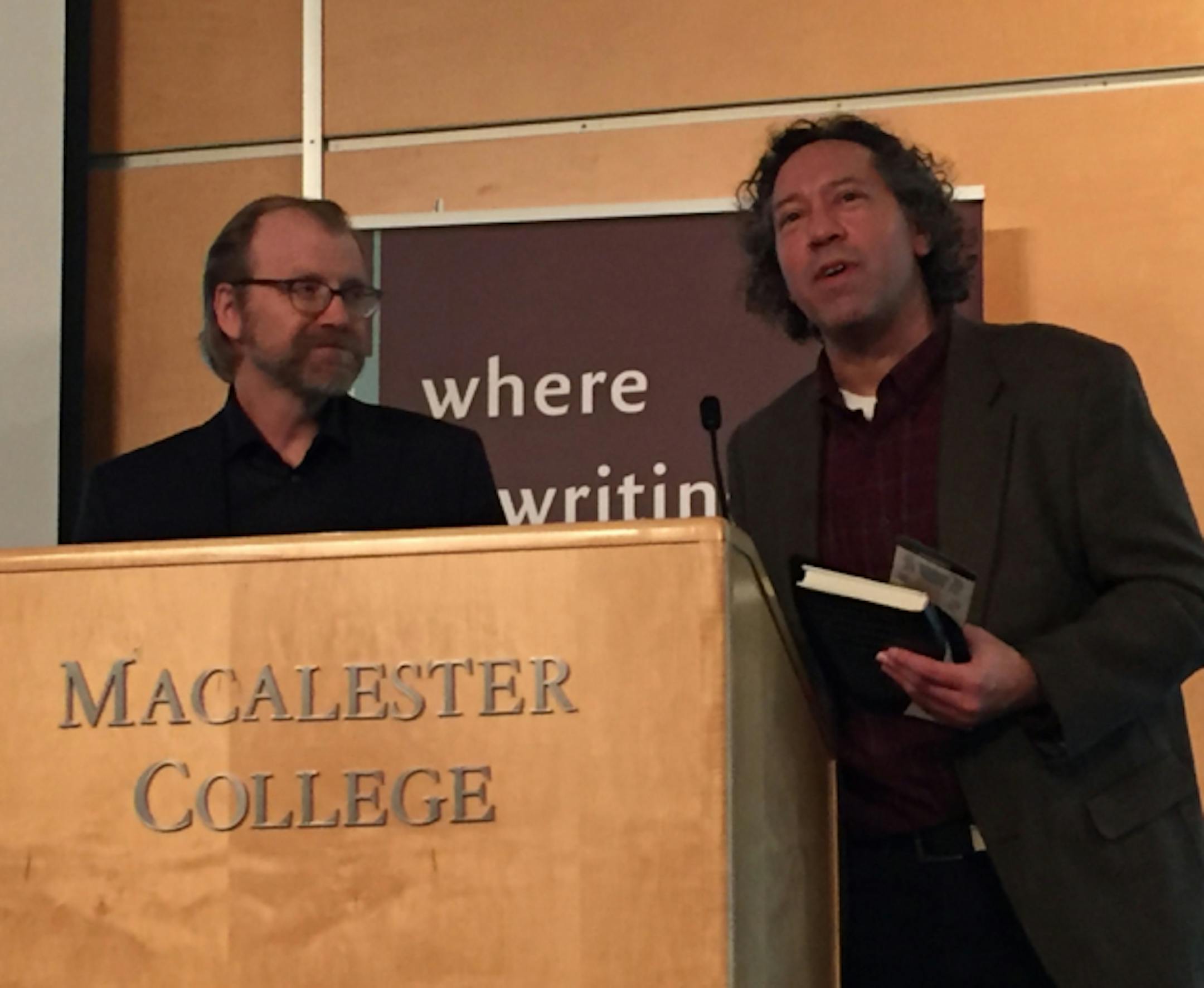
During the all-too-brief question and answer time, Saunders talked about the importance for writers of finding and trusting their own voice, their own message. Getting started as a serious writer was hard. "Not only did the world not care if I wrote, it kind of preferred that I didn't," he said.
He went through a series of "literary crushes" when he was young, beginning with Ernest Hemingway. For awhile, he wanted to write like Hemingway, be Hemingway; he envisioned Mount Hemingway (with Ernest standing on the top, looking noble), himself scrabbling up the mountain side. Until he realized that even if he got to the top of Mount Hemingway, he'd still be smaller and lesser than the actual Hemingway. To successfully imitate another writer, "You have to leave your own truths behind," Saunders said. "So you climb back down and – oh, look! Mount Kerouac!"


