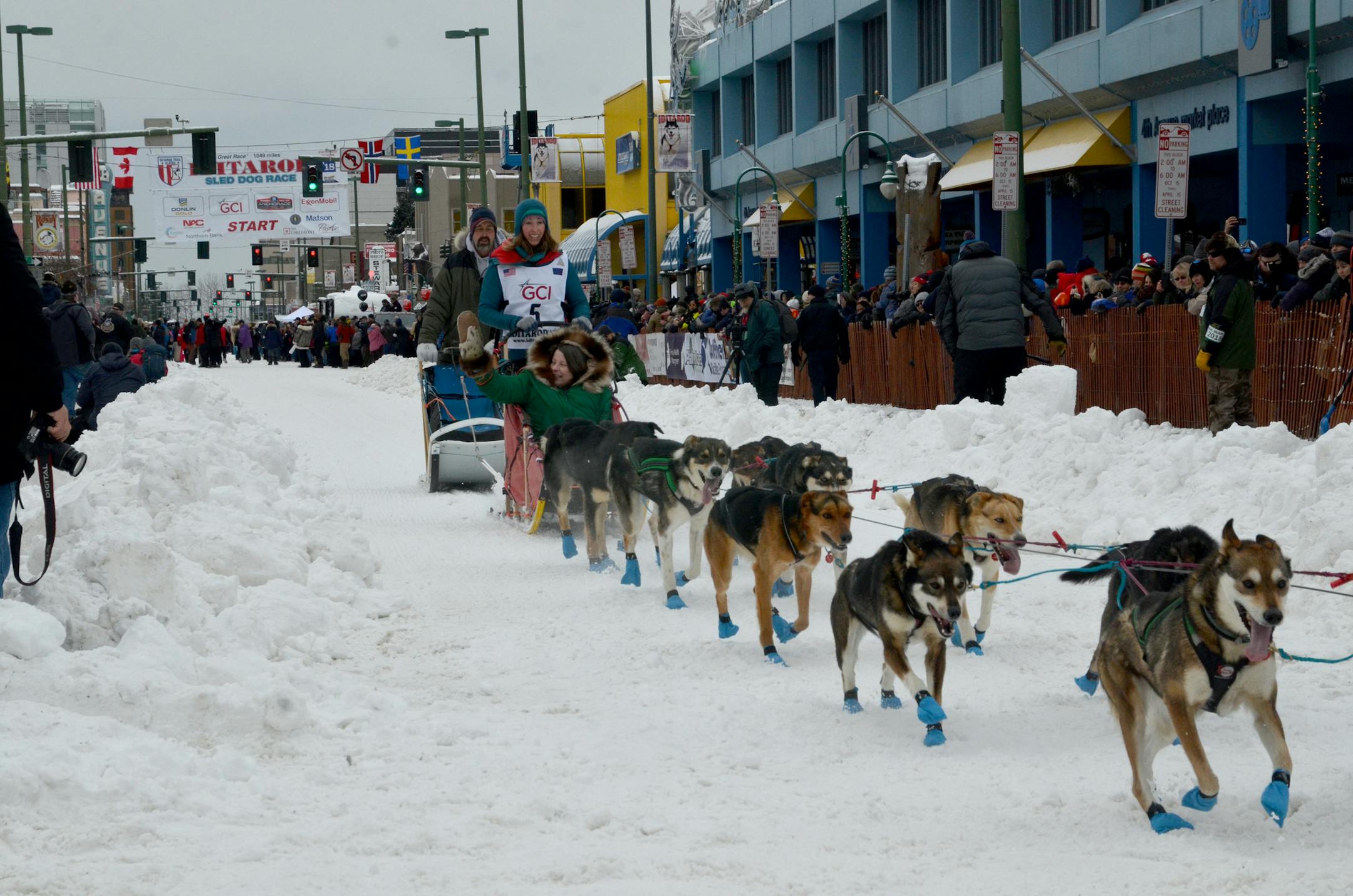
Musher Richie Diehl consoles his restless Alaskan huskies with a couple of pats and soothing words, assuring them that their turn to strut their stuff down Anchorage's 4th Avenue as part of the ceremonial start to the Iditarod sled dog race is coming soon. Dozens of other Alaskan and international mushers are doing likewise with their 16-dog teams, and a chorus of yelps, barks, whines and prolonged, wolflike howls has replaced the usual sound of traffic on the closed-off street.
These born-to-run dogs seem to be saying, "Let's go, let's go, let's go!"
Like many a cruise ship passenger, I've visited Alaska during the summer for fishing and hiking trips, enjoying pleasant temps that usually hover just below 70 degrees. But now I am wearing my snow boots and warmest winter coat, determined to embrace the stark beauty of winter like an Alaskan.
To do that, I've come to experience two mandatory events: the kickoff of the annual Iditarod, "the last great race," and Fur Rendezvous, a 10-day winter carnival that locals call "Fur Rondy" or just "Rondy." (It was slated for Feb. 22-March 3 this year and will take place Feb. 28-March 9 in 2020.)
Rondy began in 1935 as a sports tournament and coincided with the return of fur trappers who came to town to sell their harvest. The fur trade was a vital economic driver in those days, and a fur auction is still a key Rondy event.
The Iditarod always starts on the first Saturday of March, so while it's not part of Rondy, it feels like the grand finale because of the timing.
At last, the big moment comes for Diehl, a six-time Iditarod participant, and his dogs. Yelling "Hike" to get them moving seems unnecessary because there's nothing they would rather do than pull that sled.
The mushers take off in intervals from the corner of 4th Avenue and D Street, travel through several neighborhoods in which they are greeted by cheering fans enjoying the Anchorage equivalent of tailgate parties, and end 11 miles later at Campbell Airstrip.