
Mark Craig: From humble beginnings grew traditional powers

When the Steelers and Packers square off, they will play for the title in a league far removed from the days of Art Rooney and Curly Lambeau.

January 31, 2011 at 5:48AM
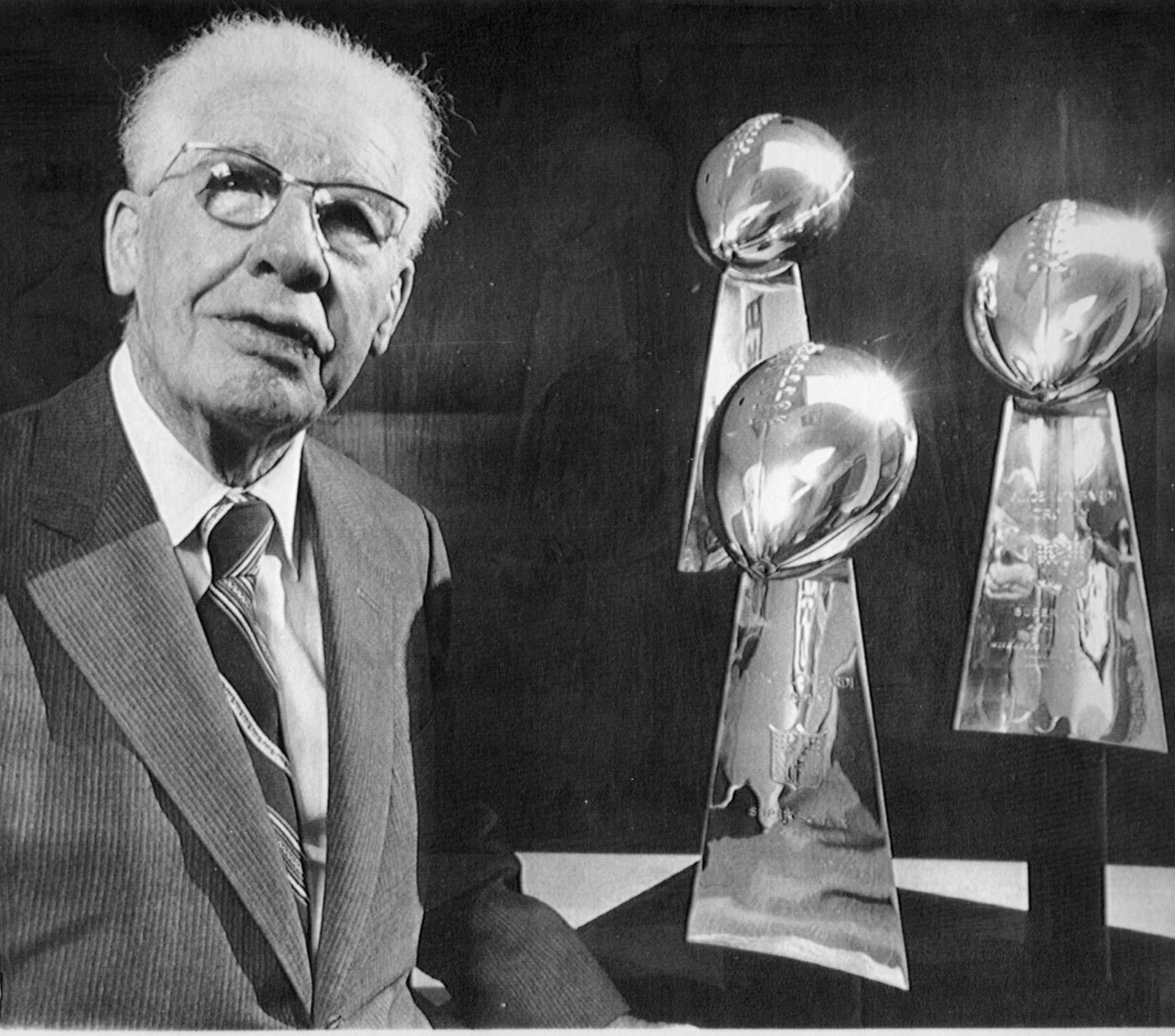
Pittsburgh Steelers pro football team founder Art Rooney Sr. posed in 1980 with three of the Steelers' four Super Bowl trophies. Associated Press file photo.
Steelers founder Art Rooney Sr. posed in 1980 with three of the Steelers' four (at the time) Super Bowl trophies. Pittsburgh now has six Super Bowl titles, after struggling prior to the AFL-NFL merger. (Ken Chia — Associated Press FILES/The Minnesota Star Tribune)

The first time Pittsburgh and Green Bay played each other was the first year the NFL legalized the forward pass from anywhere behind the line of scrimmage.

Hashmarks were new, too.

Ten teams existed, none of them west of Green Bay.

Multiple divisions were a new concept. And a season-ending championship game, which had happened by chance the year before when two teams tied in the final standings, was scheduled before the season for the first time.

The franchise fee to join the 13-year-old league was $2,500. Pittsburgh owner Art Rooney paid his way in with money he won on horse racing. But first, he had to get Pennsylvania to relax its blue laws prohibiting sporting events, including the NFL, from taking place on Sundays.

Rooney's team wouldn't be known as the Steelers for another seven years. Hoping to piggyback baseball's popularity, Rooney simply took the name of Pittsburgh's major league franchise, the Pirates.

"That was common among NFL teams at the time," said Joe Horrigan, Pro Football Hall of Fame vice president of communications/exhibits. "The Brooklyn Dodgers, Cleveland Indians, Cincinnati Reds, New York Yankees. NFL teams liked to have people think they were affiliated with the baseball teams, even though they weren't. And the baseball teams didn't seem to mind."

The NFL has come a long way since that pivotal 1933 season. On Sunday, a record crowd of more than 105,000 fans will pack Cowboys Stadium in Arlington, Texas, for Super Bowl XLV.

Millions more will watch on TV as the Steelers and Packers give us the first Super Bowl with two franchises that have been around longer than 75 years. The Packers own a league-high 12 NFL titles, while the Steelers lead the way in Super Bowl victories (six).

In 1919, Earl (Curly) Lambeau and George Calhoun organized the Packers at a cost of $500. Lambeau's employer, the Indian Packing Company, put up the money and the Packers went 10-1.

The Packers, however, aren't a charter member of the American Professional Football Association, which was formed in 1920 and changed its name to the National Football League two years later. They stayed independent until joining in 1921.

"The Packers weren't ready for prime time in 1920," Horrigan said. "They were basically a semi-pro team. Not all of their players were paid. And while the fee to join the league wasn't much, the expense of being in the league and having to travel was significant."

The Packers withdrew from the APFA briefly in January 1922 after admitting they broke league rules by using players with college eligibility remaining in 1921. Lambeau promised to obey league rules and then put up $50 of his own money to buy the franchise.

Lambeau went broke during the 1922 season. But the Green Bay community came to the rescue. Local merchants loaned Lambeau $2,500 and set up public ownership that's still in place.

In 1933, when the Steelers joined, the league was in a state of transition. For years, the NFL followed the rules of college football. But in 1933, it began developing its own rules, including one that replaced the college rule that prohibited forward passes from being thrown more than 5 yards behind the line of scrimmage.

"By 1933, the NFL was establishing itself as a major league," Horrigan said. "The small-town teams were gone, except for Green Bay. It was no longer the rag-tag operation that you saw in the 1920s."

The Steelers were 2-2 in their debut season when they made their first road trip to face the Packers in front of 4,000 fans at City Stadium on Oct. 15, 1933. The Packers won 47-0 and own an 18-14 edge in the series. Sunday will be their first meeting in a title game.

"These are two teams that were there during the NFL's maturing years, which are 1933 until post-World War II," Horrigan said. "It wasn't easy. The depression hit the teams in the industrial cities hard. Then it was right into World War II. The Steelers had to merge with the Eagles in 1943 and the Chicago Cardinals in 1944. Times were tough back then."

Words to remember as the nation's most popular sport heads toward a self-destructive work stoppage in less than two months.

Mark Craig • mcraig@startribune.com

about the writer

about the writer

Mark Craig

Sports reporter

Mark Craig has covered the NFL nearly every year since Brett Favre was a rookie back in 1991. A sports writer since 1987, he is covering his 30th NFL season out of 37 years with the Canton (Ohio) Repository (1987-99) and the Star Tribune (1999-present).

See Moreicon

More from Minnesota Star Tribune

See More
card image
J. SCOTT APPLEWHITE, ASSOCIATED PRESS/The Minnesota Star Tribune

The "winners" have all been Turkeys, no matter the honor's name.

In this photo taken Monday, March 6, 2017, in San Francisco, released confidential files by The University of California of a sexual misconduct case, like this one against UC Santa Cruz Latin Studies professor Hector Perla is shown. Perla was accused of raping a student during a wine-tasting outing in June 2015. Some of the files are so heavily redacted that on many pages no words are visible. Perla is one of 113 UC employees found to have violated the system's sexual misconduct policies in rece