

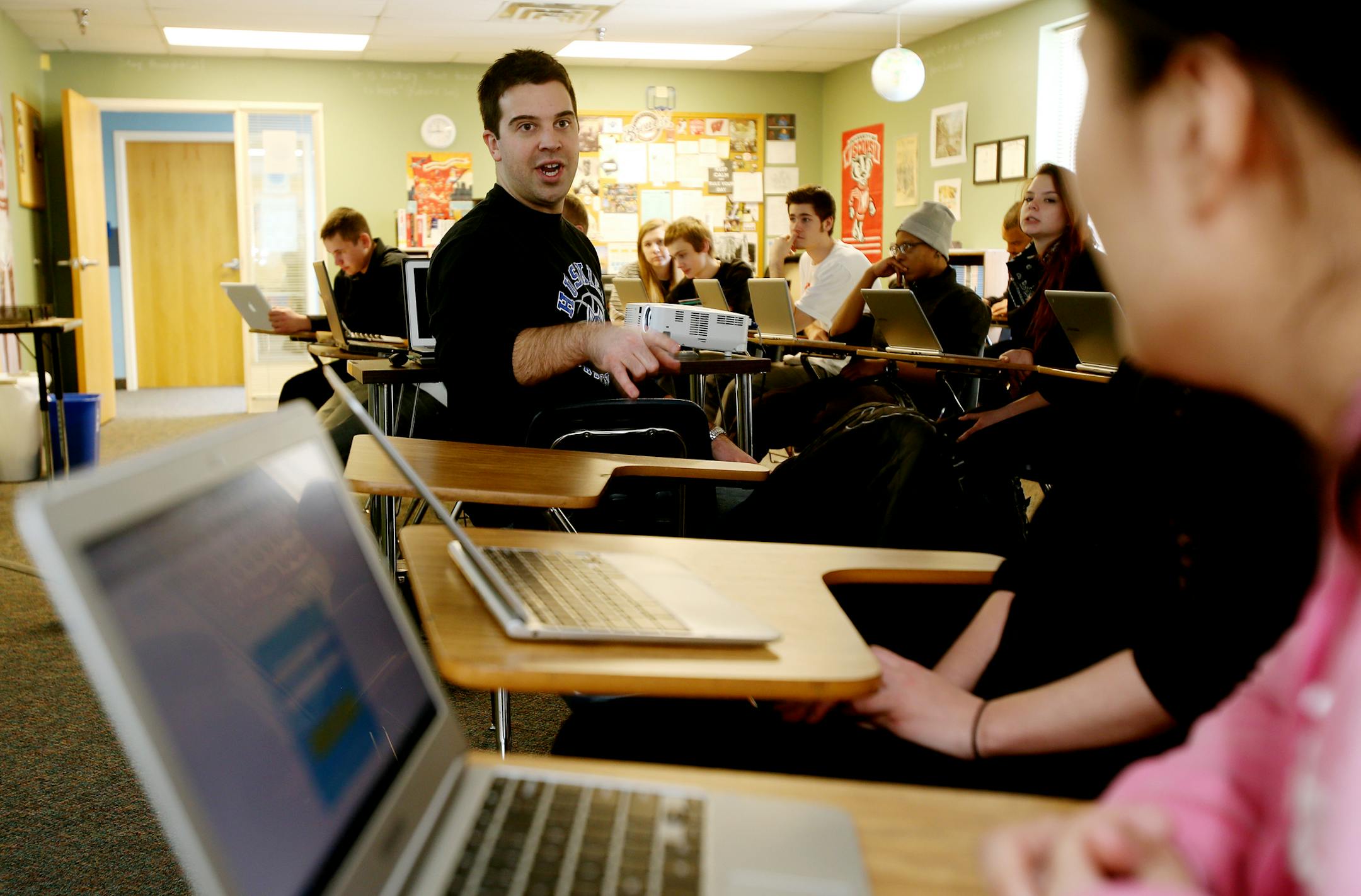
In Eric Nelson's ninth-grade geopolitics class, learning is more about strategizing than memorizing the names of foreign leaders.
"Global competence is a 21st-century skill, and schools aren't doing it enough," said Nelson, a social studies teacher at North Lakes Academy in Forest Lake, where the classroom has suddenly become grounds for healthy competition.
To sharpen his students' analytical skills and combat their "zombified" expressions and inattentiveness, Nelson last fall introduced a fantasy football-style game in which students select or draft countries, rather than NFL players, and rack up points based on the number of times their country is mentioned in media outlets such as the New York Times.
Students compete head-to-head with their classmates, with the student compiling the most points being crowned the winner at the end of each season, which can stretch for two weeks. But getting to the top requires some study. Here, a basic knowledge of current affairs comes in handy — for example, stories mentioning Russia have spiked in recent weeks with the opening of the Winter Olympics in Sochi.
Nelson hit on the idea of Fantasy Geopolitics back in 2009 after discovering, like many teachers, that it was difficult to keep his students engaged in the material covered in class.
The idea came to him after he had played several seasons of fantasy football in a league with friends.
"When I started playing fantasy football with my buddies, I thought it was a weird idea at first. But when I really dove in I found out that I was learning a ton about the NFL," the 27-year-old said.
Innovation gap
Nelson says that educators are increasingly using "gamification" — the strategy of using game mechanics in nongame situations — as a way of influencing student behavior and fostering creativity.
![North Lakes Academy teacher Eric Nelson (right) spoke to his students about the Winter Olympics facts. Forest Lake, MN on February 11, 2014. ] JOELKOYAMA•jkoyama@startribune](https://arc.stimg.co/startribunemedia/TU2JTOE5UA5535Z5JJGIURTCNY.jpg?&w=1080)
![North Lakes Academy teacher Eric Nelson (right) spoke to his students about the Winter Olympics as they were watching a video on the history of the Olympics. Forest Lake, MN on February 11, 2014. ] JOELKOYAMA•jkoyama@startribune](https://arc.stimg.co/startribunemedia/32BE36EHOFSQAVDDODEDGA2L7I.jpg?&w=1080)


