

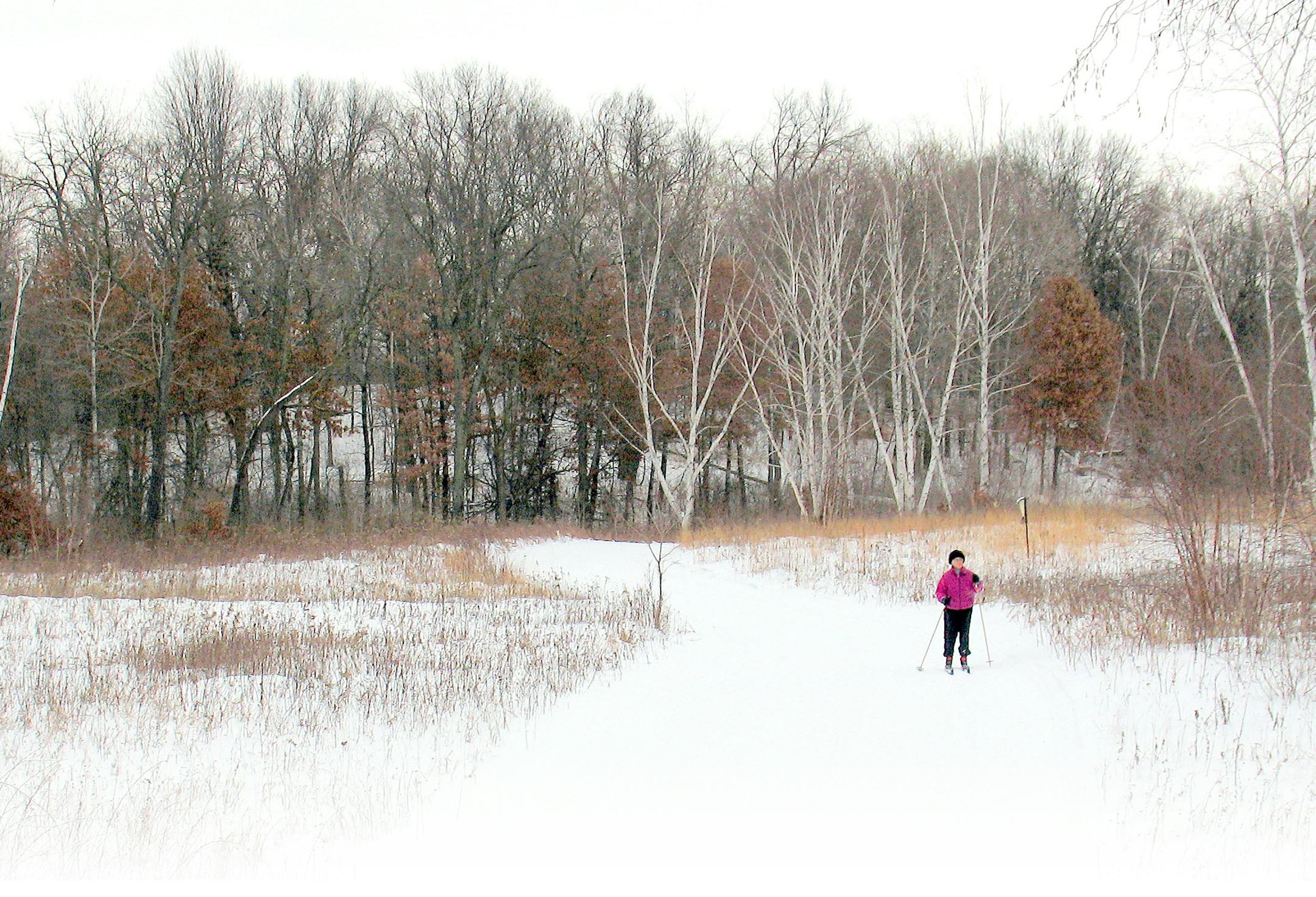
Some of us migrate south to winter roosts. Others cope by sinking into months of hibernation. Either strategy misses winter's gifts such as angel wings, diamond dust, a bright, red dot floating across an empty, pristine landscape and, overall, a profound silence.
• • •
It is a cold, windless January day as my wife, Ruth Ann, and I begin a midafternoon cross-country ski loop through William O'Brien State Park, just one of the 10 wonderful state parks in the St. Croix watershed. Bright sun is low in the sky, already casting long, blue shadows.
After 10 minutes or so along the trail, we are in the groove, and crossing a wide, frozen wetland. It is summer home to the sounds of countless insects and frogs. Today, the only sound is the smooth rhythmic swish … swish … swish of our skis, punctuated by the squeaky scrunching of our poles as they dig into cold, compacted snow. Kick and glide, kick and glide — it is a comfortable, reassuring cadence, similar to the rhythmic dip and swing of paddle strokes beside a gliding canoe.
At the next trail junction, we begin a long, gentle climb into the wooded, hilly outback of the park. Absent its summer cloak of greenery, the underlying structure of the land is exposed, revealing broad ridges and ravines, overhangs and outcrops, crags and crannies. All are tempered by the downy blanket of snow, creating soft, sensuous curves like those that artists admire in the human figure.
Though not always obvious, glaciers had a profound impact on the lay of the land. The last one to visit here arrived from the south. The south? Yes, a monster ice sheet covering much of western Minnesota stuck out a large, easterly tongue which then curled north, to this neighborhood, a thick lick of ice, a mere 10,000 years ago.
Ruth Ann and I pause often to consider the details around us. For example, the dollops of snow clinging to dark, outstretched tree limbs. A faint breath of air frees a puff that falls like powdered sugar, twinkling as it lazily drifts downward. Elsewhere, among the shadows on the forest floor, sunbathed patches of brilliant, virgin snow glitter — countless pinprick prisms, flashing little sparks of blue and silver, like diamond dust, magical.
Farther on we come on a well-populated stand of paper birch, trunks standing in ranks like sentinels protecting whatever lies in the dark woods beyond. White bark, flecked with black, blends so well with winter landscape that it looks almost as if it evolved to camouflage.
Scattered small groves of white pine are a reminder of the magnificent pre-European forests in our watershed. How ironic that this park's namesake, William O'Brien, was a pioneer lumber baron. We're thankful that in 1945 his daughter Alice donated a family landholding to establish this park.

