

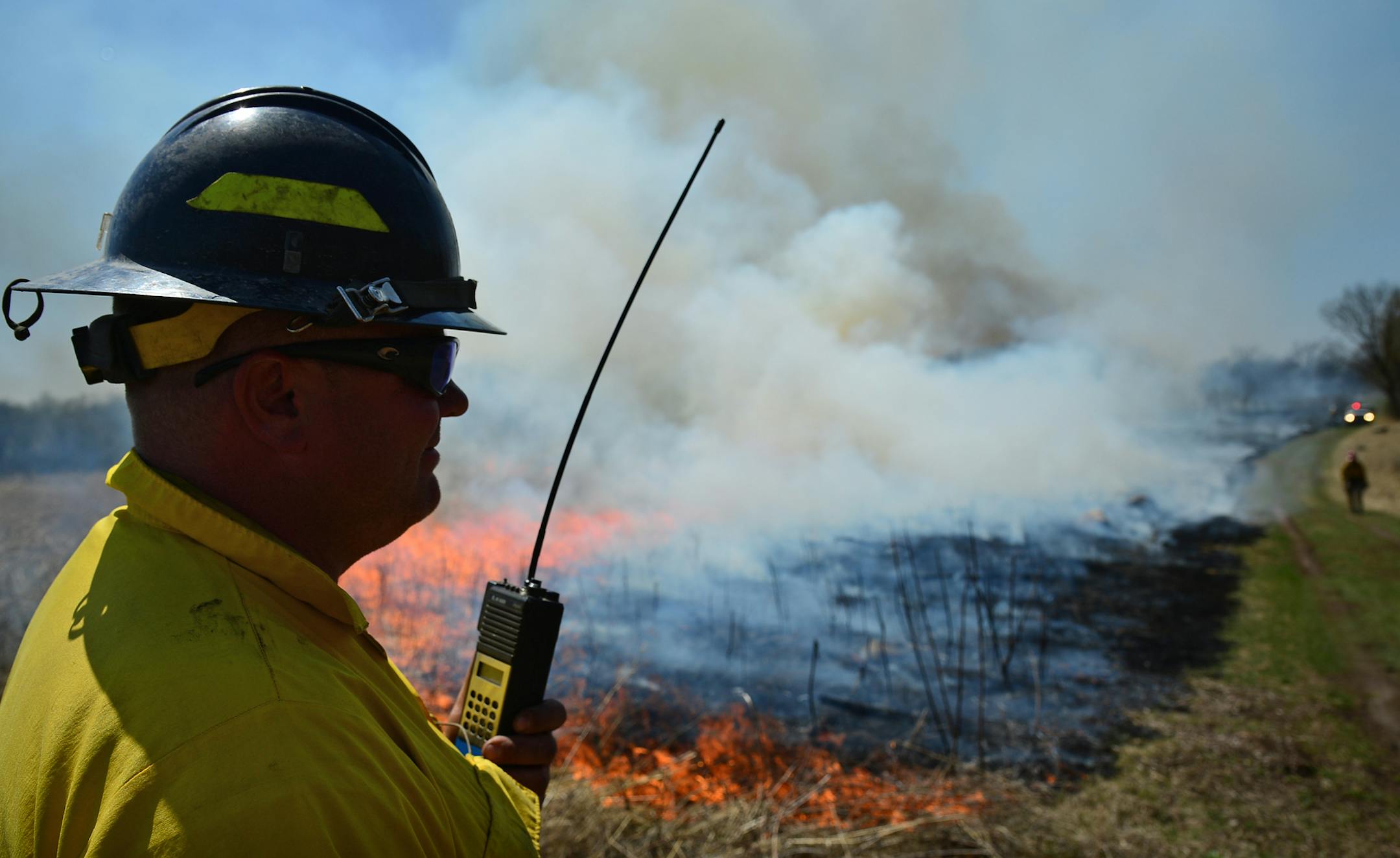
It's high noon in early May, and the gravel parking lot at the Louisville Swamp Unit of the Minnesota Valley National Wildlife Refuge between Chaska and Jordan is bustling with activity.
Instead of nature-seeking hikers, bird-watchers and photographers, 18 firefighters, most with the U.S. Fish and Wildlife Service (USFWS), are preparing their drip torches, chain saws, water hoses and other equipment for the work ahead. Several trucks and four-wheelers, some equipped with water tanks, are scattered in a semicircle. A mixture of gas and diesel fuel lingers in the air as a red-tailed hawk rides the thermals overhead. Most firefighters are either inhaling a quick lunch or enjoying some playful small talk. But their body language quickly turns serious when the "burn boss" begins the daily "burn briefing." It's time to work.
"OK, listen up," says Ryan Petersen, a range technician with the U.S. Fish and Wildlife Service, as he scribbles (in erasable black marker) the day's assignments on the so-called white board, which is actually one of the truck's white-colored passenger doors. "Act decisively, keep your wits and pay attention to what's going on out there."
In minutes, the fire crew, many of whom are friends, races off in their trucks and four-wheelers to conduct a prescribed (or controlled) burn on 250 acres of the scenic 2,600-acre unit, an outdoor oasis in one of the state's fastest-growing regions.
They're not alone. Each spring, federal and state wildlife officials intentionally set fires on public lands to improve grassland and forest habitat for numerous wildlife species — an old-as-dirt land management technique that has its roots in Native American culture. These prescribed fires are meticulously planned for months and conducted by seasoned professionals.
"Fire is often misunderstood by the public, because what they see on television — like a wildfire in California — isn't what we're doing here," says Lee Nelson, a retired fire management officer with the USFWS who occasionally assists his former co-workers on prescribed burns. "This is a controlled burn, and it's conducted only under predetermined weather conditions — when it's not too dry and not too windy, etc. We do have wildlife habitat management objectives, but safety is always our first and last consideration."
LONG RECORD OF BURNS
Before European settlement, Nelson says, wildfires, typically ignited by lightning, reinvigorated the nation's sprawling grasslands and brushlands. Fire also set back or killed troublesome woody plants, while deep-rooted prairie grasses went unharmed and flourished. The era's predominant grazing animals, bison and elk, were direct beneficiaries of fire. "I call it the The Grocery Store Effect," says Nelson. "Those old large grazers loved that new growth after a fire. To them, it was like eating ice cream."
![. ] The controlled burn at Minnesota Valley National Wildlife Refuge targeted about 200 acres of oak savannah and native prairie grass. Richard.Sennott@startribune.com Richard Sennott/Star Tribune Shakopee Minn. Thursday 5/05/2014) ** (cq)](https://arc.stimg.co/startribunemedia/V63N7N5HYV2FW3SEHIBPMLRNSQ.jpg?&w=1080)
![Aftermath of the prescribed burn ] The controlled burn at Minnesota Valley National Wildlife Refuge targeted about 200 acres of oak savannah and native prairie grass. Richard.Sennott@startribune.com Richard Sennott/Star Tribune Shakopee Minn. Thursday 5/05/2014) ** (cq)](https://arc.stimg.co/startribunemedia/T74JUBQDGBOAZMYVKELQF3X6QA.jpg?&w=1080)
![An ATV with a drip torch lit the interior fire of the prescribed burn. ] The controlled burn at Minnesota Valley National Wildlife Refuge targeted about 200 acres of oak savannah and native prairie grass. Richard.Sennott@startribune.com Richard Sennott/Star Tribune Shakopee Minn. Thursday 5/05/2014) ** (cq)](https://arc.stimg.co/startribunemedia/H5RJMV3WHOX63ELEXDC7CLW5UU.jpg?&w=1080)


