The buffalo isn't happy. She is eyeing me warily from the other side of a rickety wooden and wire fence. This iconic symbol of the Great Plains is shaggy but gorgeous, and as I raise my camera, her eyes lock with mine. Suddenly miffed by my intrusion, or maybe my red sweater, she takes a couple of steps backward, snorts mightily, then charges full speed ahead.
Luckily, there was a fence. The tango between the bison and me was at the High Plains Homestead close to Crawford, in the far northwest corner of Nebraska near its intersection with South Dakota and Wyoming. The Homestead, reached by threading a number of well-maintained dirt roads, is reminiscent of an Old West cowboy town, reconstructed with a sheriff's office and jail, a school, a saloon with swinging doors so authentic that you expect Yosemite Sam to come crashing through at any moment, and the critters, a menagerie of horses, chickens and buffalo, one in particular that doesn't care for my presence in the least.
My traveling companions and I — four friends in a rented van — stopped by the Homestead for its ribs — slow-cooked on an outdoor grill — but the place is also a bed-and-breakfast with rooms decorated to honor Nebraska's cowboys, cowgirls and caballeros.
I expected western Nebraska to be an inland ocean of flat, open prairies, endless grasslands and gently rising sand hills.
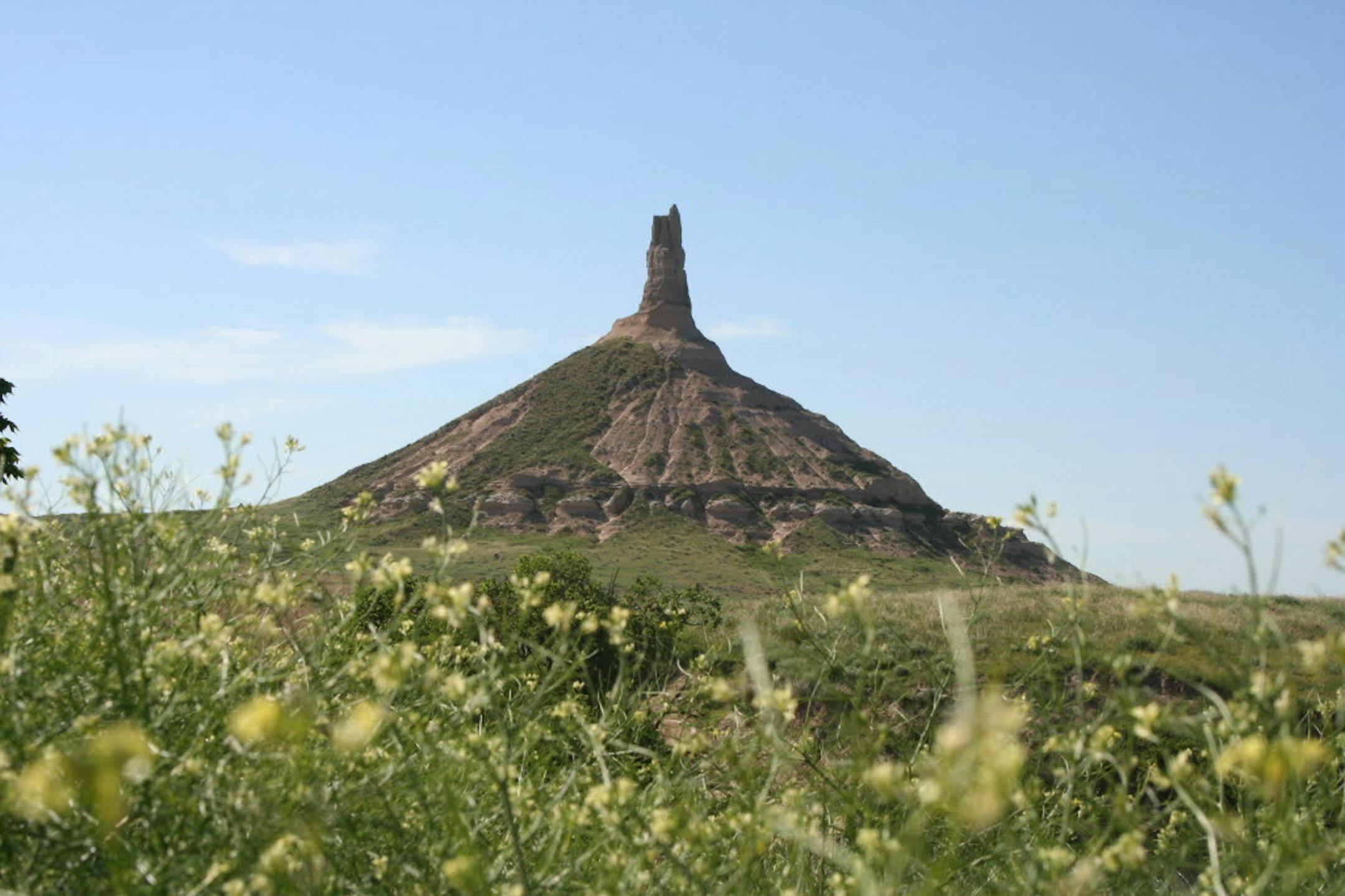
That is all here, of course, but what I didn't expect to find is a land, an almost prehistoric land, of high plains striated by mesas, buttes and the strangest of rock formations, all cut with mountains, deep valleys and fertile river beds. This wealth of unexpected natural beauty caught me off-guard.
I can blame the journey to western Nebraska not only on nature, but also on the wonderful "Lonesome Dove," Larry McMurtry's beloved and prizewinning novel and later CBS miniseries that depicted a cattle drive from Texas to Montana, which takes the motley crew of cowboys through Nebraska. When the cowboy character of Augustus "Gus" McCrae, played by Robert Duvall, tells Lorena, played by Diane Lane, that he's "bound for Ogallala, honey," my interest was piqued. I picked up a map and found that Ogallala actually exists.
And that's how I found myself in Nebrasky, in Gus-speak. For a few days this past summer, we drove hundreds of miles across the western fringes of Nebraska, from Sidney and Ogallala in the south to Alliance, Scottsbluff and Gering in its middle, to Crawford and Fort Robinson State Park in the north. The roads are gloriously empty, with no such thing as rush hour, unless you count the herds of deer and antelope playing in the open fields.
It is here that the heartland meets the wild, wild West under clouds floating like flower petals in big, bright cerulean skies. On the drive to Ogallala from Sidney, where we had first stayed overnight, my mind conjures images of the great herds of cattle driven up from Texas as they feasted on the sweet prairie grass. Ogallala is a town of fewer than 5,000 residents whose cowboy roots are still strong with plenty of cattle ranchers and farmers. In Ogallala proper, we visit the Petrified Wood Gallery with its collection of petrified wood art, then take time to climb the steps to Boot Hill, a flower-strewn cemetery that was quite literally the end of the trail for cowboys and pioneers who first settled the town where the fictional Clara lived.