
Technology helps to find a teen's silenced voice

Diagnosed with autism in infancy and unable to talk since then, Ben Alexander communicates by typing.

The Associated Press
April 29, 2016 at 4:10AM
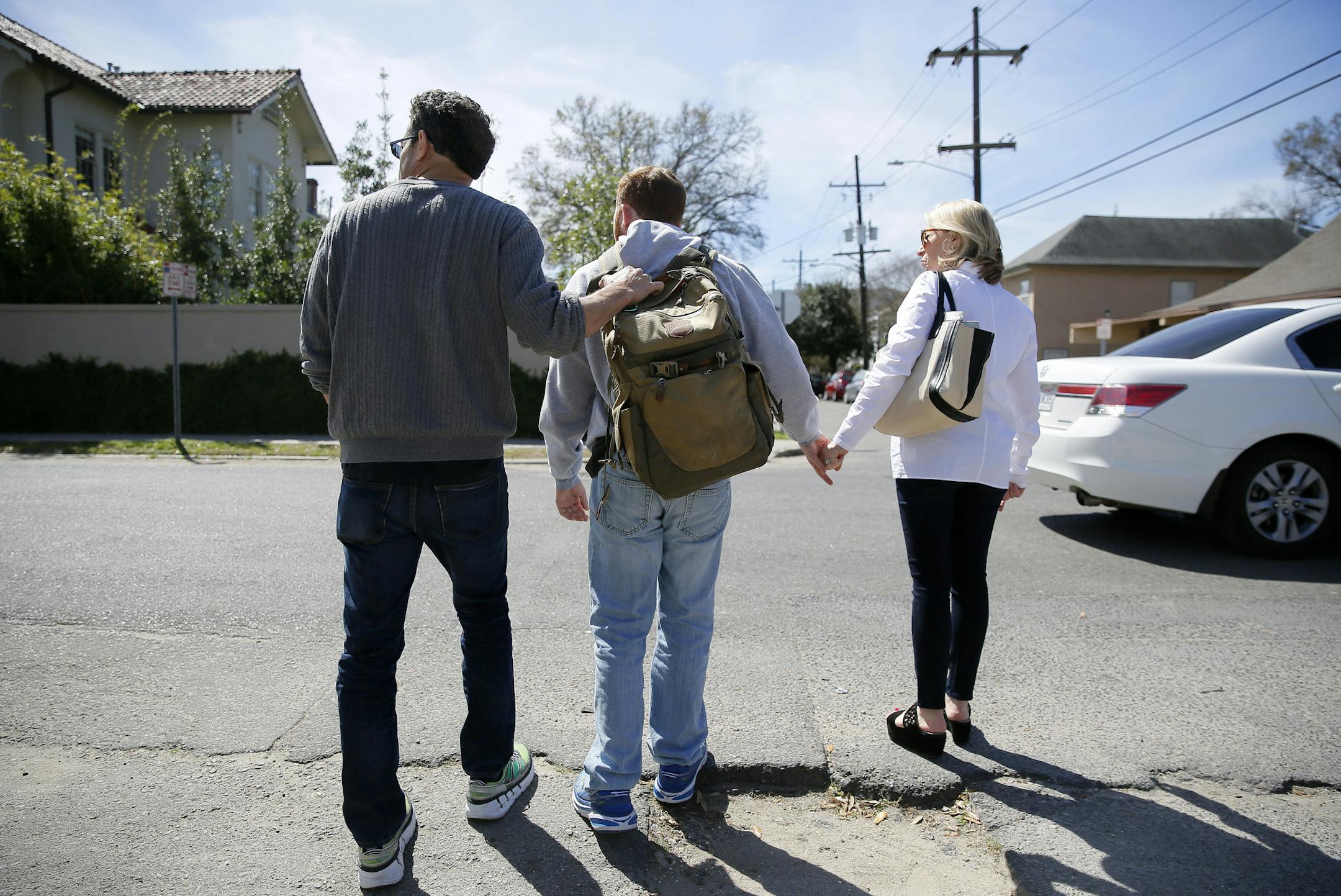
ADVANCE FOR USE SUNDAY, APRIL 24, 2016 AND THEREAFTER -In this Wednesday, March 2, 2016 photo, Sam Alexander and Ellen Schneider help their son, Ben, cross a street on their way to lunch in New Orleans. When Alexander was about 2 1/2 he was diagnosed with autism. Often called pervasive developmental disorder, it was accompanied by epileptic episodes, which worsened in adolescence, as did some of his erratic behavior. (AP Photo/Jonathan Bachman)
Sam Alexander and Ellen Schneider helped their son, Ben, cross a street on their way to lunch in New Orleans. When Alexander was about 2 1/2 he was diagnosed with autism. Often called pervasive developmental disorder, it was accompanied by epileptic episodes, which worsened in adolescence, as did some of his erratic behavior. (Jonathan Bachman/The Associated Press)

METAIRIE, La. – Though he cannot speak, Benjamin Alexander has much to say, one typed word at a time.

Ben was diagnosed with nonverbal autism and epilepsy a few months before his third birthday. Now 22, he is a writer and a student at Tulane University in New Orleans with a GPA of 3.7. In his essays, he returns repeatedly to the "fiend" that tried to silence him, the condition he sarcastically calls his "gift."

"Who in the hell gave me this gift?" he wrote in one piece published in a local online journal. "Please, take it back."

Ben wants to help educate people about autism and challenge stereotypes. That's not easy because he still needs some assistance using a computer to communicate, and that's caused some to doubt him over the years.

On a recent evening, Ben's father settles him at the keyboard and rests his hand under his son's arm. He lightly squeezes Ben's forearm, a subtle move that sets him into action. Ben begins to punch the keys with one finger.

"I . am . not . stupid . as . some . people . used . to . think," Ben types. He unwraps his arm from his dad's and hits the period by himself, causing the computer to read each word in a robotic voice that he doesn't really like, but needs.

Later he adds, "I want people to know I am here."

Ben's mother is an ophthalmologist, his father an obstetrician. They also have two daughters, Hillary, 25, and Lexi, 15.
"We cure things with our hands. We cut it out. If it's something that needs to be removed, we remove it," his dad, Sam Alexander, says. But with Ben's condition, "we couldn't do that."

When Ben was born, there was no indication that anything was wrong. Family videos show a smiley, chubby-cheeked boy with curly red hair just beginning to form words. "Hello," he seems to utter in one video, after picking up an old telephone receiver.

In the months that followed, however, Ben lost those first few words. He stopped looking people in the eye. His parents often would find him off in a corner spinning around and around.

Doctors initially told them to be patient, that it wasn't unusual for some kids to have delayed speech. But then, when Ben was about 2½, came the diagnosis they feared: autism. Often called pervasive developmental disorder, it was accompanied by epileptic episodes, which worsened in adolescence.

"It felt like he died," his dad says.

Ben never spoke again.

Though advised to keep their expectations low, his parents took him from specialist to specialist, to Miami, Boston and Chicago, and tried any number of recommended therapies.

Early on in their battle with autism, Ben's parents heard that a nonverbal boy in India was writing poetry about his condition, and they wondered: What if Ben could communicate that way? So they tried facilitated communication, a controversial method where another person supports the typing hand of a nonverbal autistic person to help him "speak" using a computer.

One afternoon, dad asked 8-year-old Ben a question.

"Who is the president of the United States?"

"G-e-o-r-g-e-w-b-u-s-h," Ben typed on a portable keyboard, according to his father, who supported his typing hand.

These days, dad often only needs to hold Ben's forearm loosely when he types, or he places his flat hand atop his son's wrist to steady him in moments of higher anxiety.

By the time Ben was 9, he wrote an essay — "My Adventure in Life" — that won a state writing honor. It was compiled from his answers to his mom's questions about what his autism felt like.

In simple words — and with mom telling him what didn't make sense or pointing out spelling and punctuation errors — Ben told readers how he needed to be by himself to think and how looking into her eyes was often difficult for him, even "painful."

This year, at his father's suggestion, Ben wrote about a remarkable meeting — and a transformative conversation. Using his voice simulator, he spoke to one of his heroes, Steve Gleason, a former Saints player who now has amyotrophic lateral sclerosis, or ALS, and also speaks with the help of a computer.

The conversation turned serious when Ben shared his anger, asking: "Can you tell me how you stay so positive? How do you deal with frustration? How do you make your computer scream?"

Gleason replied that he'd found purpose by helping others with a foundation he and his wife formed.

He also assured Ben that it was normal to question the meaning of his life. Ben was amazed.

"I have only dreamed about being normal," he wrote in the piece, published on Tulane's news site.

Gleason also told Ben that he could be an example for other people with autism. Ben, in his interview, says he knows that's true.

"I am not the autism poster boy. But I hope that people will … allow us to be heard."

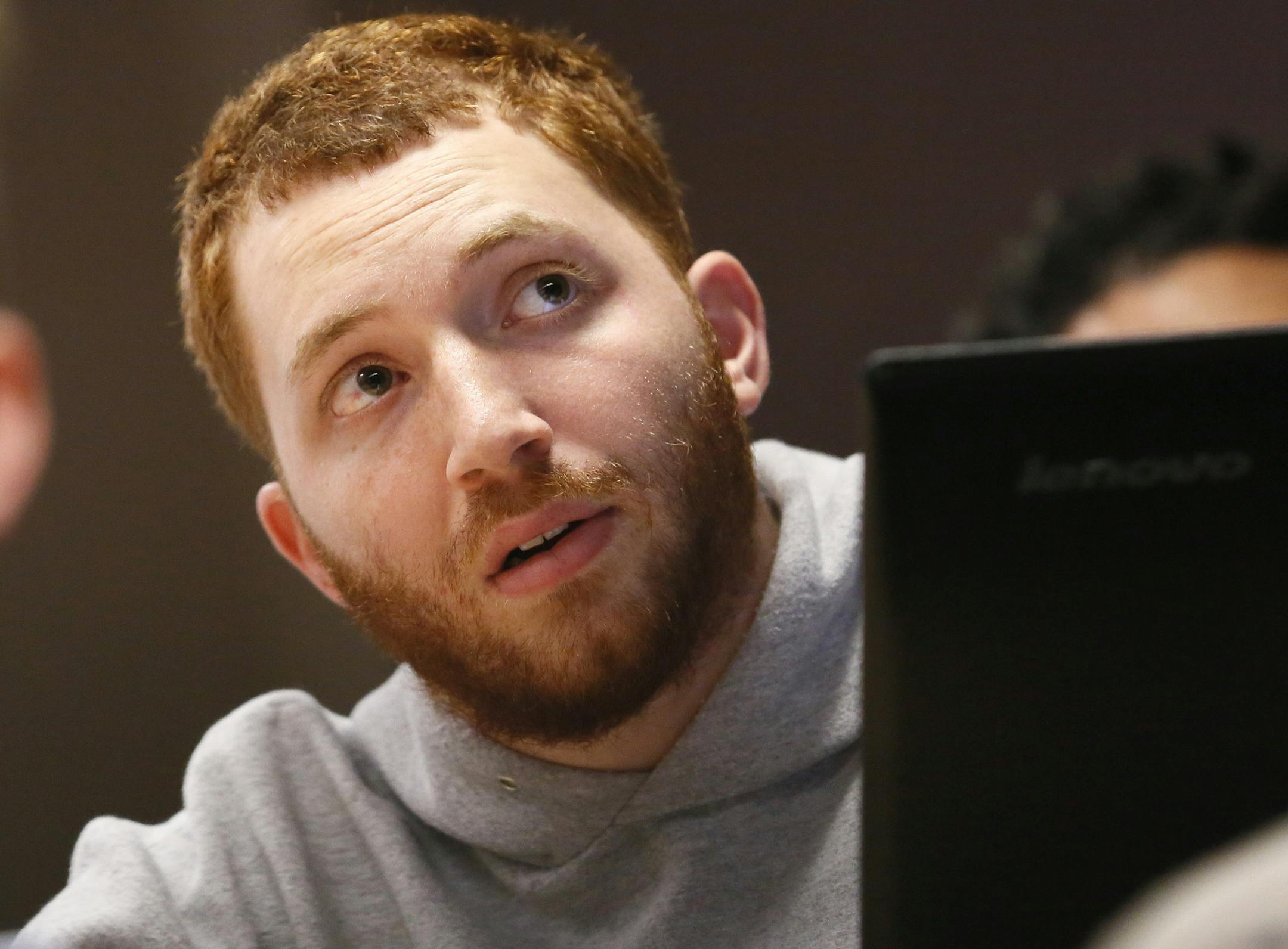
ADVANCE FOR USE SUNDAY, APRIL 24, 2016 AND THEREAFTER - In this Wednesday, March 2, 2016 photo, Ben Alexander listens to a lecture during a class for screenwriting at Tulane University in New Orleans. Alexander has nonverbal autism, a condition that became apparent when he was 2 years old. He has found his voice through writing using what is known as “facilitated communication,” a method in which another person supports the hand of the autistic person so he or she can communicate t
‘I am here’: Ben Alexander began typing when he was 8. Now he’s a college student who writes essays and talks of penning a novel. (Jonathan Bachman/The Associated Press)
about the writer

about the writer

Martha Irvine

More from No Section

See More
FILE -- A rent deposit slot at an apartment complex in Tucker, Ga., on July 21, 2020. As an eviction crisis has seemed increasingly likely this summer, everyone in the housing market has made the same plea to Washington: Send money — lots of it — that would keep renters in their homes and landlords afloat. (Melissa Golden/The New York Times) ORG XMIT: XNYT58
Melissa Golden/The New York Times

It’s too soon to tell how much the immigration crackdown is to blame.