

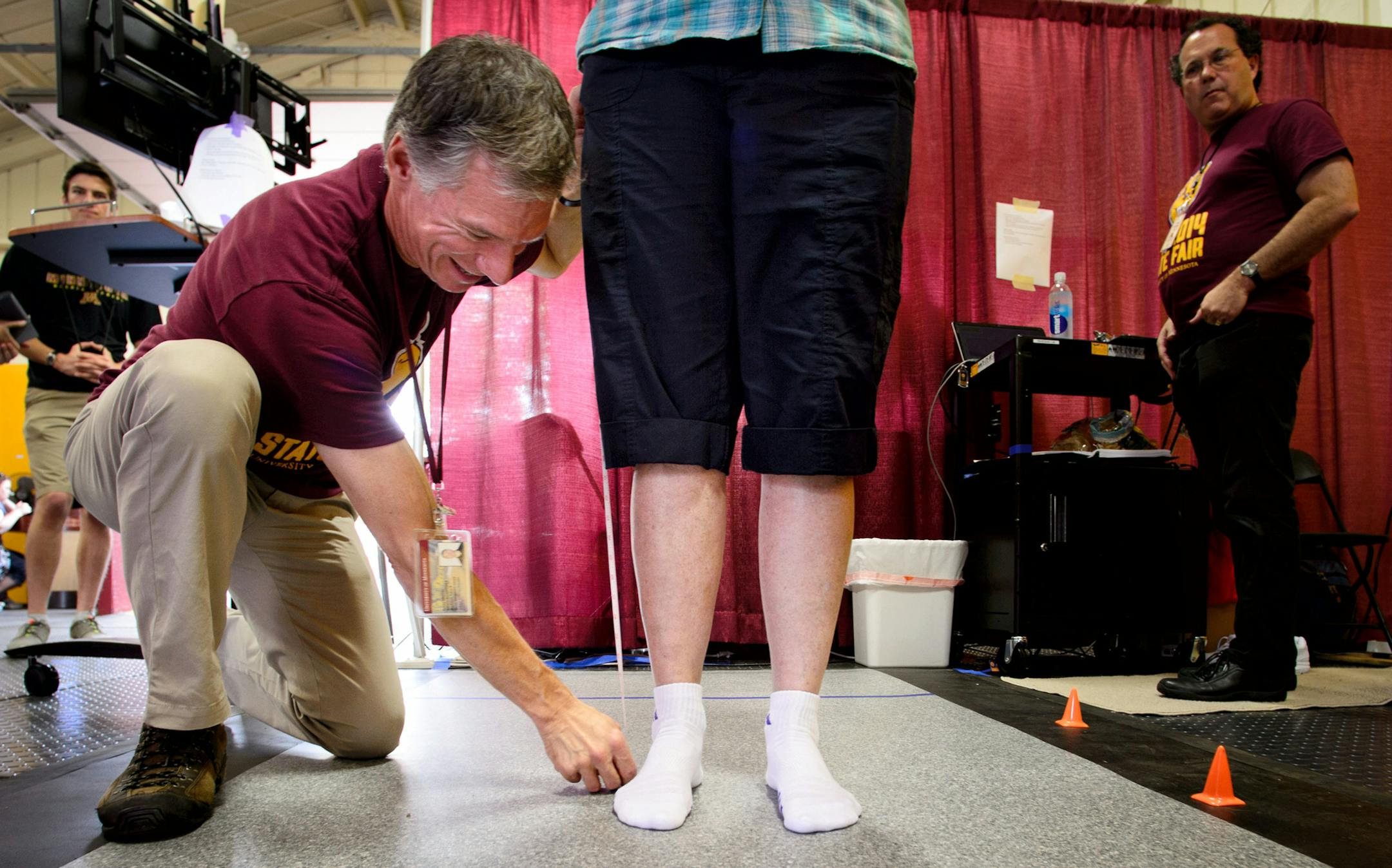
Fran Holmsten stood at the edge of a long walkway in her stocking feet, hands at her sides.
When she heard the signal, she nodded a few times, walked several steps forward, paused, spun around and walked back.
On a computer monitor beside her, the path she'd taken was visible in soft gray and white, like footsteps in the snow.
Holmsten, 71, and her husband, Dick, 74, were visiting the University of Minnesota's new Driven to Discover building at the State Fair for the second time in a week. The building, where dozens of U researchers are working over the fair's 12 days, gives fairgoers a chance to participate in studies on everything from medicine to social science.
The Holmstens volunteered Thursday for a Parkinson's disease study measuring how participants walk, sleep and perceive odors — all things that are diminished by the disease. The huge cross-section of people at the fair gives researchers a chance to examine gait, sleep and sense of smell in people without Parkinson's.
Lead researcher Colum MacKinnon, an assistant neurology professor at the U, said finding participants is typically a long, arduous process.
"If we need to know what the normative population [those unaffected by disease] is doing, we post fliers, we put ads in the paper, we go on the radio and we ask people to volunteer," he said. "And sometimes it works, and sometimes it doesn't."
Corjena Cheung, an assistant professor in the U's School of Nursing, is working with four other faculty members to study fitness in adults over 55. She said the team recruited about 300 people during its first three days at the fair.


