

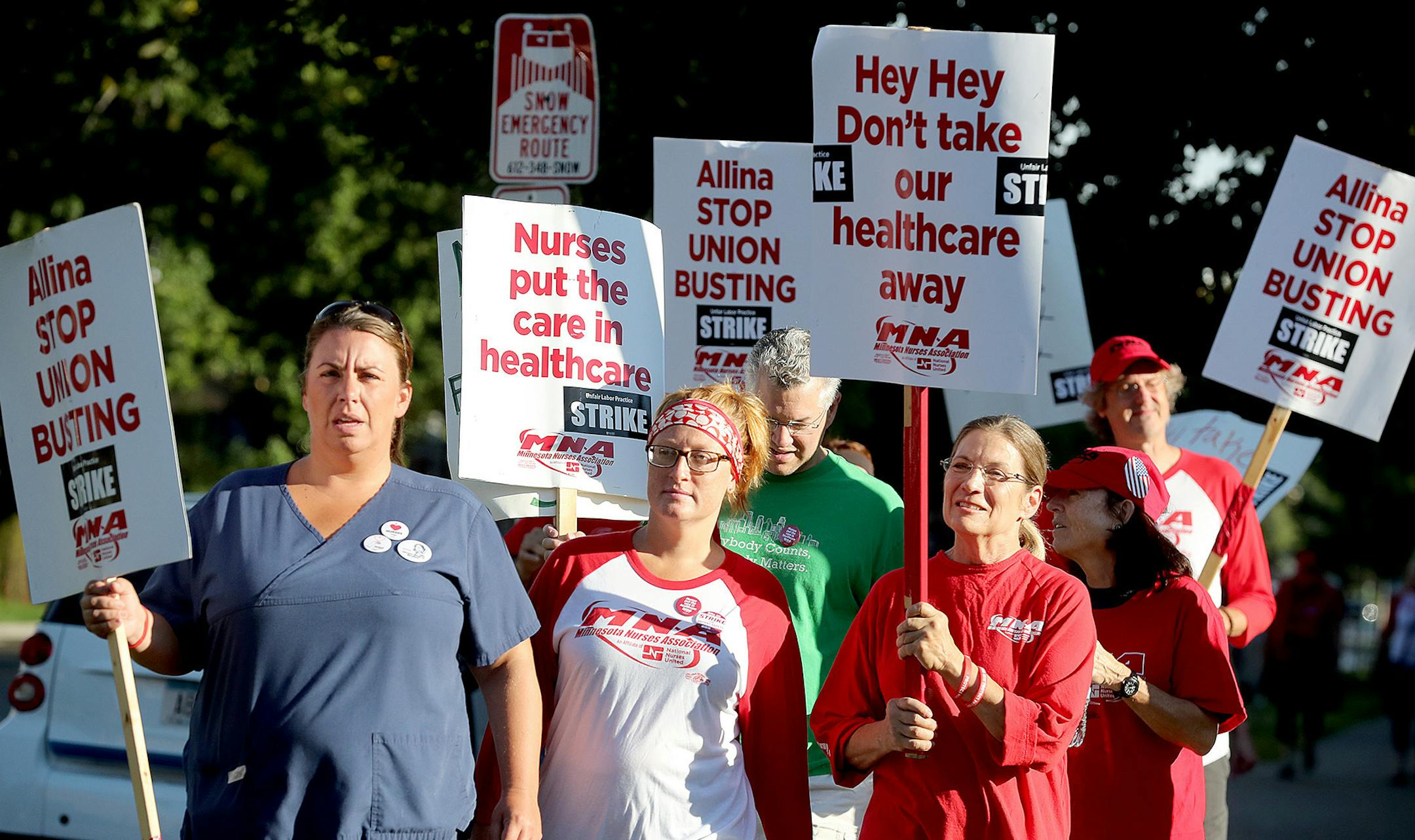
On Labor Day, 4,800 nurses represented by the Minnesota Nurses Association went on strike against the five hospitals of Allina Health. The strike continues at great cost to the nurses and Allina, as well as possible risk to patients, who are being cared for by 1,500 replacement nurses.
Despite having agreed on many issues, the two sides are stuck on the central issue: Allina wants to replace four health plans covering union workers with plans that cover Allina's nonunion employees, the majority of its workforce. The union plans are very generous and very expensive, with premiums between $10,272 and $20,148 per year for a single employee. Premiums for employees with dependents and families cost more.
Poor design contributes to the high premium costs. The member pays the same out-of-pocket price ($11) for a brand-name prescription drug, even if an identical generic drug is available for a lower cost.
The cost problem will become even more acute in 2020, when the federal law known as the Affordable Care Act (or Obamacare) will start charging a 40 percent "Cadillac tax" on premiums that exceed $10,200 per year for single coverage and $27,500 per year for families. Several of the union plans are already above the caps.
In order to settle the strike, the union has to give up its health plans. But management has to understand that the employees are giving up a benefit — even a poorly designed one — and they are making reasonable demands for compensation.
I teach a class in health economics at the University of Minnesota to students who are earning master's degrees in health administration. I divided them into 10 groups of four to five students and asked each group to put on a "union" or "management" hat and bargain over the outstanding issues in this dispute. They had only half an hour to work.
Two of the toughest issues concern "cost-sharing" and "diminishment of benefits." On the cost-sharing issue, management has proposed capping the total amount it will pay for premiums in 2019 at 3 percent more than the 2018 level; the union wants no cost-sharing cap. On diminishment of benefits, management wants a free hand to cut the actuarial value of the company plans by up to 5 percent per year after the union employees have transitioned to the company plans; the union wants no more than a 5 percent cut over the life of the contract. Management wants Allina's actuaries to verify the cuts, while the union wants the actuaries to be chosen by both sides.
The labor and management teams quickly realized that they could cut through the simpler issues to reach the more difficult ones. For example, all of the groups agreed to use an independent actuary or the union's proposal for actuaries representing both sides.


