

In Chanhassen, the first sign of spring wafts from the rafters of the Sugar Shack, expelling the unmistakably sweet scent of maple syrup.
It's here, inside a small cabin at the Minnesota Landscape Arboretum, that thousands of gallons of tree sap are boiled into America's favorite breakfast condiment.
Production is arduous, requiring around 35 gallons of sap to yield a single gallon of maple syrup.
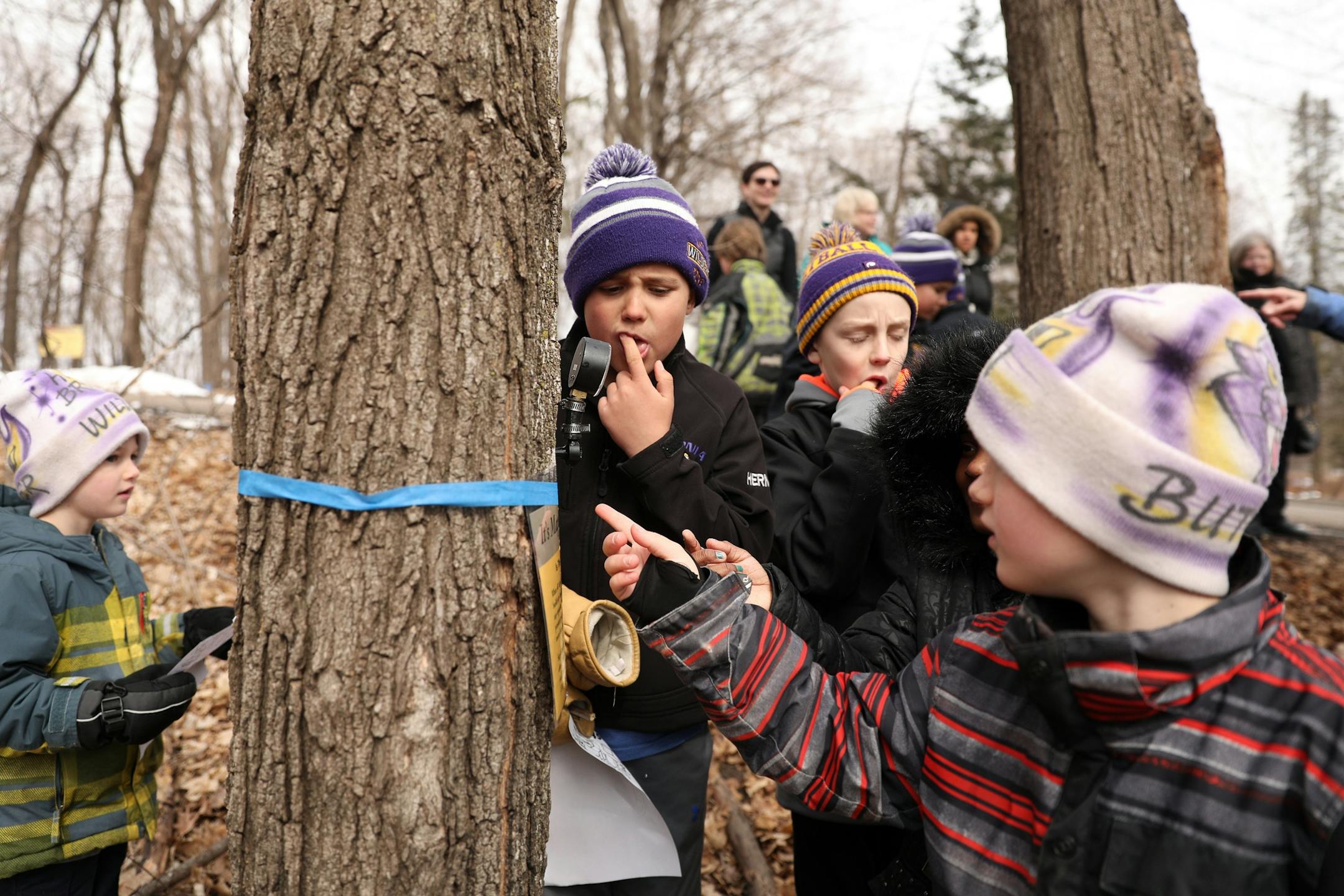
"That's why the cost is so high — you need a lot and it's a labor of love," program volunteer Steve Hanson explained to a group of touring schoolchildren.
Syruping typically peaks in March, when temperatures warm to at least 40 degrees by day, sending sap up the trunks, but still dipping below freezing at night. This year, because of an unusual freeze-thaw cycle, spring was sprung three weeks early. As a result, the arboretum recorded its earliest tapping date on Feb. 8, leading to its longest-running production season — now at 45 days and counting.
Minnesota produces less than 1 percent of the country's maple syrup, lagging far behind such power players in the Northeast as New York and Vermont. Even so, maple syrup production has become the most popular educational program at the arboretum, which runs a modest commercial tapping operation with nearly 400 trees.
The classes draw 1,500 students from around the state each year. Children learn that American Indians were the first to manufacture syrup, a technique later adopted by European settlers. After identifying a mature sugar maple, students take turns drilling a tap hole, where they insert a spike and attach a plastic collection bag. Throughout the woods, tools from various eras of syrup remain: steel buckets affixed to a few trees and an old-fashioned wood-burning stove for cooking smaller batches.
"Collecting sap in birch bark wasn't the most efficient," Hanson said of the earliest methods. "Now we have tubes that bring it to us. Life is a lot simpler now."
![Alison Casey, the Arboretum's signature exhibits and events manager, visited tables dressed as "Mrs. Pancake" during the Arboretum's annual pancake breakfast. ] ANTHONY SOUFFLE ï anthony.souffle@startribune.com A surprisingly warm winter has sprung at the state's maple syrup production into life several weeks early at the Minnesota Landscape Arboretum in Chaska, Minn. The Arboretum recorded the earliest sap tap date yet. They sponsor several educational programs that explain the process of](https://arc.stimg.co/startribunemedia/7MW6EDMZJKIS45QIAVQDPDHHZM.jpg?&w=1080)
![A mini archive of sorts contains bottles of a syrup from past years produced by the Minnesota Landscape Arboretum. ] ANTHONY SOUFFLE ï anthony.souffle@startribune.com A surprisingly warm winter has sprung at the state's maple syrup production into life several weeks early at the Minnesota Landscape Arboretum in Chaska, Minn. The Arboretum recorded the earliest sap tap date yet. They sponsor several educational programs that explain the process of maple syrup making, hold an annual pancake b](https://arc.stimg.co/startribunemedia/TUO5MTHSNFLWZZTHFNRC6PD2VU.jpg?&w=1080)


